
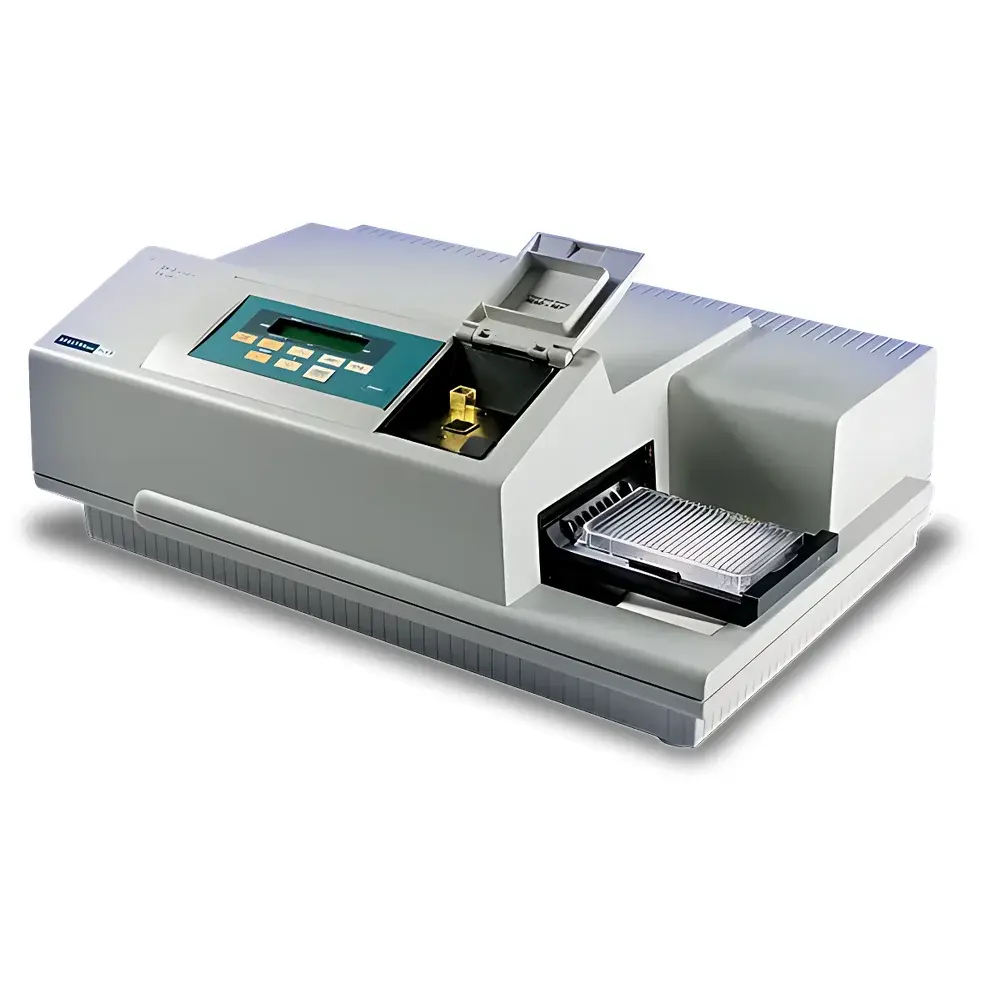
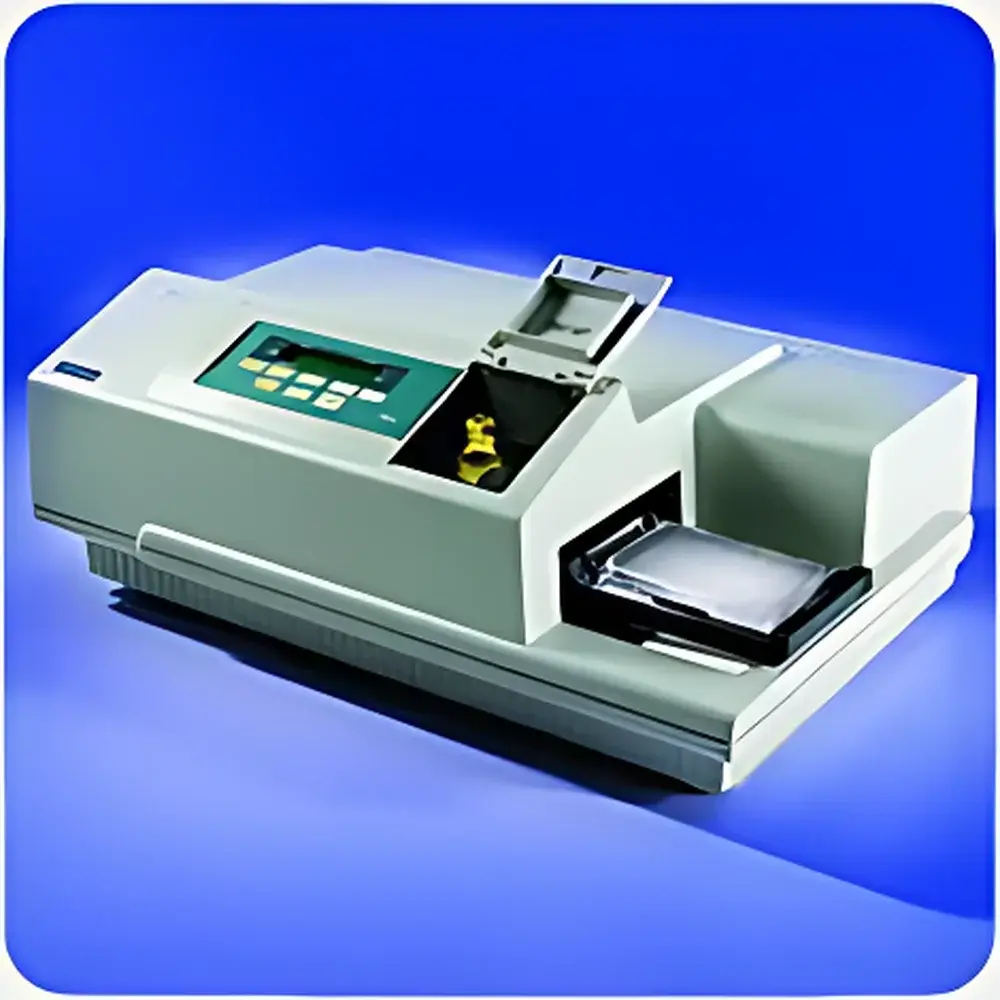
Molecular Devices SpectraMax Plus384 Microplate Reader
| Brand | Molecular Devices |
|---|---|
| Origin | USA |
| Manufacturer Type | Original Equipment Manufacturer (OEM) |
| Origin Category | Imported |
| Model | SpectraMax Plus384 |
| Detection Method | Absorbance (UV-Vis-NIR) |
| Function Type | Single-Mode Absorbance Reader |
| Automation Level | Fully Automated Microplate Reader |
| Assay Modes | Endpoint, Kinetic, and Spectral Scan |
| Curve Fitting | SoftMax Pro Software with Comprehensive Algorithm Library (Including Linear, Log-Log, Four-Parameter Logistic, etc.) |
| Detector Type | Photodiode Array (PDA)-Based Dual-Beam Optical System |
| Wavelength Range | 190–1000 nm (Monochromator-Based Continuous Scanning) |
| Absorbance Range | 0–4.0 OD |
| Linearity Range | 0–3.0 OD (R² ≥ 0.999) |
| Wavelength Switching Speed | ≤9 seconds per wavelength |
| Absorbance Precision | ±0.006 OD (at 0.5 OD, 450 nm, n=20) |
Overview
The Molecular Devices SpectraMax Plus384 Microplate Reader is a high-performance, monochromator-based absorbance microplate reader engineered for precision quantification across the ultraviolet, visible, and near-infrared spectra (190–1000 nm). Unlike filter-based systems, its grating monochromator delivers continuous wavelength selection—equivalent to >800 discrete filters—eliminating the need for physical filter wheels or manual filter changes. The instrument implements a true dual-beam optical architecture: each of the nine independent optical channels maintains a dedicated sample beam and reference beam path, ensuring real-time background subtraction and exceptional photometric stability. This design directly mirrors the performance principles of benchtop double-beam spectrophotometers, delivering high reproducibility (<0.006 OD precision) and minimizing drift during extended kinetic assays. The system supports standard cuvette formats (12 × 75 mm), 96-well and 384-well microplates—including flat-, round-, and V-bottom configurations—and integrates seamlessly with automated liquid handlers and stackers via standardized communication protocols (e.g., RS-232, USB, Ethernet).
Key Features
- Integrated cuvette and microplate detection capability in a single platform—enabling direct comparison between traditional spectrophotometry and high-throughput microplate workflows.
- PathCheck Sensor technology: measures actual liquid height in each well and automatically normalizes absorbance values to a 1-cm optical pathlength, enabling accurate concentration calculation without standard curves for analytes with known extinction coefficients.
- Expanded dynamic range: PathCheck extends effective linear detection beyond 4.0 OD by compensating for variable fill volumes—supporting reliable quantification from 20 µL (384-well) to 300 µL (96-well) with automatic pathlength correction.
- Nine-channel dual-optical-path design: eight channels dedicated to parallel microplate reading; one channel reserved for cuvette measurements—each with independent sample and reference beams for simultaneous ratiometric acquisition.
- Spectral scanning mode: acquires full UV-Vis-NIR spectra (190–1000 nm) in under 30 seconds, facilitating optimal wavelength selection, reaction monitoring, and spectral fingerprinting of biomolecules.
- Thermal control via Virtual Lid™ technology: maintains precise, uniform temperature (ambient to 45 °C) within the sample chamber without physical lid contact—critical for enzyme kinetics and cell-based assays.
- Automated optical validation using SpectraTest ABS1: NIST-traceable calibration kit enabling routine verification of wavelength accuracy, photometric linearity, and stray light performance per ISO 17025 and CLIA guidelines.
Sample Compatibility & Compliance
The SpectraMax Plus384 accommodates all ANSI/SLAS-standard microplates (96- and 384-well), including clear, white, black, and UV-transparent polystyrene and polypropylene plates. It accepts standard 12 × 75 mm glass or quartz cuvettes and supports diverse assay chemistries—including ELISA, nucleic acid quantitation (A260/A280), protein assays (Bradford, BCA, Lowry, A280), enzyme kinetics (NAD(P)H, β-galactosidase), cytotoxicity, microbial growth, and endotoxin detection. The system complies with key regulatory frameworks: FDA 21 CFR Part 11 (via SoftMax Pro audit trail, electronic signatures, and secure user access controls), ISO/IEC 17025 for testing laboratories, and GLP/GMP documentation requirements. All optical validations are traceable to NIST standards through the SpectraTest ABS1 package.
Software & Data Management
SoftMax Pro software serves as the validated, industry-standard data acquisition and analysis engine for the SpectraMax Plus384. It provides full support for endpoint, kinetic, and spectral scan protocols—with built-in curve-fitting algorithms (linear, semi-log, four-parameter logistic, sigmoidal, exponential decay), statistical outlier detection, and plate mapping visualization. Raw absorbance data, corrected pathlength values, and time-resolved kinetic traces are stored in vendor-neutral formats (e.g., CSV, XML) for downstream integration with LIMS or ELN systems. The software includes a complete validation suite compliant with FDA 21 CFR Part 11: electronic signatures, role-based permissions, immutable audit trails, and change-controlled versioning. Optional IQ/OQ/PQ documentation templates are provided for laboratory qualification.
Applications
This reader supports a broad spectrum of life science applications requiring high-fidelity absorbance measurement. These include quantitative immunoassays (ELISA/EIA), nucleic acid purity assessment (A260/A280 ratios), protein concentration determination (UV280, Bradford, BCA), enzyme activity profiling (kinetic Michaelis-Menten analysis), cellular metabolic assays (MTT, XTT, resazurin), microbial viability screening, hemagglutination and platelet aggregation studies, and endotoxin quantification (LAL-based chromogenic assays). Its wide spectral range enables characterization of novel dyes, nanoparticles, and nanomaterials exhibiting absorption in the NIR region (>700 nm), extending utility beyond classical biochemical applications into materials science and diagnostics development.
FAQ
Does the SpectraMax Plus384 support kinetic assays with temperature control?
Yes—it features Virtual Lid™ thermal regulation (ambient to 45 °C) with ramp rate control and real-time monitoring, optimized for multi-hour enzyme kinetics and cell-based functional assays.
Can PathCheck correct for evaporation during long kinetic runs?
PathCheck measures initial liquid height at the start of each read cycle but does not dynamically track volume loss; users should employ sealed plates or humidity-controlled chambers for extended kinetics.
Is SoftMax Pro compatible with third-party LIMS or ELN platforms?
Yes—data export is supported in CSV, XML, and SDMX formats; API access is available via SoftMax Pro’s COM interface for custom integration.
What validation documentation is included for GxP environments?
SpectraTest ABS1 provides NIST-traceable optical verification reports; SoftMax Pro includes preconfigured IQ/OQ protocols, electronic signature logs, and 21 CFR Part 11 compliance documentation.
How does the 9-channel dual-beam architecture improve data quality compared to single-beam readers?
Dual-beam per channel eliminates lamp intensity drift and environmental fluctuations in real time, yielding superior inter-plate and intra-plate reproducibility—especially critical for low-signal assays and high-density screening.
Related Products




