
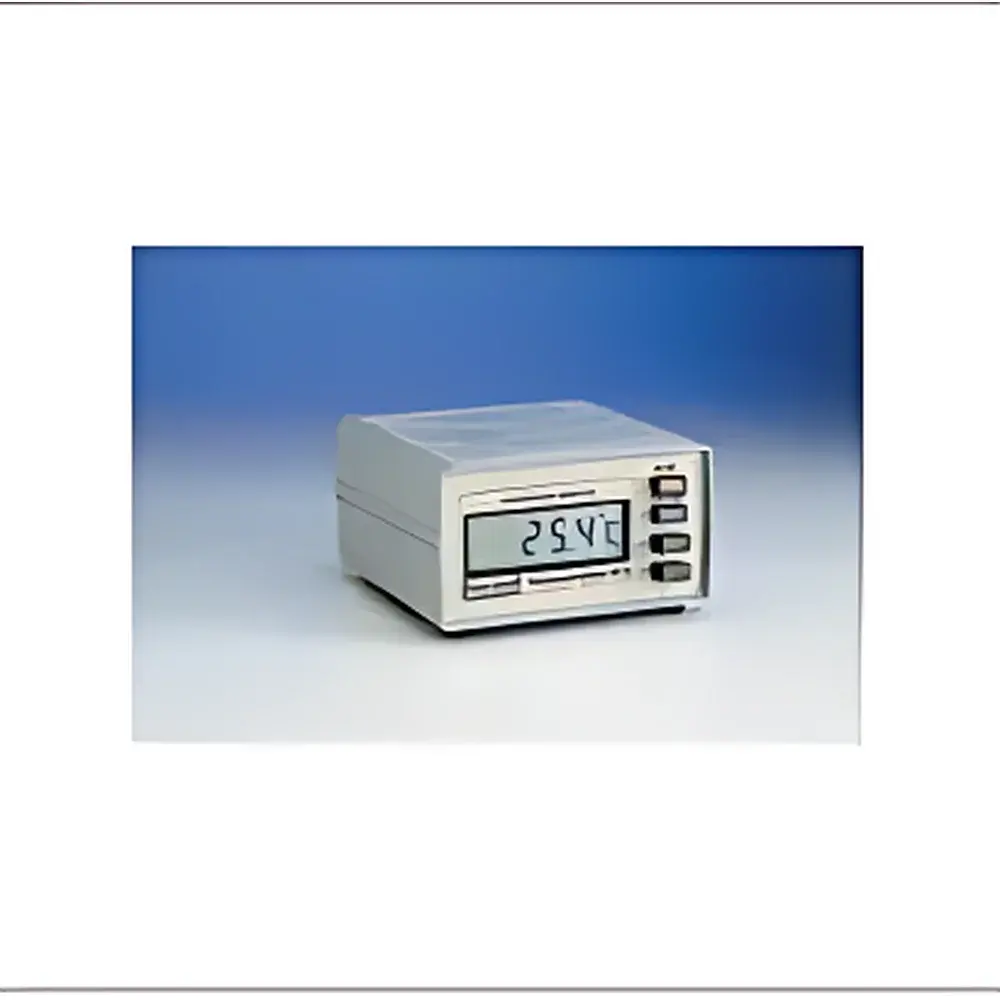
Monitoring Thermocouple Thermometer – Model 601956 (Single-Input) & Model 597569 (Triple-Input)
| Origin | USA |
|---|---|
| Manufacturer Type | Authorized Distributor |
| Import Status | Imported |
| Model | 601956 / 597569 |
| Pricing | Upon Request |
| Display | 3.5-digit, 12.7 mm (601956) / 18 mm (597569) high LED |
| Input Socket | Miniature T-type quick-disconnect (copper-constantan) |
| Power Supply | 4 × C-cell batteries (included) |
| Battery Life | 1200–2000 hours |
| Accuracy | ±0.1 °C ±1 digit |
| Resolution | 0.1 °C / 0.1 °F |
| Temp Range (601956) | 25–45 °C only |
| Temp Range (597569) | −10 to +60 °C (14–140 °F) |
| Output | Analog voltage output (connector not included) |
| Compliance | NIST-traceable calibration |
Overview
The Monitoring Thermocouple Thermometer series—comprising Models 601956 (single-input) and 597569 (triple-input)—is a precision analog-digital hybrid instrument engineered for continuous, real-time temperature monitoring in regulated life science environments. Designed explicitly for use with standard T-type (copper-constantan) thermocouples, these instruments operate on the Seebeck principle: measuring the thermoelectric voltage generated at the junction of dissimilar metals and converting it into a calibrated temperature reading via internal linearization algorithms. Unlike general-purpose digital multimeters, these thermometers feature dedicated cold-junction compensation (CJC) circuitry optimized for physiological and environmental stability, ensuring traceable accuracy across dynamic thermal gradients. The 3.5-digit LED display updates three times per second—enabling rapid detection of transient thermal events critical in animal physiology studies, incubator validation, or sterile process monitoring. Both models are battery-powered (4 × C-cells), eliminating ground-loop risks and enabling safe operation in proximity to sensitive biological specimens or grounded equipment.
Key Features
- High-stability analog-to-digital conversion with integrated cold-junction compensation for T-type thermocouples
- Real-time sampling rate of 3 Hz per channel—optimized for detecting subtle thermal drifts in vivo or in controlled chambers
- Model 601956: Dedicated narrow-range configuration (25–45 °C) with 0.1 °C resolution—ideal for core body temperature or incubation setpoint verification
- Model 597569: Wide-range dual-scale capability (−10 to +60 °C / 14 to 140 °F), user-selectable via front-panel button; supports simultaneous multi-point monitoring across three independent inputs
- NIST-traceable calibration certificate provided; accuracy maintained at ±0.1 °C ±1 digit over full operating range
- Analog voltage output (0–5 V or 0–10 V configurable via external jumper—documentation supplied) for integration with chart recorders, PLCs, or data acquisition systems (output connector not included)
- Robust industrial-grade enclosure with miniature T-type quick-disconnect sockets—ensuring repeatable probe mating and minimizing thermal EMF errors
- Low-power architecture: 1200–2000 hours of continuous operation on supplied alkaline C-cells; no external power supply required
Sample Compatibility & Compliance
These thermometers are compatible exclusively with ASTM E230-compliant Type T thermocouples (copper/constantan), including fine-wire microprobes (e.g., 30–40 AWG) used in intravital or tissue-surface measurements. The input circuitry is electrically isolated to prevent common-mode noise interference—a critical requirement in electrophysiology labs or MRI-adjacent spaces. All units conform to IEC 61000-4-2 (ESD immunity) and IEC 61000-4-3 (radiated RF immunity) standards. Calibration documentation satisfies GLP audit requirements per 21 CFR Part 11 when paired with validated electronic records systems. While not FDA-cleared as a medical device, the 601956 and 597569 are routinely deployed in AAALAC-accredited facilities for compliance with Guide for the Care and Use of Laboratory Animals temperature monitoring mandates (Section 2.3.2).
Software & Data Management
These are standalone hardware instruments with no embedded firmware or USB connectivity. Data logging is achieved externally via the analog output interface—compatible with industry-standard DAQ systems (e.g., National Instruments USB-6009, Keysight 34972A) or analog chart recorders meeting IEC 60651 Class 2 specifications. For audit-trail compliance, users are advised to pair the analog output with a validated data acquisition system that provides time-stamped, tamper-evident storage and electronic signature support per 21 CFR Part 11. Configuration parameters (e.g., scale selection, output scaling) are managed solely via physical front-panel controls—eliminating software validation overhead in GxP environments.
Applications
- Continuous core temperature monitoring during rodent or non-human primate surgical procedures
- Validation and routine checks of CO₂ incubators, hypothermia/hyperthermia chambers, and environmental test enclosures
- Multi-point thermal profiling of bioreactor jackets or sample racks in stability chambers
- Calibration reference for secondary temperature sensors in ISO 17025-accredited testing labs
- Field-deployable temperature surveillance in mobile veterinary clinics or field research stations
- Teaching laboratories requiring robust, low-maintenance instrumentation for thermocouple fundamentals instruction
FAQ
What thermocouple types are supported?
Only Type T (copper-constantan) thermocouples compliant with ASTM E230 are supported. Other types (e.g., K, J, E) will produce inaccurate readings due to uncorrected Seebeck coefficient mismatches.
Is the analog output isolated?
No—the analog output shares the same ground reference as the instrument’s internal circuitry. For galvanic isolation, an external signal isolator (e.g., Dataforth SCM5B37) must be installed between the thermometer and recorder.
Can the units be wall-mounted or benchtop-installed?
Yes—both models accept optional flip-up mounting brackets (sold separately) for vertical orientation above work surfaces or inside enclosures with limited depth clearance.
How often does NIST traceability require recalibration?
Annual recalibration is recommended for GLP/GMP applications; biannual verification suffices for educational or non-regulated research use. Certificate of Calibration includes as-found/as-left data and uncertainty budget per ISO/IEC 17025.
Are replacement batteries commercially available?
Yes—standard alkaline or lithium C-cell batteries (ANSI C18.1, IEC R14) are globally interchangeable. Rechargeable NiMH C-cells are not recommended due to voltage sag affecting low-power CJC stability.



