
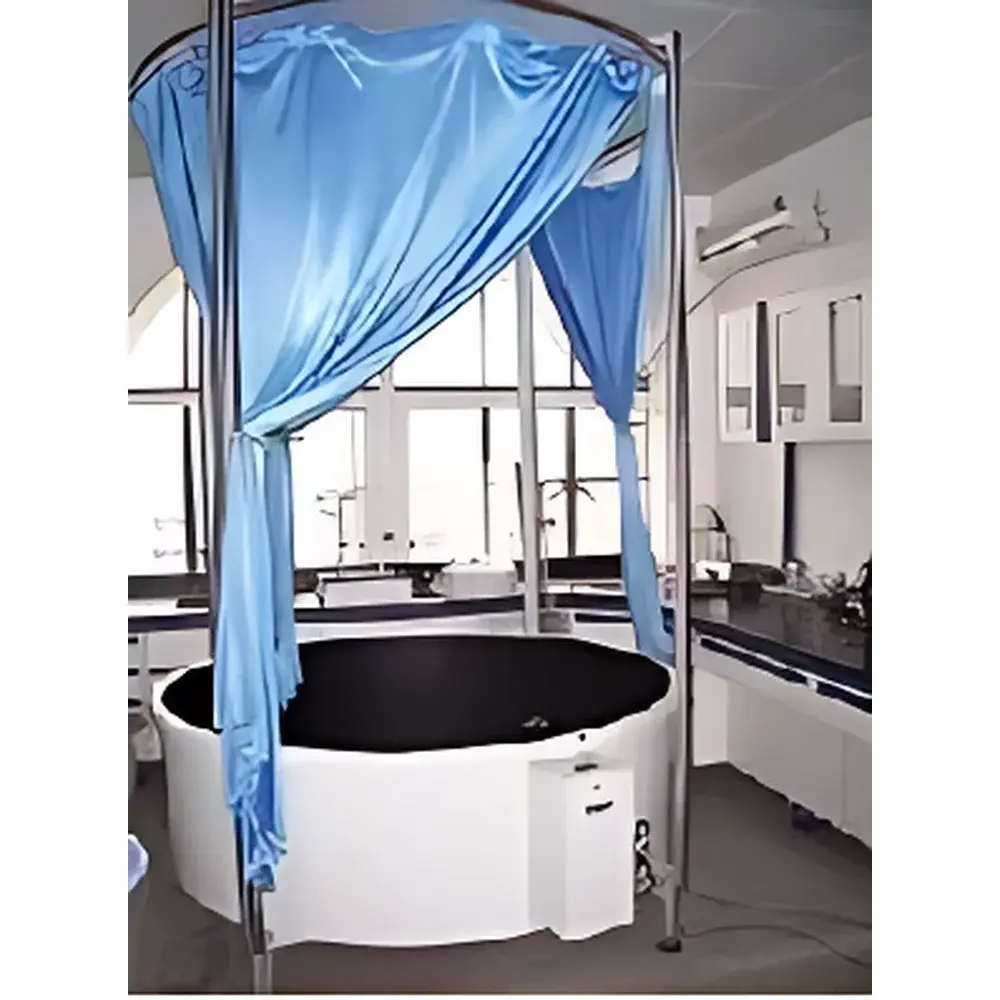
Morris Water Maze System
| Origin | USA |
|---|---|
| Manufacturer Type | Distributor |
| Origin Category | Imported |
| Model | Morris |
| Pricing | Upon Request |
Overview
The Morris Water Maze System is a validated, video-based behavioral tracking platform engineered for quantitative assessment of spatial learning and memory in rodent models. Grounded in the classical Morris water maze paradigm (Morris, 1984), the system employs real-time computer vision algorithms to objectively quantify navigation performance without requiring physical tagging or invasive modification of test subjects. It operates on the principle that hippocampal-dependent spatial cognition can be inferred from latency to locate a submerged platform, path efficiency, quadrant preference, and search strategy — all derived from high-fidelity trajectory reconstruction. Designed for rigorous preclinical neuroscience research, the system supports standardized protocols aligned with NIH guidelines for behavioral phenotyping and is routinely employed in studies of neurodegeneration, neuropharmacology, developmental neurotoxicity, and cognitive aging.
Key Features
- Non-invasive, markerless tracking using grayscale thresholding or background subtraction algorithms — eliminating need for dye injection, reflective markers, or surgical implantation
- Configurable experimental parameters including trial duration, post-start delay, platform dwell time, and auto-termination upon platform detection
- Region-of-interest (ROI) masking to suppress false positives caused by surface glare, water ripples, or ambient reflections
- Dedicated data archiving structure: each experiment generates an independent folder containing metadata, trajectory logs (.csv), and synchronized raw AVI video files
- Offline re-analysis capability: trajectory data files are portable across Windows workstations, enabling collaborative validation and secondary analysis without re-recording
- Integrated reporting engine generating standardized output tables and plots — including escape latency, platform crossings, total path length, quadrant time/distance distribution (%), and thigmotaxis index
Sample Compatibility & Compliance
The system is optimized for C57BL/6, BALB/c, Sprague-Dawley, and Wistar rats and mice (18–35 g). The circular pool (90–180 cm diameter × 50 cm height) features temperature-controlled water (22 ± 1 °C) and electrostatically coated interior surfaces to minimize visual cues and ensure consistent reflectance properties. Platform dimensions and submersion depth are fully adjustable to accommodate species- and age-specific swim capacity. All hardware components — including monochrome CCD camera (60 fps, 720 × 480 resolution), frame grabber card, and industrial-grade mounting rig — comply with IEC 61000-6-3 EMC standards. Experimental protocols adhere to AAALAC International accreditation requirements and support GLP-compliant documentation workflows, including timestamped audit trails for parameter changes and manual intervention logs.
Software & Data Management
The proprietary acquisition and analysis software runs on Windows 10/11 (64-bit) and implements deterministic frame synchronization between video capture and event logging. Data export conforms to FAIR principles: trajectory coordinates are stored in UTF-8 CSV format with millisecond-level timestamps; metadata follows ISA-Tab schema conventions. Software supports FDA 21 CFR Part 11-compliant user authentication, electronic signatures, and immutable audit trails for critical operations (e.g., parameter edits, data deletion, report generation). Raw video archives are encoded in lossless Motion JPEG-A to preserve pixel integrity for retrospective ethogram annotation or machine learning model training.
Applications
- Spatial reference memory evaluation in transgenic Alzheimer’s disease models (e.g., APP/PS1, 5xFAD)
- Hippocampal lesion validation and functional mapping studies
- Pharmacological screening of nootropic, anxiolytic, or neuroprotective compounds
- Developmental neurobehavioral toxicology (e.g., prenatal exposure to environmental contaminants)
- Comorbid behavioral phenotyping in depression/anxiety models — extended protocol integration with forced swim test (FST) and tail suspension test (TST) modules
- Exercise-intervention studies assessing cognitive resilience via chronic swimming paradigms
FAQ
Is the system compatible with third-party video hardware?
Yes — the software accepts standard DirectShow-compatible video sources, enabling integration with USB3 or GigE cameras meeting minimum resolution and frame-rate specifications.
Can multiple animals be tracked simultaneously?
No — the current architecture is designed for single-subject trials per session to maintain compliance with established behavioral testing standards and avoid inter-animal interference artifacts.
Does the software support automated zone classification (e.g., target quadrant vs. opposite quadrant)?
Yes — quadrants are defined relative to platform position at trial initiation and remain fixed throughout analysis; time/distance metrics are automatically binned by spatial sector.
How is water temperature stability maintained during long-duration experiments?
The system integrates with external recirculating chillers or heated baths via RS-232 or analog voltage interface; temperature logs are synchronized with behavioral data streams.
Are raw video files compressed, and what is the storage requirement per 5-minute trial?
Uncompressed AVI files require ~1.2 GB per 5-minute trial at default settings; optional H.264 compression reduces footprint by ~75% while preserving motion fidelity for centroid tracking.




