
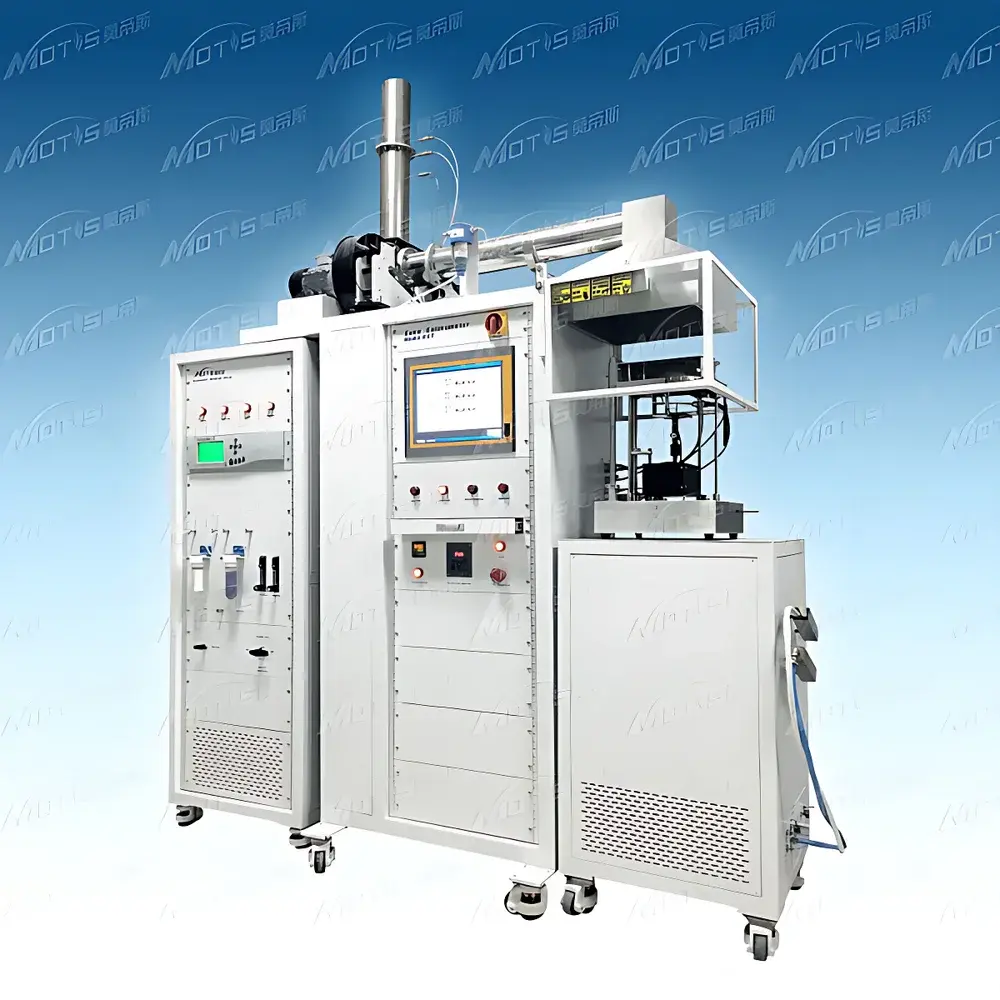
MOTIS CCA Advanced Cone Calorimeter
| Brand | MOTIS |
|---|---|
| Origin | Jiangsu, China |
| Model | CCA |
| Compliance | GB/T 16172–2007, ISO 5660-1/2/3/4:2002, ASTM E1354–2011 |
| Radiant Heat Flux Range | 0–100 kW/m² |
| Mass Loss Measurement | 0–2000 g ±0.1 g |
| Oxygen Analysis | 0–25% vol, ±0.1% accuracy |
| CO₂/CO Detection | 0–10% / 0–1% vol, ±0.1% accuracy |
| Exhaust Flow Control | 0.024 m³/s min, variable via inverter-driven fan |
| Laser Smoke Density System | He–Ne source (632.8 nm), ±2% stability over 8 h |
| Data Acquisition | Advantech industrial modules, 3000 Vdc isolation, 50/60 Hz auto-filtering |
| Software | VB-based, GLP-compliant, with full calibration traceability and audit trail |
Overview
The MOTIS CCA Advanced Cone Calorimeter is a research-grade fire testing instrument engineered for precise, repeatable measurement of combustion behavior under controlled radiant heating conditions. Based on the oxygen consumption calorimetry principle—internationally validated and codified in ISO 5660-1, ASTM E1354, and GB/T 16172—it quantifies critical fire parameters including heat release rate (HRR), peak HRR (PHRR), total heat released (THR), mass loss rate (MLR), smoke production rate (SPR), and effective heat of combustion (EHC). The system operates by exposing a flat, horizontally mounted specimen (typically 100 mm × 100 mm) to a defined radiant flux from a conical electric heater, igniting it via a calibrated spark source, and continuously analyzing the combustion gases and effluent smoke to derive thermokinetic and toxicological metrics. Its architecture supports both fundamental flame retardancy research and regulatory compliance testing for construction materials, polymers, composites, and coated substrates.
Key Features
- High-stability 5 kW radiant cone assembly with dual-layer ceramic-fiber insulation (13 mm thickness, 1000 kg/m³ density) ensuring thermal uniformity and long-term operational integrity.
- Precisely regulated irradiance up to 100 kW/m² across a central 50 mm × 50 mm zone, with spatial uniformity maintained within ±2% of center-point value—verified per ISO 5660-1 Annex A.
- Triple OMEGA thermocouple (1.0–1.6 mm diameter) feedback loop with PID temperature control enables stable, programmable radiant flux delivery.
- 10 kV spark ignition system with 3 ± 0.5 mm electrode gap and fixed 13 ± 2 mm offset from specimen center ensures reproducible flame initiation.
- Water-cooled quartz heat flux meter (0–100 kW/m² range) with integrated recirculating chiller for real-time incident flux validation and C-factor calibration.
- Dual-detector He–Ne laser photometry system (632.8 nm) for optical density measurement: main and reference silicon photodiodes with >99.8% linearity and <0.1% instability over 24 h.
- Exhaust ducting with ISO-calibrated orifice plate (57 ± 3 mm ID), high-accuracy differential pressure sensor (0–500 Pa, ±1.0% FS RSS), and 12-port annular sampling probe oriented against flow direction for representative gas capture.
- Gas analysis subsystem featuring UK Servomex paramagnetic O₂ sensor (0–25%, ±0.1% accuracy, <12 s response), NDIR CO₂/CO sensors (0–10%/0–1%, ±0.1%), and fully temperature- and pressure-compensated electronics housed in a 19″ rack-mount cabinet.
- Industrial-grade data acquisition platform built around Advantech modular I/O: eight-channel isolated analog input modules (±15 V, 1 kV surge protection), digital output module (12-channel open-collector), RS-485 converter with 3000 Vdc isolation, and configurable mA/V output interface—all compliant with IEC 61000-4 immunity standards.
Sample Compatibility & Compliance
The CCA accommodates standard test specimens measuring 100 mm × 100 mm × up to 50 mm thick, compatible with solid, cellular, laminated, and fiber-reinforced materials. Specimen mounting uses non-combustible aluminum holders with integrated thermocouples for surface temperature monitoring. All mechanical, thermal, and analytical subassemblies are designed and verified to meet the dimensional, metrological, and procedural requirements of ISO 5660-1:2015 (including Annexes A–D), ASTM E1354–2011, and GB/T 16172–2007. Each delivered system includes a certified calibration package: NIST-traceable heat flux meter verification report, orifice plate coefficient (C-factor) documentation with historical trend curves, and inter-laboratory PMMA reference material comparison data against recognized international cone calorimeters (e.g., Fire Testing Technology, Tewes). Full compliance with GLP documentation practices—including electronic audit trails, user access control, and versioned calibration logs—is supported through embedded software functionality.
Software & Data Management
The proprietary VB.NET-based control and analysis suite provides full instrument orchestration, real-time parameter visualization, automated calibration workflows, and standardized reporting. It supports multi-sensor linearization (thermocouples, pressure transducers, gas analyzers), dynamic C-factor compensation during tests, and post-acquisition calculation of all ISO-defined fire parameters using published algorithms (e.g., HRR = ΔO₂ × 13.1 kJ/g O₂). Raw data files are stored in ASCII-delimited format with timestamped metadata; processed reports export to PDF or Excel with embedded graphs and statistical summaries. The software architecture conforms to FDA 21 CFR Part 11 principles: electronic signatures, role-based permissions, immutable audit logs, and secure backup protocols. Comprehensive bilingual (English/Chinese) operator manuals—including derivation of all calculated parameters, uncertainty budgets, and troubleshooting matrices—are supplied with each installation.
Applications
The MOTIS CCA serves laboratories engaged in fire safety engineering, material development, and regulatory certification. Typical use cases include quantitative evaluation of flame-retardant additives in polyolefins and engineering thermoplastics; assessment of intumescent coating performance on structural steel; comparative analysis of smoke toxicity in cable jacketing compounds; validation of fire modeling inputs for CFD simulations (e.g., FDS, PyroSim); and generation of data for building code compliance (e.g., EN 13501-1, NFPA 286). Its high signal-to-noise ratio and low baseline drift make it suitable for low-HRR materials such as treated wood products and mineral wool insulation. Research applications extend to pyrolysis kinetics studies, oxidative degradation pathways, and coupled thermal–chemical modeling of condensed-phase decomposition.
FAQ
What standards does the MOTIS CCA comply with?
It meets ISO 5660-1/2/3/4:2002, ASTM E1354–2011, and GB/T 16172–2007 for heat release, smoke, and mass loss measurements.
Is the system suitable for GLP or ISO/IEC 17025-accredited labs?
Yes—the software implements full audit trail logging, electronic signature capability, calibration history tracking, and report version control aligned with ISO/IEC 17025:2017 Clause 7.7 and FDA 21 CFR Part 11.
Can the CCA be integrated into an existing fire test laboratory network?
All modules support Modbus TCP and OPC UA protocols; analog outputs (4–20 mA, 0–10 V) and digital I/O enable seamless interfacing with central SCADA or LIMS platforms.
What maintenance is required for long-term accuracy?
Annual recalibration of heat flux meter, gas analyzers, and differential pressure sensors is recommended; laser alignment and orifice plate inspection should occur quarterly per ISO 5660-1 Annex B.
Does MOTIS provide application support and method development assistance?
Yes—MOTIS offers remote and on-site technical support, custom test protocol development, and training programs covering ISO-compliant operation, data interpretation, and uncertainty analysis.



