
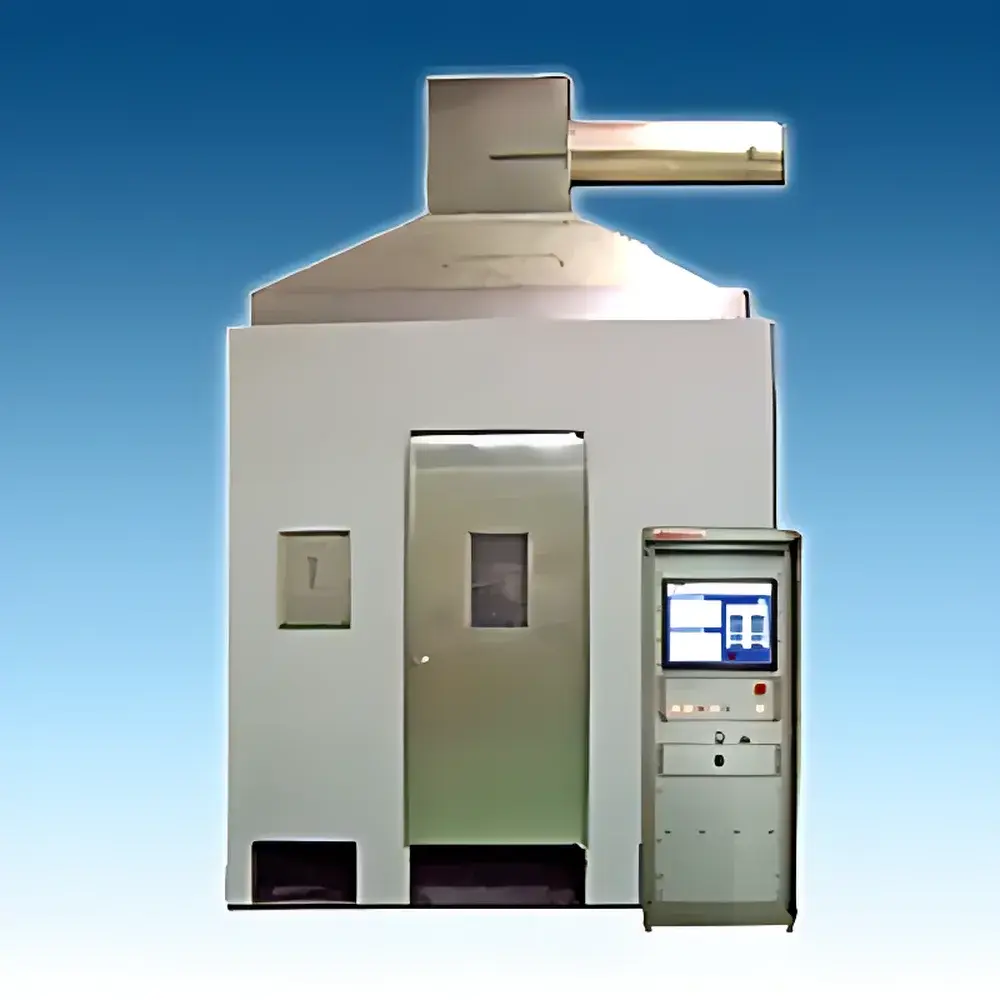
MOTIS FRAT UL 1685 Vertical Tray Flame Propagation Test Chamber
| Brand | MOTIS |
|---|---|
| Model | FRAT |
| Standard Compliance | UL 1685, IEEE 383, IEEE 1202 |
| Chamber Dimensions (L×W×H) | 2600 × 2600 × 3100 mm |
| Internal Volume | 20.28 m³ |
| Floor Area | 6.76 m² |
| Test Duration | 20 min |
| Burner Heat Release Rate | 20 kW (70,000 BTU/hr) |
| Burner Type | Venturi-mixed propane burner per IEC 60332-3 |
| Tray Dimensions | 305 × 76 × 2438 mm |
| Ladder Bar Width | 25 ± 6 mm |
| Ladder Rung Spacing | 229 mm |
| Temperature Monitoring | Thermocouples + bidirectional hot-wire anemometry in exhaust duct |
| Gas Control | Mass flow controller + solenoid valves |
| Data Acquisition | Dedicated DAQ board for flame & structural temperature logging |
| Safety | Manual emergency power cutoff (instrument only, excludes PC) |
Overview
The MOTIS FRAT UL 1685 Vertical Tray Flame Propagation Test Chamber is a rigorously engineered combustion test system designed to evaluate the vertical flame spread behavior of single or bundled electrical cables under controlled, standardized fire exposure conditions. It operates on the principle of forced-convection vertical tray fire testing, where cable samples are mounted on a calibrated steel ladder inside a large-volume, draft-controlled chamber and subjected to a defined 20 kW propane flame for 20 minutes. The apparatus quantifies flame propagation distance, char length, and self-extinguishment performance—key metrics for assessing fire-resistance classification in low-smoke, zero-halogen (LSZH), and nuclear-grade (IE) cable systems. Its design strictly conforms to the physical configuration, instrumentation, and procedural requirements outlined in UL 1685 (Standard for Vertical Tray Fire Propagation and Smoke Release of Electrical Cables), IEEE 383 (for Class 1E cables used in nuclear power generating stations), and IEEE 1202 (Flame Propagation Test for Wires and Cables). The chamber’s 20.28 m³ internal volume and 6.76 m² floor area meet the minimum spatial criteria specified in these standards to ensure thermodynamic stability and representative plume development during sustained combustion.
Key Features
- Full-scale vertical tray configuration with precision-machined steel ladder (rung spacing: 229 mm; bar width: 25 ± 6 mm) compliant with UL 1685 Annex A and IEEE 383 Clause 6.2
- Venturi-type propane burner delivering stable 20 kW (70,000 BTU/hr) heat flux, calibrated per IEC 60332-3 methodology and traceable to NIST-certified flow standards
- Integrated mass flow controller for propane and air supply, maintaining consistent stoichiometric ratio despite upstream pressure fluctuations
- Dual-sensor exhaust monitoring: Type K thermocouples (±0.5 °C accuracy) and bidirectional hot-wire anemometers for real-time measurement of exhaust gas temperature and axial/tangential velocity profiles
- Dedicated data acquisition system with 16-bit resolution, sampling at 10 Hz, logging flame temperature, ladder surface temperature, and exhaust dynamics synchronously
- Fail-safe solenoid valve train with manual override buttons on front control panel; independent emergency power cutoff isolates all high-voltage components (excluding host PC)
- Stainless-steel interior lining with non-combustible insulation, rated for continuous operation up to 1000 °C exhaust temperatures
Sample Compatibility & Compliance
The FRAT chamber accommodates cable bundles up to 300 mm wide on the standard 305 × 76 × 2438 mm steel tray, supporting both solid-core and stranded conductors, jacketed or armored configurations, including PVC, PE, EPR, silicone rubber, and fluoropolymer-insulated types. It supports specimen preparation per UL 1685 Section 7 (bundle diameter, tie spacing, support height), IEEE 383 Section 5.3 (IE qualification protocols), and ASTM E603 (fire test calorimetry reference). All instrumentation—including thermocouple placement (per UL 1685 Figure 3), burner alignment (±2 mm tolerance), and airflow calibration (ISO 5167-compliant pitot traverse)—is validated prior to each test sequence. The system meets GLP documentation requirements for audit-ready test records, with timestamped raw data files compatible with FDA 21 CFR Part 11–compliant electronic signature workflows when integrated with validated LIMS software.
Software & Data Management
The FRAT system interfaces with MOTIS FireTest Suite v4.2—a Windows-based application developed under IEC 62443-3-3 security guidelines. It provides real-time visualization of exhaust temperature gradients, flame height tracking via optical pyrometry integration (optional), and automated calculation of flame front progression rate (mm/min) and post-test char depth. All acquired parameters are stored in HDF5 format with embedded metadata (test ID, operator, calibration certificate IDs, ambient conditions). Export modules support CSV, PDF test reports aligned with UL 1685 Annex B reporting templates, and XML schemas for enterprise-level integration with SAP QM or TrackWise QMS platforms. Audit trails record every parameter change, user login/logout, and calibration event with immutable timestamps—fully compliant with ISO/IEC 17025:2017 Clause 7.7 and ANSI/NCSL Z540-1 traceability frameworks.
Applications
This test chamber is deployed in cable manufacturing QA laboratories, third-party certification bodies (e.g., UL, CSA, TÜV SÜD), and nuclear regulatory compliance centers for qualification of Class 1E safety-related wiring per 10 CFR 50 Appendix B. Typical use cases include: comparative evaluation of halogen-free flame-retardant (HFFR) compound formulations; validation of jacket thickness vs. flame arrest performance; smoke density correlation studies using companion DIN 53436 or ASTM E662 cone calorimeter data; and periodic surveillance testing of production lots against original type-test baselines. Its dimensional fidelity enables direct extrapolation to full-scale cable tray installations in data centers, offshore platforms, and subway tunnel infrastructure.
FAQ
What standards does the FRAT chamber fully satisfy?
UL 1685, IEEE 383 (Class 1E), IEEE 1202, and IEC 60332-3 — with hardware and firmware validated per each standard’s latest revision (UL 1685: 2023 Edition, IEEE 383-2022).
Is exhaust gas analysis (e.g., CO, HCN) supported?
The base configuration includes thermal and flow sensing only; optional FTIR or electrochemical gas analyzers can be integrated via ISO 10156-compliant flange ports and synchronized via TTL triggers.
Can the chamber be used for horizontal tray testing?
No — the FRAT is configured exclusively for vertical orientation per UL 1685 Clause 5. Horizontal flame spread tests (e.g., UL 94, IEC 60332-1) require separate apparatus.
What maintenance intervals are recommended for the mass flow controller?
Calibration verification every 6 months using certified reference gases (NIST-traceable); full recalibration annually or after 500 test cycles, per ISO 17025 Clause 6.5.2.
Does the system support remote diagnostics?
Yes — Ethernet-enabled DAQ and PLC modules support secure SSH access and diagnostic log export; MOTIS Remote Assist requires signed service agreement and TLS 1.3 encryption.
Related Products



