
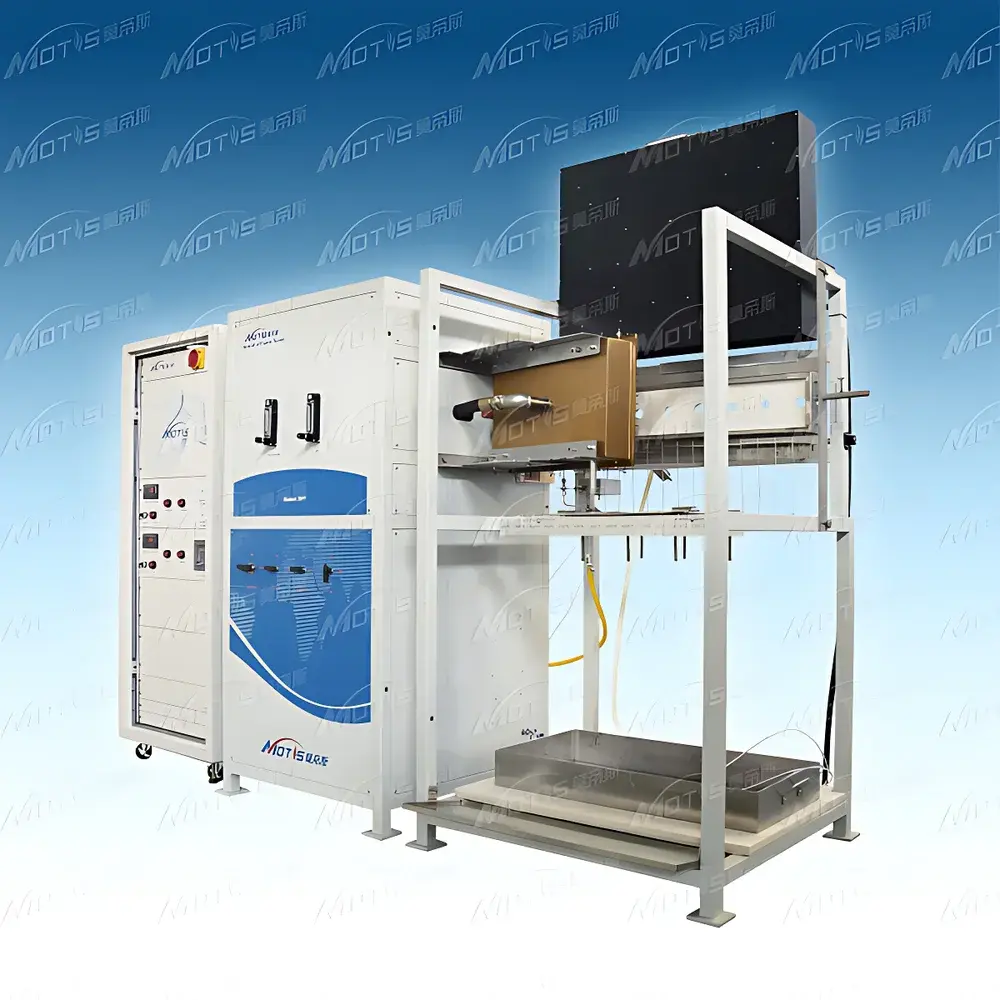
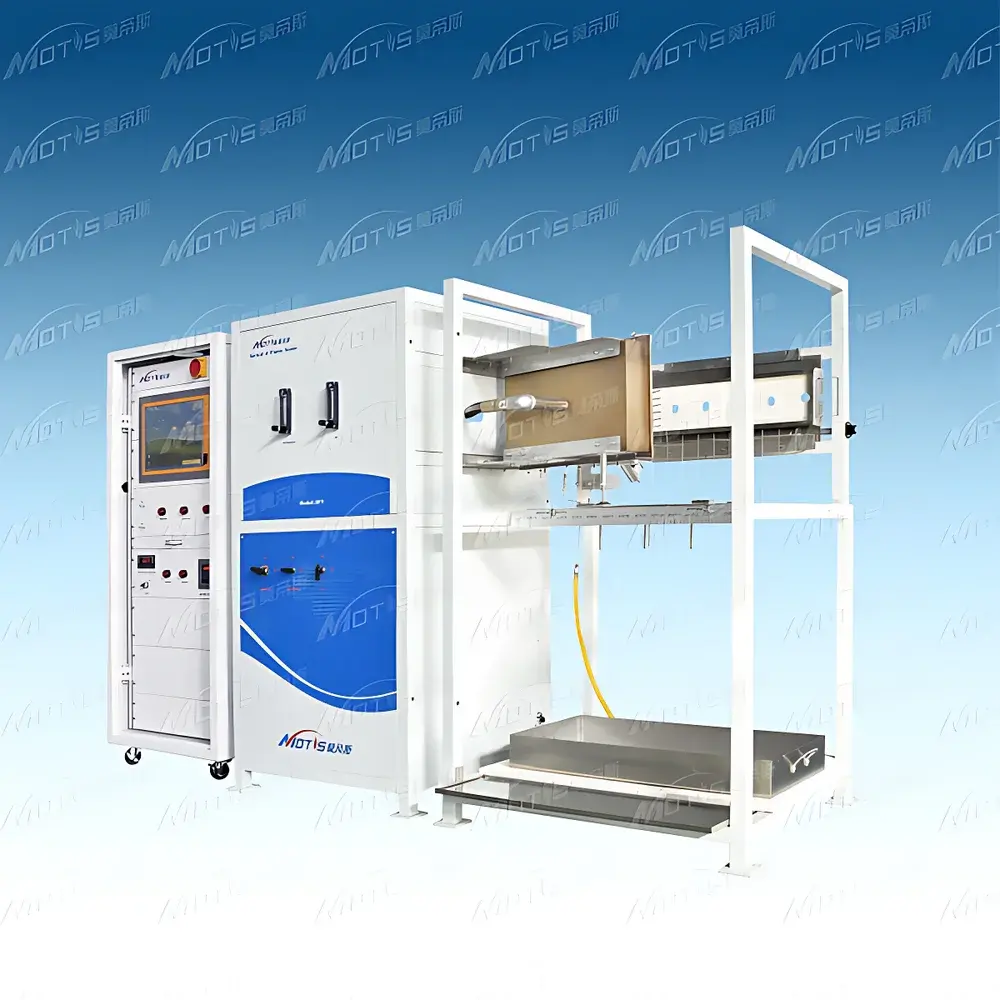
MOTIS IMO SFT Thermal Radiation Flame Spread Tester
| Brand | MOTIS |
|---|---|
| Origin | Jiangsu, China |
| Model | SFT |
| Compliance | ISO 5658-2, IMO Resolution A.653(16), GB/T 28752-2012 |
| Application Domain | Transportation (Marine, Rail, Automotive Interiors) |
| Radiation Panel Dimensions | 480 mm × 280 mm |
| Calibrated Heat Flux Range | 0–100 kW/m² (via water-cooled calorimeter) |
| Ignition Source | Ceramic-tube burner with propane/air or methane/air mixture |
| Data Acquisition | Thermocouple array (mV output), synchronized video capture, foot-switch-triggered timing |
| Cooling | Portable closed-loop water chiller for calorimeter stabilization |
| Software | PC-based control & analysis platform compliant with GLP audit trail requirements |
Overview
The MOTIS IMO SFT Thermal Radiation Flame Spread Tester is a precision-engineered combustion test system designed to quantify flame propagation behavior of vertically oriented materials under controlled radiant heat exposure. It operates on the principle of calibrated radiant flux impingement—using a propane-fueled ceramic burner and a large-area radiant panel (480 mm × 280 mm)—to simulate real-world fire exposure conditions encountered in marine, rail, and road transportation compartments. The instrument measures critical fire performance parameters including time-to-ignition (TTI), flame spread rate (mm/s), critical heat flux (CHF, kW/m²), total heat release (MJ/m²), and sustained heat release rate (kW/m²). Its physical configuration adheres strictly to the geometric and procedural constraints defined in ISO 5658-2:2006 “Reaction to fire tests — Ignitability of products subjected to thermal irradiance — Part 2: Single-flame source”, IMO Resolution A.653(16) “Revised recommendations on the fire-test procedures”, and the national standard GB/T 28752-2012 “Test method for lateral flame spread on vertical surfaces”. The system enables reproducible evaluation of surface flame spread resistance for interior linings, insulation composites, ceiling panels, and deck coverings used in passenger-carrying vehicles where regulatory compliance with SOLAS Chapter II-2 and EN 45545-2 is mandatory.
Key Features
- Modular radiation panel assembly with stainless steel mesh diffuser to ensure uniform thermal flux distribution across the 480 mm × 280 mm irradiation zone
- Dual ignition capability: ceramic-tube burner for direct flame contact (propane or methane, 1 kW / 3 kW calibration modes) and radiant panel for non-contact thermal exposure
- Water-cooled, sliding-track-mounted calorimeter with NIST-traceable calibration; supported by portable closed-loop chiller for thermal stability during prolonged testing
- Multi-point thermocouple array (type K, 0–1200 °C) for real-time surface temperature profiling and TTI determination
- Integrated high-resolution digital camera with adjustable-angle optical mirror and foot-switch-triggered frame capture for synchronized visual documentation of flame front progression
- Propane and methane mass flow controllers (MFCs) with Venturi mixing system for precise stoichiometric gas-air ratio control and repeatable heat release profiles
- Variable-frequency blower for radiation panel air supply, enabling dynamic adjustment of combustion intensity and radiant output
- Calibration verification suite including porous reference plate and traceable heat flux mapping protocol per ISO 5658-2 Annex B
Sample Compatibility & Compliance
The SFT accommodates rigid and semi-rigid flat specimens up to 1000 mm height × 300 mm width × 50 mm thickness, mounted vertically in a standardized sample holder. Compatible material classes include polymeric composites, fiber-reinforced panels, sandwich cores, foams, laminates, and coated textiles—commonly specified in shipboard bulkheads (IMO FTP Code), high-speed train interiors (EN 45545-2 HL3), and bus/coach seating systems (ECE R118). All test configurations satisfy the dimensional tolerances, environmental conditioning requirements (23 ± 2 °C, 50 ± 5 % RH), and repeatability criteria outlined in ISO 5658-2 and IMO A.653(16). The system supports full audit readiness: raw data logs (time-stamped thermocouple mV signals, calorimeter voltage outputs, video metadata) are stored with immutable timestamps, supporting FDA 21 CFR Part 11-compliant electronic records when deployed in GMP-regulated environments.
Software & Data Management
The integrated Windows-based software provides real-time monitoring, automated test sequencing, and post-processing analytics. It controls gas flow rates, blower speed, data sampling frequency (up to 10 Hz), and synchronizes video capture with thermal signal acquisition. The interface displays live heat flux curves, flame spread distance vs. time plots, and automatically calculates CHF via the “back-extrapolation” method per ISO 5658-2 Section 9.3. All measurement data are exported in CSV and PDF formats, with embedded metadata (operator ID, calibration certificate numbers, ambient conditions). Audit trail functionality records user actions, parameter changes, and software version history—fully aligned with GLP/GMP documentation standards.
Applications
- Fire safety qualification of marine interior finishes per IMO FTP Code Annex 1 (Surface Flammability)
- EN 45545-2 hazard level HL3 certification for rail vehicle wall linings and overhead panels
- Development and validation of low-flame-spread composites for electric bus battery enclosures
- Comparative assessment of intumescent coatings under radiant exposure gradients
- Research into pyrolysis kinetics and char layer formation dynamics in thermoset laminates
- Regulatory submission support for Type Approval documentation required by classification societies (e.g., DNV, LR, ABS, BV)
FAQ
What standards does the SFT fully comply with?
ISO 5658-2:2006, IMO Resolution A.653(16), and GB/T 28752-2012 — including all apparatus geometry, calibration procedures, and pass/fail criteria.
Can the system be used for both radiant and direct-flame ignition protocols?
Yes: it supports dual-mode operation — radiant panel exposure (per ISO 5658-2) and ceramic-burner direct ignition (per IMO A.653 Annex 2).
Is the calorimeter calibration traceable to national standards?
Yes: the water-cooled calorimeter is supplied with a NIST-traceable calibration certificate valid for 12 months; recalibration is performed using the included porous reference plate and sliding track alignment protocol.
Does the software meet regulatory data integrity requirements?
Yes: it implements electronic signatures, audit trails, and immutable timestamping — fully compatible with FDA 21 CFR Part 11 and EU Annex 11 expectations for regulated testing laboratories.
What maintenance is required for long-term measurement stability?
Quarterly verification of MFC accuracy, annual thermocouple calibration, biannual cleaning of radiant panel mesh and burner orifices, and continuous chiller fluid level/temperature monitoring.



