
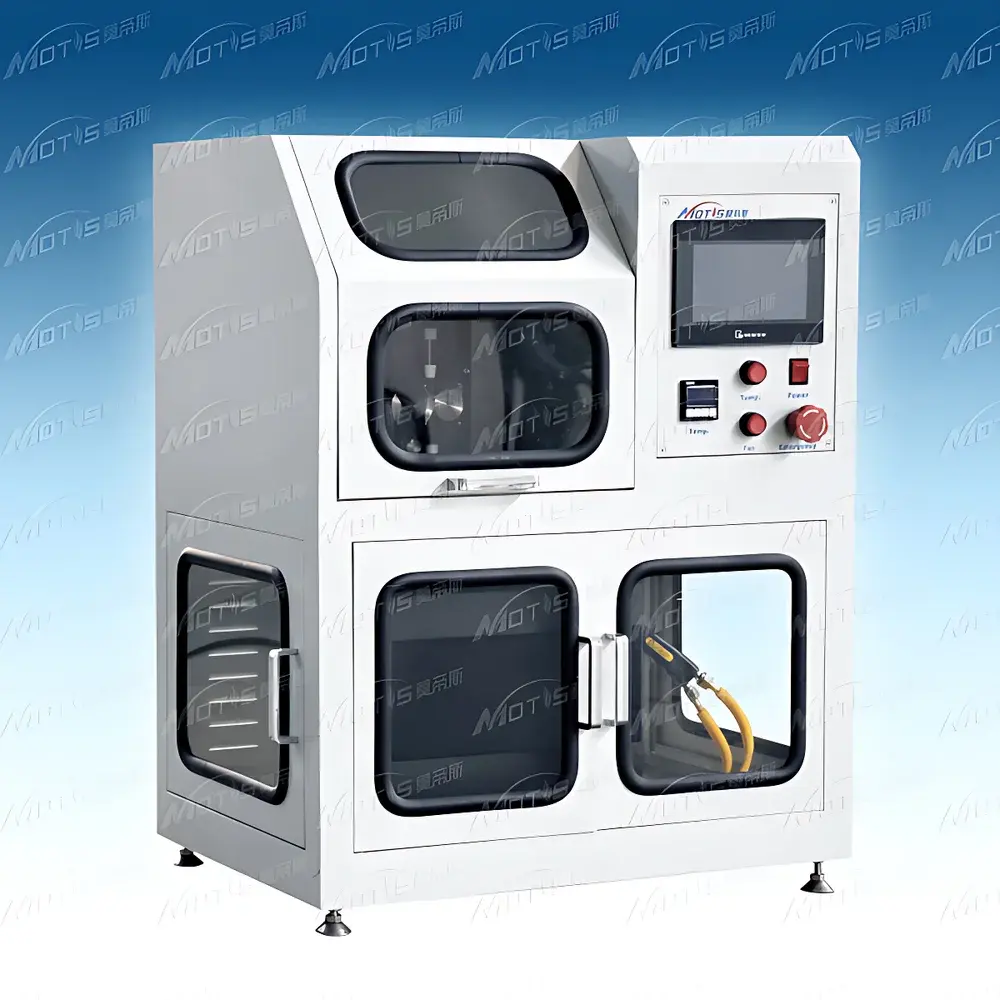
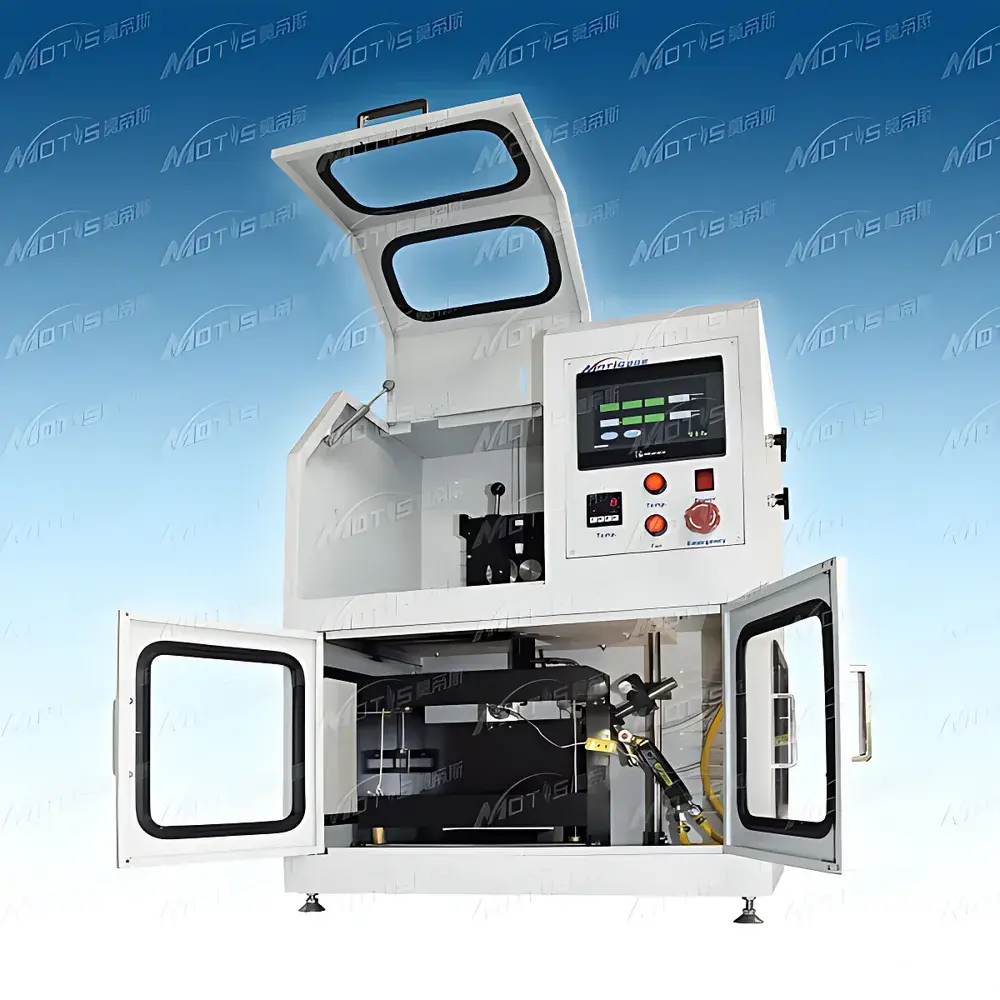
MOTIS MMS Molten Metal Droplet Impact Tester
| Brand | MOTIS |
|---|---|
| Origin | Jiangsu, China |
| Manufacturer Type | Authorized Distributor |
| Country of Origin | China |
| Model | MMS |
| Pricing | Available Upon Request |
| Standards Compliance | EN 348, ISO 9150, GB 8965.2–2009, GB/T 17599–1998 |
| Power Supply | 220 V AC, 50 Hz |
| Operating Environment | 20 ± 2 °C, 65 ± 5 % RH |
| Dimensions (W × H × D) | 800 × 1200 × 450 mm |
| Gas Supply | Oxygen and Acetylene |
| Burner Nozzle Diameter | 1.2 ± 0.1 mm |
| Specimen Pre-tension | 175 ± 0.5 g (via calibrated copper weight) |
| Droplet Guidance Angle | 45° with high-temperature anti-adhesion coated channel |
| Metal Feed Mechanism | Stepper motor–driven wire feed system with adjustable linear speed |
| Backside Temperature Sensor | Calibrated thermocouple array for real-time fabric rear-surface temperature monitoring |
| Data Logging | Automated temperature vs. time acquisition |
Overview
The MOTIS MMS Molten Metal Droplet Impact Tester is a precision-engineered physical property testing instrument designed to quantify the thermal protective performance (TPP) of fabrics and composite materials against transient exposure to molten metal droplets—primarily relevant to welding, foundry, and metallurgical occupational safety applications. It operates on the principle of controlled, reproducible generation of molten metal droplets via oxy-acetylene combustion, followed by standardized impact onto vertically mounted textile specimens. The core measurement metric is the number of droplets required to induce a 40 °C temperature rise on the specimen’s reverse surface, as detected by a calibrated thermocouple array positioned in direct thermal contact with the fabric backing. This methodology aligns rigorously with internationally recognized test protocols—including EN 348 (Protective clothing — Protection against heat and fire — Test method for resistance to small splashes of molten metal), ISO 9150 (Textiles — Determination of resistance to penetration by molten metal), and Chinese national standards GB 8965.2–2009 and GB/T 17599–1998—ensuring traceable, auditable, and inter-laboratory comparable results for certification, R&D validation, and quality assurance workflows.
Key Features
- Oxy-acetylene burner assembly with precision-machined 1.2 ± 0.1 mm nozzle, delivering stable flame geometry and consistent metal melting kinetics.
- Stepper motor–controlled metal wire feed mechanism enabling programmable linear advancement speed, ensuring repeatable droplet mass and frequency across test runs.
- 45° angled molten droplet guidance channel with high-temperature anti-adhesion coating (≥800 °C service life), minimizing residue accumulation and maintaining trajectory consistency.
- Dedicated specimen frame incorporating a calibrated 175 ± 0.5 g copper counterweight system to apply standardized pre-tension—critical for simulating realistic fabric drape and thermal response under industrial conditions.
- Backside thermocouple sensor array mounted directly beneath the test specimen, interfaced with a high-resolution data acquisition module for continuous temperature logging at ≥10 Hz sampling rate.
- Integrated human-machine interface (HMI) panel providing real-time flame status, feed speed setting, ambient condition monitoring, and temperature curve visualization during test execution.
- Modular gas flow control subsystem with independent needle valves and pressure gauges for oxygen and acetylene, facilitating precise stoichiometric ratio adjustment per EN 348 requirements.
Sample Compatibility & Compliance
The MMS accommodates flat textile specimens measuring up to 200 mm × 200 mm, compatible with woven, knitted, nonwoven, and laminated structures—including aluminized, ceramic-coated, and inherently flame-resistant (IFR) substrates. Specimens are clamped within a rigid, grounded stainless-steel frame to eliminate thermal bridging and ensure mechanical stability during impact. All operational parameters—including burner standoff distance (150 mm), droplet fall height (300 mm), and ambient conditioning (20 ± 2 °C / 65 ± 5 % RH)—are maintained per clause-specified tolerances in EN 348 and ISO 9150. The system supports full audit readiness for GLP-compliant laboratories: calibration records for thermocouples (per ASTM E230/E230M), gas pressure instrumentation (ISO/IEC 17025 traceable), and mechanical tensioning components are retained in accordance with ISO/IEC 17025 documentation requirements.
Software & Data Management
Temperature-time profiles are acquired via embedded analog-to-digital conversion and stored in CSV format with timestamp, ambient condition metadata, and operator ID fields. While droplet counting remains manual per current standard requirements (to preserve observer-defined event attribution), the system logs all thermal transients with millisecond-level resolution, enabling post-test analysis of onset latency, peak rate of temperature rise (dT/dt), and time-to-40 °C threshold. Data files comply with FDA 21 CFR Part 11–aligned file integrity controls when deployed with optional networked PC-based acquisition software (sold separately), supporting electronic signatures, audit trails, and version-controlled report generation. Exported datasets integrate natively with statistical process control (SPC) platforms and LIMS environments via standard OPC UA or Modbus TCP interfaces.
Applications
- Qualification testing of welding protective garments per EN ISO 11612 and ANSI/ISEA 105–2019.
- Material screening for foundry worker apparel, including aprons, sleeves, and spats exposed to aluminum, copper, or steel splash hazards.
- R&D evaluation of novel phase-change material (PCM)-enhanced textiles and aerogel-reinforced composites for enhanced latent heat absorption.
- Failure mode analysis of thermal barrier coatings and reflective metallized layers under dynamic molten metal loading.
- Supporting ISO 13998 (protective gloves against thermal risks) and ISO 11999 (firefighter turnout gear) supplementary testing where molten metal exposure is a secondary hazard scenario.
FAQ
Does the MMS support automated droplet counting?
No—per EN 348 and ISO 9150, droplet enumeration is performed visually by trained operators to ensure unambiguous identification of discrete impact events. Automated optical detection is not currently standardized for this test method.
Can the system be used with metals other than mild steel welding wire?
Yes—provided the selected wire alloy melts within the thermal range of the oxy-acetylene flame (~3100 °C max) and maintains consistent fluidity. Common alternatives include aluminum 4043, copper EC, and stainless steel 308L; however, nozzle clogging risk increases with high-zinc or high-silicon alloys.
Is third-party calibration certification included with delivery?
Factory calibration certificates for thermocouples (NIST-traceable), gas pressure regulators, and mechanical tension weights are provided. On-site ISO/IEC 17025 accreditation services are available through MOTIS-authorized calibration partners.
What maintenance intervals are recommended for sustained compliance?
Burner nozzles should be inspected and cleaned after every 20 test cycles; thermocouple verification is required before each daily test session using a reference dry-block calibrator (±0.5 °C tolerance). Full system performance verification per EN 348 Annex B is advised quarterly.
Is the MMS suitable for use in ATEX-classified environments?
No—the system is rated for general laboratory use (IEC 61000-6-3 EMC, IEC 61010-1 safety). Integration into hazardous area zones requires external explosion-proof enclosures and gas leak detection systems, which are not supplied as standard.



