
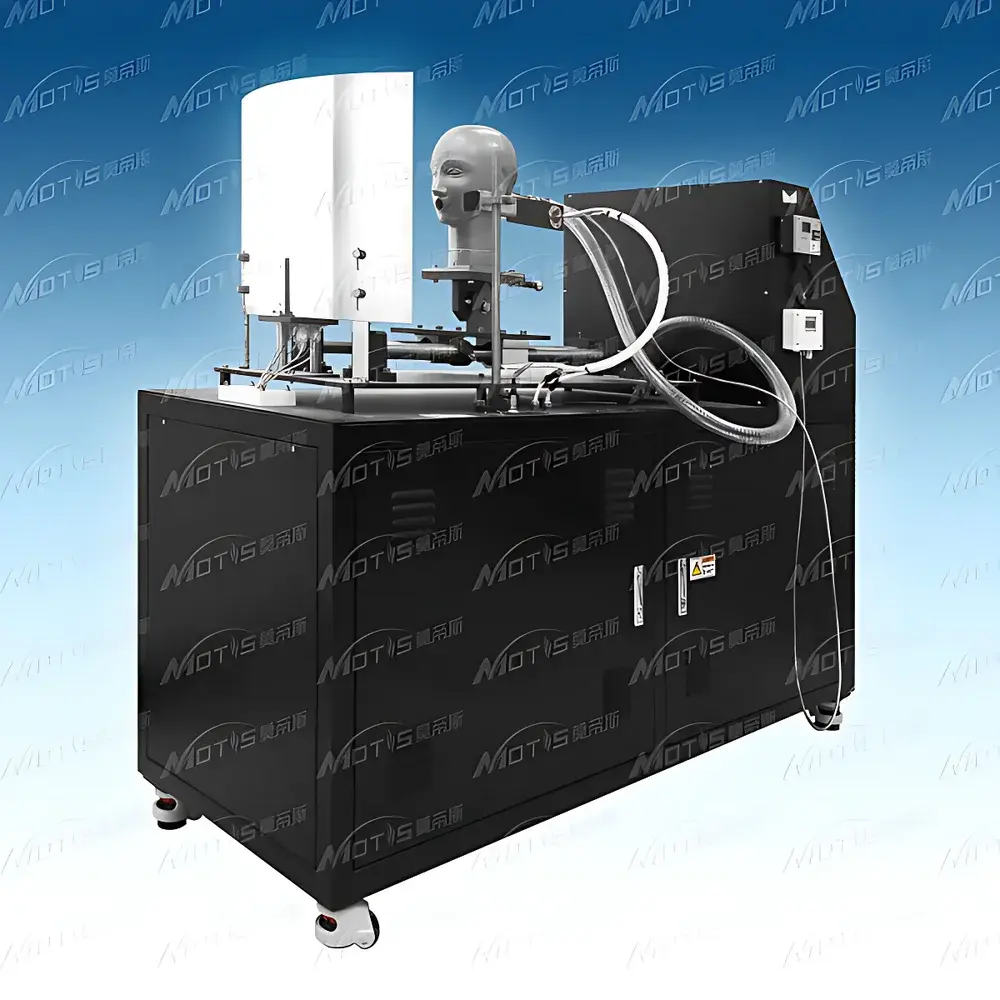
MOTIS RRT Full-Face Respirator Thermal Radiation Resistance Tester
| Brand | MOTIS |
|---|---|
| Origin | Jiangsu, China |
| Model | RRT |
| Heating System | 4000 W primary + 2000 W auxiliary electric heating elements with dual PID temperature control |
| Reflector | Stainless steel parabolic reflector |
| Headform | Metallic anthropomorphic headform with adjustable horizontal positioning rail |
| Thermal Flux Measurement | Water-cooled heat flux meter calibrated per ISO 8503-2 |
| Breathing Simulation | Programmable sinusoidal artificial lung (PLC-controlled |
| Failure Detection | Differential pressure sensor for real-time mask seal integrity monitoring |
| Compliance | EN 136:2023, GB/T 16556–2007 |
| Power Supply | 220 V AC, 30 A |
| Dimensions | 1400(W) × 600(D) × 1400(H) mm |
Overview
The MOTIS RRT Full-Face Respirator Thermal Radiation Resistance Tester is a purpose-built engineering system designed to evaluate the thermal radiation resistance performance of full-face respirators under controlled, standardized exposure conditions. It operates on the principle of directional radiant heat transfer—using high-power electric heating elements to generate a stable, reproducible thermal flux field directed toward a representative anthropomorphic headform wearing the test respirator. The system replicates the critical exposure scenario defined in EN 136:2023 and GB/T 16556–2007: namely, whether prolonged or transient exposure to intense infrared radiation—such as that encountered near industrial furnaces, fire suppression zones, or metallurgical processes—induces structural degradation, seal failure, or internal temperature rise sufficient to compromise respiratory protection. Unlike generic thermal chambers, the RRT integrates synchronized physiological simulation (via programmable breathing) and real-time functional validation (via differential pressure sensing), enabling assessment not only of material stability but also of dynamic sealing integrity during thermal stress.
Key Features
- High-fidelity thermal radiation source: Dual-zone heating configuration comprising a 4000 W primary emitter and 2000 W auxiliary emitter, each regulated by independent PID controllers to ensure thermal stability within ±1.5 °C over extended test cycles.
- Optimized radiation geometry: Precision-machined stainless steel parabolic reflector ensures collimated, uniform irradiance distribution across the facial contour of the headform, minimizing edge effects and maximizing repeatability between tests.
- Anthropometric headform with mechanical adjustability: ASTM F1858-compliant metallic headform mounted on a linear translation rail, allowing precise positioning from 100 mm to 500 mm from the radiation source—enabling compliance with distance-dependent test protocols in EN 136 Annex D.
- Water-cooled heat flux meter: Calibrated per ISO 8503-2, installed at the standard measurement plane (typically 100 mm from source), delivering traceable radiative flux data in kW/m² with <2% linearity deviation across 10–100 kW/m² range.
- Physiologically accurate breathing simulation: PLC-driven artificial lung generating sinusoidal airflow profiles; tidal volume adjustable from 0.5–2.0 L and respiratory rate from 12–30 breaths/min—fully compatible with USP and ISO 10993-10 biocompatibility testing workflows.
- Real-time functional failure detection: Integrated micro-differential pressure transducer continuously monitors pressure differentials across the mask-to-face interface, triggering automated test termination upon breach exceeding ±5 Pa threshold—aligned with EN 136 Clause 6.4.3 pass/fail criteria.
Sample Compatibility & Compliance
The RRT accommodates all certified full-face respirators conforming to EN 140, EN 136, or GB/T 16556 dimensional envelopes—including elastomeric, silicone, and thermoplastic facepieces with integrated or detachable visors, speech diaphragms, and exhalation valves. Test specimens are mounted without modification using standard headband tensioning mechanisms. The system supports full audit trails required for GLP-compliant laboratories and meets essential requirements for ISO/IEC 17025 accreditation: calibration records for heat flux meter and pressure sensor are retained in device firmware; all test parameters (distance, flux, breathing profile, duration) are logged with UTC timestamps. It satisfies regulatory alignment for PPE Category III certification under EU Regulation (EU) 2016/425 and supports technical documentation preparation for CE marking submissions.
Software & Data Management
The embedded HMI interface provides guided test setup, real-time parameter visualization (flux density, headform surface temperature, differential pressure, airflow waveform), and automatic report generation in PDF/CSV format. All raw sensor data—including time-synchronized 10 Hz sampling of pressure differential and thermal flux—is stored locally on encrypted SD card with SHA-256 hash verification. Optional Ethernet connectivity enables integration into enterprise LIMS via Modbus TCP or OPC UA. Audit trail functionality complies with FDA 21 CFR Part 11 requirements: user authentication, electronic signatures, and immutable event logging (e.g., parameter changes, manual overrides, calibration events) are enforced at firmware level.
Applications
- Validation of respirator performance in foundry, glass manufacturing, and steel processing environments where radiant heat flux exceeds 15 kW/m².
- Developmental testing of novel facepiece materials (e.g., ceramic-coated polymers, aerogel composites) for enhanced thermal attenuation.
- Quality assurance screening for batch release of PPE supplied to fire brigades, nuclear decommissioning teams, and petrochemical emergency response units.
- Root cause analysis of field-reported seal failures under thermal stress, correlating lab-based differential pressure decay curves with real-world incident data.
- Supporting ISO/TR 21872:2021 methodology development for combined thermal-radiant and particulate filtration integrity assessment.
FAQ
What standards does the RRT explicitly support?
EN 136:2023 (Clause 6.4.3), GB/T 16556–2007 (Section 7.4), and ISO 8503-2 (for heat flux meter calibration).
Can the RRT be used for half-mask testing?
No—the headform geometry, reflector design, and test envelope are optimized exclusively for full-face respirators per EN 136 definitions.
Is external cooling water required for the heat flux meter?
Yes: continuous deionized water flow at 1.2 L/min and ≤25 °C inlet temperature is mandatory for meter stability and calibration validity.
Does the system include calibration certificates?
Factory calibration certificates for the heat flux meter and differential pressure sensor are provided; annual recalibration is recommended per ISO/IEC 17025 guidelines.
What safety interlocks are implemented?
Overtemperature cutoff (≥800 °C at emitter surface), door-open emergency shutdown, water-flow failure alarm, and current leakage detection per IEC 61000-6-3 EMC standards.



