
MOTIS SCF Photovoltaic Module Fire Resistance Test System
| Brand | MOTIS |
|---|---|
| Origin | Jiangsu, China |
| Model | SCF |
| Compliance | ASTM E108, UL 790, NFPA 256, IEC 61730-2 Annex A |
| Test Chamber Dimensions (L×W×H) | 1020 × 1000 × 1473 mm |
| Roof Deck Substrate | Plywood, 1300 × 1000 × 120 mm |
| Non-combustible Backstop Panel | Stainless steel, installed at rear end of test deck |
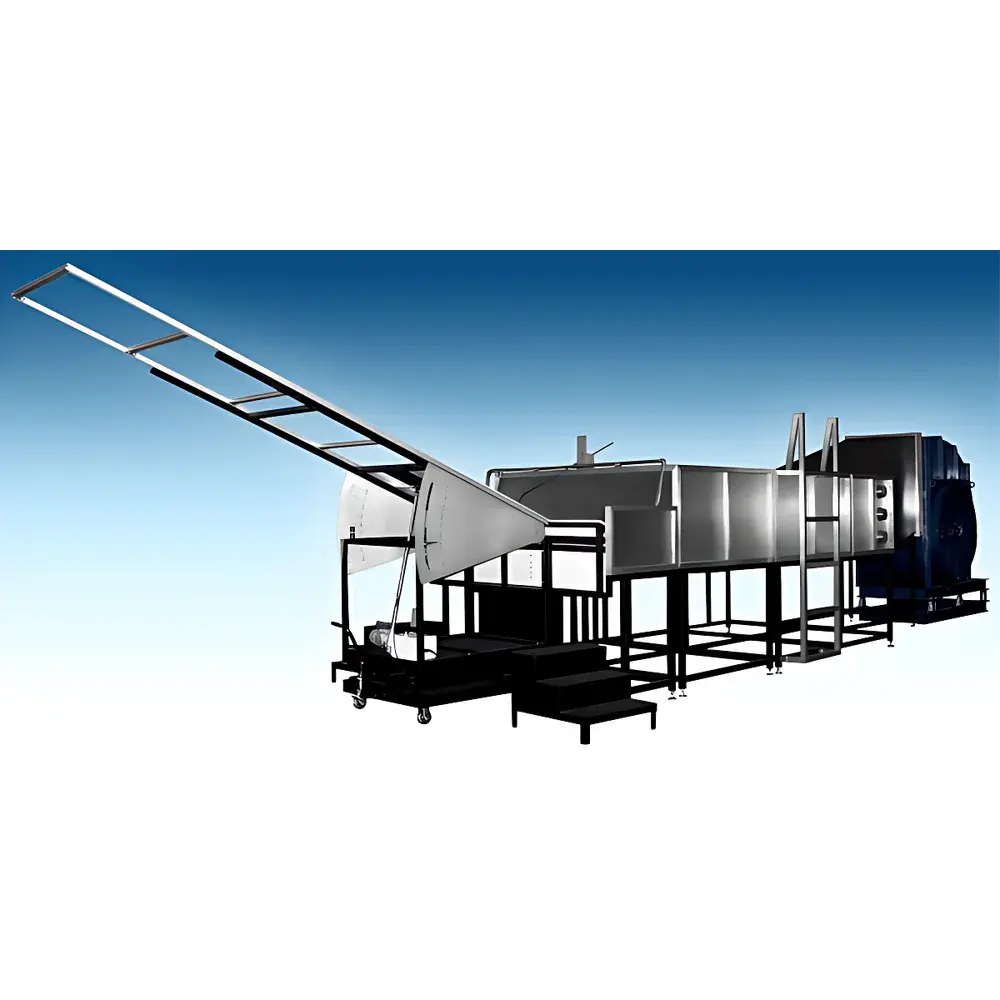
| Adjustable Fan-shaped Deflector Plate | 1440 × 940 mm, stainless steel, angle-adjustable |
| Eave Simulator Assembly | 330 × 2130 × 584 mm, non-combustible board mounted at front frame |
| Airflow Velocity | 19 ± 8 km/h (5.5 ± 2.2 m/s), monitored via calibrated anemometer |
| Exhaust Duct | Stainless steel, 2130 × 762 × 3000 mm, equipped with honeycomb flow straightener, guide vanes, and adjustable turbulence plates |
| Fan | 220 V, 50 Hz, three-phase, reverse-flow capable, 0–100% infinitely variable speed control, min. airflow 300 m³/min |
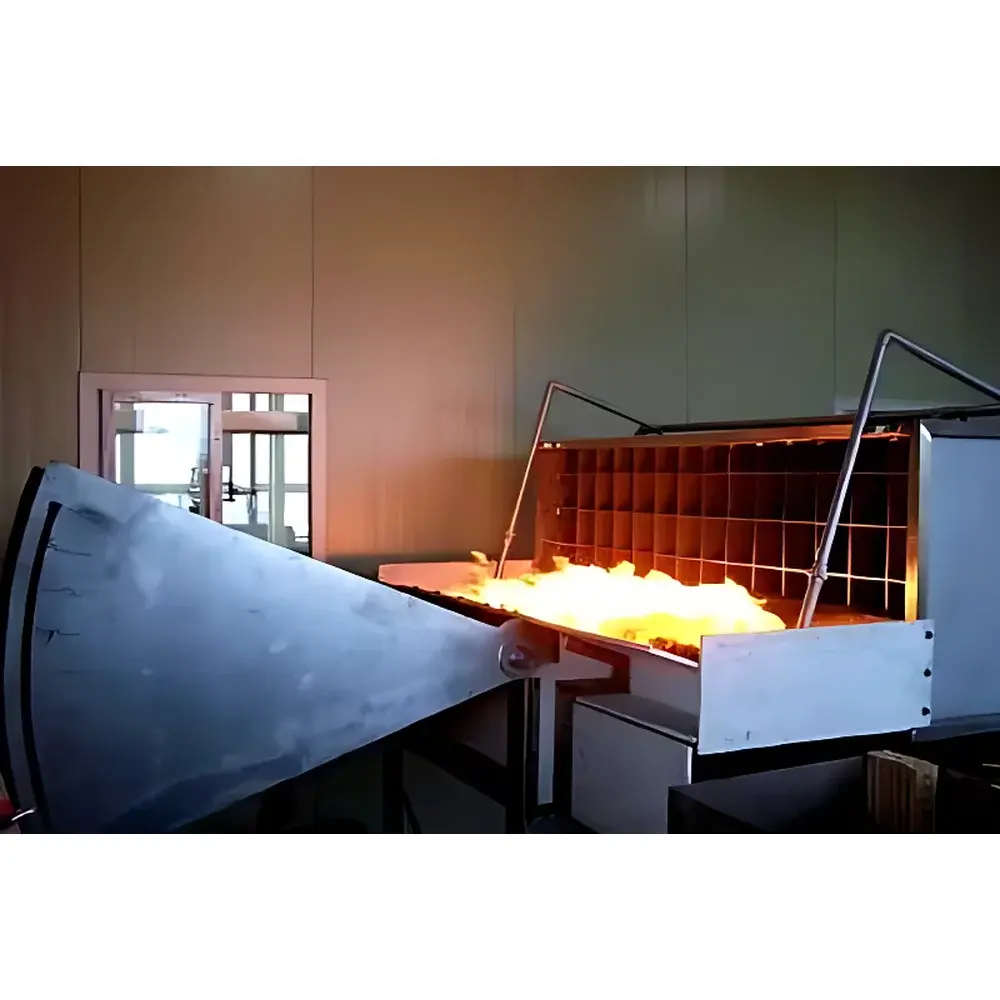
| Gas Burner | 1.12 m long × 60.3 mm OD, linear slit (12.7 mm wide × 0.91 m long), heat output Class A/B: 21,000–22,000 Btu/min (369–387 kWh) for 10 min |
| Class C | 18,000–19,000 Btu/min (316–334 kWh) for 4 min |
| Burner Surface Temperature | 880 ± 10 °C |
| Automatic Ignition System | High-voltage electrode ≥1.8 kVp |
| Mass Flow Control | Precision thermal mass flow meters for repeatable gas delivery per test class |
| Data Acquisition | NI-based LabVIEW system with 16-bit thermocouple input, 16-bit analog input, digital I/O, 12-bit analog output, 4/8-slot chassis, real-time & Ethernet modules |
| Sample Support | Rotatable metal mesh tray with load-bearing capacity for standard PV modules (up to 2.0 m length) |
Overview
The MOTIS SCF Photovoltaic Module Fire Resistance Test System is a fully integrated, standards-compliant combustion test chamber engineered for the quantitative evaluation of fire propagation behavior in photovoltaic (PV) modules under simulated rooftop exposure conditions. It operates on the principle of controlled external flame impingement—where a calibrated gas burner delivers defined thermal fluxes to the underside of a module mounted on a representative roof deck substrate—enabling classification per ASTM E108, UL 790, NFPA 256, and IEC 61730-2 Annex A. Unlike generic flammability testers, the SCF replicates real-world fire dynamics including radiant heat transfer, convective airflow interaction, and ember generation, making it suitable for both R&D validation and third-party certification testing. Its architecture conforms to the physical geometry and boundary conditions specified in Class A (1.82 m), Class B (2.4 m), and Class C (3.9 m) fire exposure protocols, ensuring traceable, inter-laboratory reproducible results required for building code compliance and insurance underwriting.
Key Features
- Modular stainless-steel structural frame (1020 × 1000 × 1473 mm) with corrosion-resistant finish, designed for long-term stability under thermal cycling and high-humidity exhaust environments.
- Adjustable fan-shaped deflector plate (1440 × 940 mm) enabling precise angular alignment of flame vector relative to test specimen surface—critical for simulating wind-driven fire spread scenarios.
- Dual-zone airflow management: upstream honeycomb straightener and downstream turbulence plates ensure laminarized, uniform 5.5 ± 2.2 m/s airflow across the test deck, independently verified by NIST-traceable anemometry.
- UL-listed gas burner assembly with 1.12 m linear slit configuration, delivering stable thermal output from 316–387 kWh with ±2% repeatability across Class A–C test durations.
- Automated ignition and closed-loop mass flow control using thermal mass flow meters, synchronized with LabVIEW-based sequencing to enforce strict adherence to ASTM/UL ramp profiles and dwell times.
- Rotatable metal mesh support tray accommodating standard PV modules up to 2.0 m in length, facilitating full-surface exposure without mechanical shadowing or thermal distortion.
- Integrated eave simulator (330 × 2130 × 584 mm) and non-combustible backstop panel to replicate flame roll-over and prevent rear-side re-ignition—key requirements in IEC 61730-2 Annex A.
Sample Compatibility & Compliance
The SCF accommodates framed and frameless crystalline silicon (c-Si), thin-film (CIGS, CdTe, a-Si), and emerging perovskite-based PV modules conforming to IEC 61215, IEC 61646, and UL 1703 dimensional envelopes. Mounting fixtures allow secure clamping of modules onto the 1300 × 1000 × 120 mm plywood roof deck substrate, which meets ASTM D5516 specifications for structural wood-based sheathing. All fire exposure configurations comply with mandatory test report elements required by AHJs (Authority Having Jurisdiction), including flame spread distance measurement points, char depth assessment zones, and sustained flaming duration thresholds. The system supports GLP-compliant audit trails when paired with LabVIEW’s built-in 21 CFR Part 11 add-ons, enabling electronic signature capture, user access logs, and immutable data archiving.
Software & Data Management
Data acquisition is performed via a National Instruments PXI platform running LabVIEW Real-Time 2022 with dedicated modules: 16-bit thermocouple input (Type K, ±0.5 °C accuracy), 16-bit analog voltage input (±10 V range), digital I/O for burner valve and fan status, and 12-bit analog output for proportional gas flow control. The software implements automated test sequencing—including pre-test ambient stabilization, flame-on timing, airflow synchronization, and post-test cooldown—while logging all sensor channels at 10 Hz minimum. Export formats include CSV, TDMS, and XML for integration with LIMS or statistical process control (SPC) platforms. Audit-ready reports auto-generate pass/fail determinations per clause in ASTM E108 Section 7 and IEC 61730-2 Clause A.4, with embedded timestamps, operator IDs, calibration certificate references, and environmental condition metadata.
Applications
The SCF serves critical functions across the PV value chain: manufacturers use it to qualify new encapsulant formulations (e.g., POE vs. EVA), backsheet polymers (e.g., fluoropolymer-coated PET), and fire-retardant additives prior to UL listing; module recyclers apply it to assess residual flammability risk in end-of-life panels; building code authorities deploy it for field verification of installed array fire performance; and fire safety researchers leverage its programmable airflow and burner modulation to study flame–module interaction physics under varying wind speeds and incident angles. It is also referenced in NFPA 1, ICC IBC Chapter 15, and California Title 24 Part 6 for Class A fire-rated roof assemblies incorporating PV.
FAQ
Does the SCF meet UL Subject 790 listing requirements for Class A fire rating?
Yes—the system satisfies all apparatus, procedural, and reporting criteria in UL 790 Edition 5, including burner calibration frequency, airflow verification intervals, and specimen mounting tolerances.
Can the system be configured for small-scale screening tests before full-scale certification?
While not intended as a screening tool, the modular burner and airflow subsystems permit reduced-duration Class C trials (4-minute exposure) for rapid comparative evaluation of material variants.
Is third-party calibration support available for the thermocouples and mass flow meters?
All sensors ship with NIST-traceable calibration certificates; MOTIS partners with ISO/IEC 17025-accredited labs for annual recalibration services with documented uncertainty budgets.
What electrical infrastructure is required for installation?
A dedicated 220 V, 50 Hz, three-phase circuit with 63 A breaker and grounded conduit is required; exhaust duct must terminate outdoors with minimum 1.2 m clearance from air intakes.
How is data integrity ensured during extended fire tests lasting over 30 minutes?
LabVIEW’s real-time kernel prevents OS-level interruptions; onboard SSD storage buffers all channels at full rate; redundant Ethernet streaming to external NAS provides failover redundancy.



