
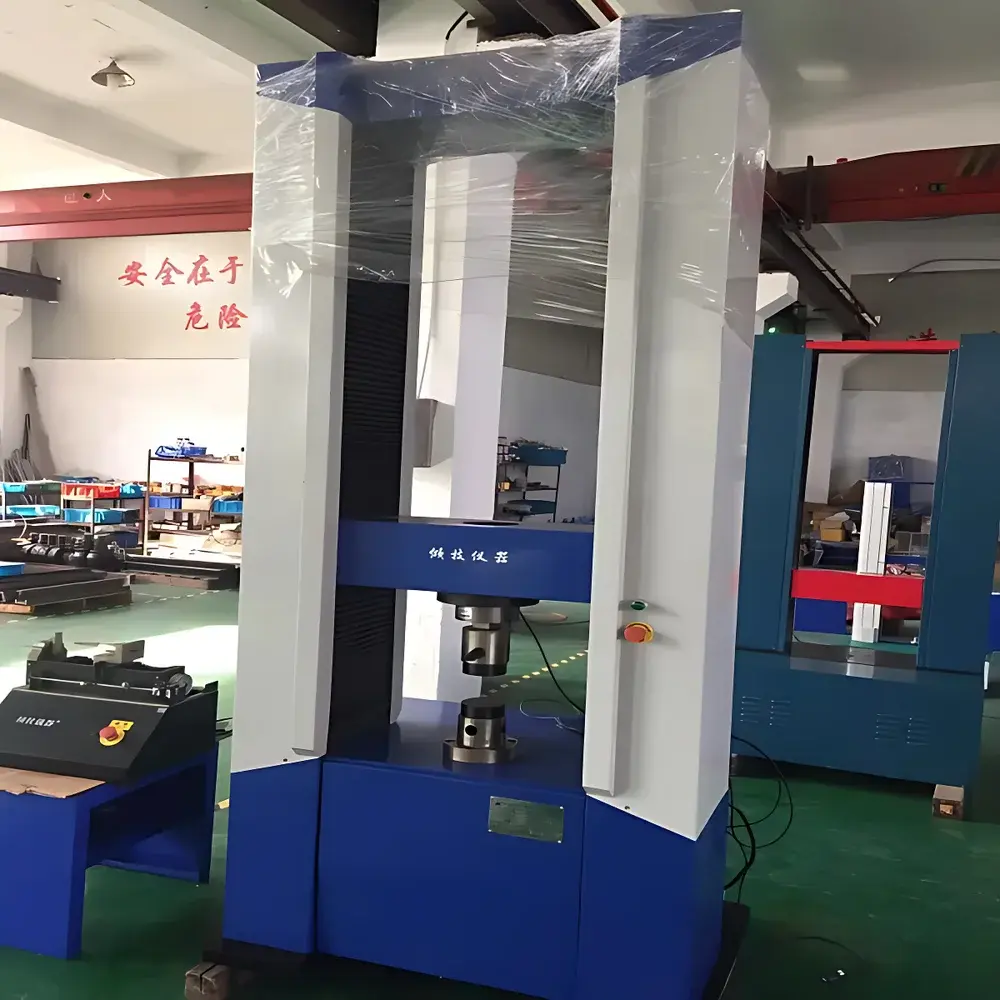
QJ212 Brake Disc Shear Strength Testing Machine – Electronic Universal Testing Machine
| Origin | Shanghai, China |
|---|---|
| Manufacturer Type | Authorized Distributor |
| Origin Category | Domestic (PRC) |
| Model | QJ212 |
| Price | ¥68,000 |
| Instrument Type | Electromechanical Universal Testing Machine |
| Max Load Capacity | 500 kN |
| Effective Test Width | 500 mm |
| Effective Tensile Stroke | 600 / 800 mm |
| Test Speed Range | 0.001–1000 mm/min |
| Speed Accuracy | ±0.5% of indicated value |
| Load Resolution | ±1/250,000 full scale (single-range, no auto-ranging) |
| Displacement & Strain Measurement Accuracy | ±0.5% of indicated value |
| Safety Protection | Electronic limit switches, overload protection at 110% of rated load |
| Control System | Windows-based PC interface with real-time curve display, data editing, curve overlay, zoom, traversal and export functions |
| Compliance Standards | ISO 6892-1, ASTM E8/E21, JIS Z2241, DIN 50125, GB/T 228.1 |
Overview
The QJ212 Brake Disc Shear Strength Testing Machine is a high-capacity electromechanical universal testing system engineered for precise mechanical characterization of automotive brake components—particularly cast iron and composite brake discs—under controlled shear, compression, and bending loading conditions. Designed around a robust dual-column load frame architecture, the system implements closed-loop servo control to deliver repeatable force application across a 10–500 kN load range. Its primary metrological function relies on strain-gauge-based load cell transduction, coupled with high-resolution encoder-based displacement feedback and optional extensometry for localized strain measurement. Unlike hydraulic systems, the QJ212 employs a precision ball-screw actuator driven by a brushless AC servo motor, enabling fine speed resolution (down to 0.001 mm/min) and dynamic response suitable for both quasi-static shear strength evaluation per ISO 6336-3 (gear tooth flank strength) analog methodologies and standardized disc shear testing protocols used in Tier-1 OEM supplier qualification workflows.
Key Features
- Single-range load measurement with ±1/250,000 full-scale resolution—no range switching required, ensuring consistent accuracy across the entire 10–500 kN span
- Adjustable crosshead travel (600 mm or 800 mm standard) accommodates large-diameter brake discs (up to Ø420 mm) and multi-specimen fixtures
- Dual-speed crosshead movement: rapid positioning (≥200 mm/min) and fine-load-rate control (0.001–1000 mm/min), programmable in discrete steps or continuous ramps
- Integrated electronic limit switches and hardware-triggered emergency stop prevent over-travel; software-enforced overload cutoff activates at 110% of selected load range
- Windows-native control interface supports ASTM E1712-compliant data acquisition: timestamped force/displacement/strain channels, real-time curve rendering, and audit-ready data export (CSV, XLSX, PDF)
- Modular fixture interface compliant with ISO 26203-2 mounting standards, enabling quick-swappable shear jigs, compression platens, and three-point bend assemblies
Sample Compatibility & Compliance
The QJ212 is routinely deployed for evaluating shear strength of ventilated and solid brake discs per internal OEM specifications aligned with SAE J2998 (Brake Rotor Structural Integrity) and ISO 10113 (Metallic Materials — Tensile Testing — Method of Test at Ambient Temperature). It accepts specimens conforming to ISO 6892-1 Type 5 geometry for disc rim shear coupons and supports custom tooling for hub-to-rotor interface shear tests. All test sequences can be preconfigured to meet GLP documentation requirements—including user authentication, electronic signatures, and 21 CFR Part 11-compliant audit trails when operated with validated software modules. Calibration certificates traceable to NIM (National Institute of Metrology, China) and optionally UKAS-accredited labs are available upon request.
Software & Data Management
The embedded Windows-based control suite provides ISO/IEC 17025-aligned test method definition: users define load rate profiles, hold durations, failure criteria (e.g., 5% load drop), and pass/fail thresholds prior to execution. Raw data streams are stored in encrypted binary format with metadata headers (operator ID, environmental temp/humidity logs if interfaced with external sensors, calibration expiry dates). Post-test analysis includes automatic yield point detection (0.2% offset method), ultimate shear strength calculation, modulus derivation from linear elastic region, and statistical reporting across batch runs. Export options include ASTM E1432-compliant test reports and raw time-series datasets compatible with MATLAB, Python (pandas), and Minitab for advanced Weibull analysis of shear failure distributions.
Applications
- Shear strength validation of cast grey iron (GG25/GG30) and spheroidal graphite iron (GJS400–18) brake rotors under simulated clamping loads
- Interfacial shear testing of bonded ceramic–metal composite brake discs (e.g., C/C-SiC hybrids)
- Compression creep evaluation of brake pad backing plates at elevated temperatures (when integrated with environmental chamber)
- Bending fatigue pre-screening of disc hat sections using three-point flexure per ISO 14125
- Validation of finite element models (FEM) via correlation of experimental load–deflection curves with simulation outputs
- Supplier quality assurance testing per IATF 16949 clause 8.4.2.2 (external provider process verification)
FAQ
What shear test configurations does the QJ212 support for brake discs?
It supports both direct double-lap shear (per ISO 14273) and indirect torsional shear via custom mandrel fixtures simulating caliper clamp forces.
Is the system compatible with third-party extensometers?
Yes—standardized 10 V analog output and LVDT/strain gauge input channels enable integration with clip-on or non-contact extensometers meeting ASTM E83 Class B-1 accuracy.
Can test methods be locked to prevent unauthorized modification?
Administrative access control allows method templates to be password-protected and digitally signed, satisfying internal SOP enforcement requirements.
What maintenance intervals are recommended for long-term accuracy?
Load cell recalibration every 12 months; ball-screw lubrication and encoder alignment verification every 6 months; annual mechanical inspection per ISO 7500-1 Class 1 verification protocol.
Does the system provide raw data export for statistical process control (SPC)?
Yes—CSV exports include all sampled channels at user-defined rates (1–100 Hz), enabling direct import into JMP or InfinityQS for real-time SPC charting and capability analysis (Cpk/Ppk).



