
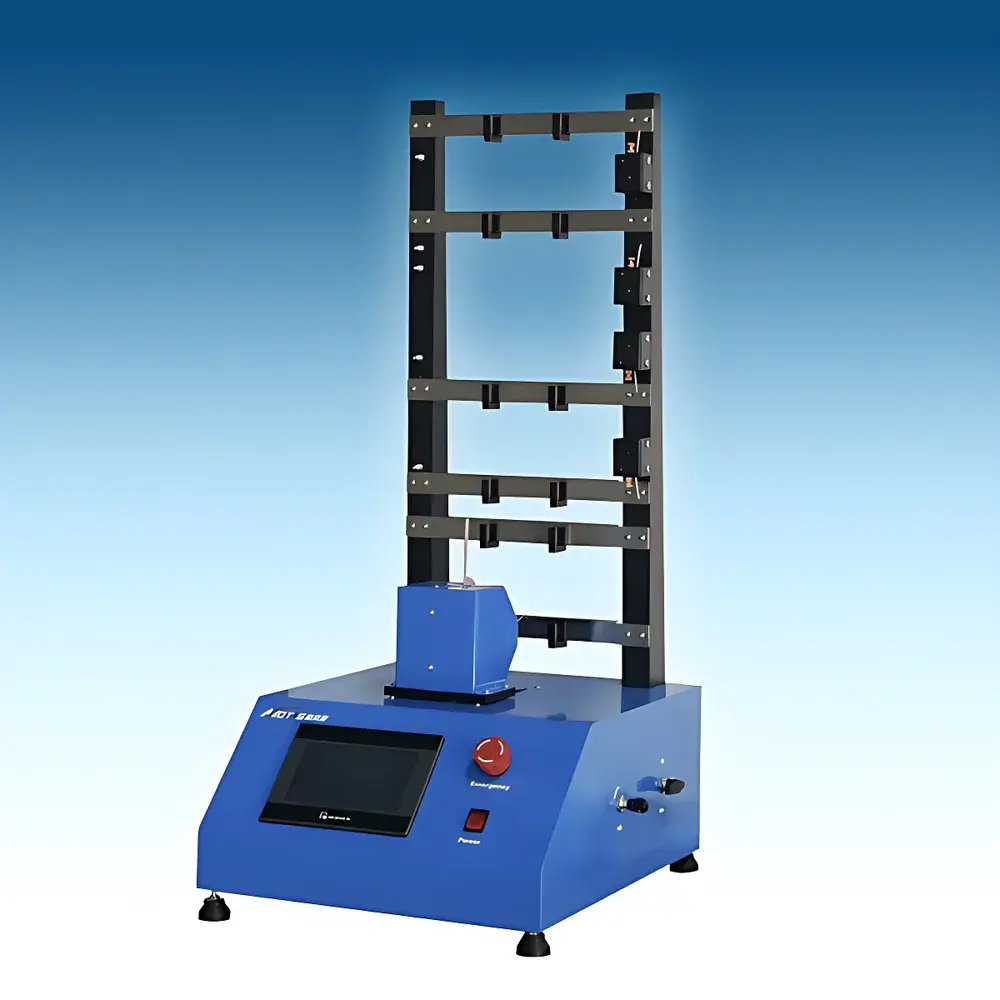
MOTIS VFT Vertical Flammability Tester for Automotive Interior Materials
| Brand | MOTIS |
|---|---|
| Model | VFT |
| Application | Automotive Interior Trim (M-Class Vehicles ≥22 Passengers) |
| Compliance | GB 32086–2015 |
| Construction | Stainless Steel Sample Holder Frame (560 mm H × 170 mm W) |
| Burner | Brass, Adjustable ±30° Tilt & Vertical Positioning |
| Ignition | High-Voltage Pulse Auto-Ignition |
| Control System | PLC + Touchscreen HMI |
| Timing | Fully Automated (Ignition Duration, Afterflame Time, Burn Rate Calculation) |
| Sample Fixation | Dual 2 mm Diameter Pins (27 mm Spacing), 20 mm Height Stop Pins |
| Flame Impingement Distance | 20 mm from Specimen Bottom |
| Marking Line Adjustment | Motorized Positioning |
| Flame Detection | Precision Microswitch-Based Endpoint Sensing |
| Data Handling | Automatic Burn Rate (mm/min) Computation & Timestamped Storage |
Overview
The MOTIS VFT Vertical Flammability Tester is an engineered test system designed specifically to evaluate the vertical flame propagation behavior of interior trim materials used in M-class motor vehicles accommodating 22 or more passengers—such as coaches, articulated buses, and high-capacity transit vehicles. It operates on the principle of controlled direct-flame impingement under standardized thermal exposure conditions, in strict accordance with GB 32086–2015 “Technical Requirements and Test Methods for Vertical Flammability of Interior Materials for Specific Types of Motor Vehicles.” The apparatus subjects vertically oriented specimens—including curtains, sunshades, overhead linings, and other hanging textile or composite substrates—to a precisely defined propane flame for exactly 5 seconds. Following flame removal, the system automatically records afterflame time, char length, and calculates burn rate (mm/min), providing objective, repeatable metrics essential for regulatory conformance and material qualification.
Key Features
- Stainless steel sample holder frame (560 mm height × 170 mm width) ensures dimensional stability, corrosion resistance, and long-term repeatability across thousands of test cycles.
- Dual precision-machined 2 mm diameter stainless steel mounting pins (27 mm center-to-center spacing) and adjustable 20 mm height stop pins guarantee consistent specimen alignment and vertical orientation per GB 32086–2015 geometric requirements.
- Brass burner assembly meets exact dimensional and flow-path specifications outlined in Clause 6.2 of GB 32086–2015; supports both vertical and ±30° angled positioning relative to the specimen plane to accommodate design-specific flame approach angles.
- Fixed 20 mm standoff distance between burner tip and specimen lower edge is maintained via calibrated linear actuation, with fine-positioning capability for variable-thickness substrates (up to 13 mm).
- High-voltage pulse ignition delivers reliable, contactless flame initiation without manual pilot lighting—reducing operator variability and enhancing safety protocol adherence.
- Programmable 5.0 ± 0.2 s flame application duration is enforced by embedded PLC logic, eliminating timing drift associated with manual stopwatch operation.
- Motor-driven, touch-screen-adjustable marking line fixture enables rapid repositioning for specimens of differing thicknesses while preserving calibrated reference geometry.
- Microswitch-based flame detection system provides deterministic endpoint sensing at char front progression—ensuring precise afterflame time capture with <±0.1 s resolution.
- Integrated PLC + industrial-grade touchscreen HMI executes full test sequencing: flame activation, timing synchronization, extinction control, burn distance measurement, burn rate computation, and data logging—all without user intervention post-initiation.
Sample Compatibility & Compliance
The VFT accommodates flat, flexible, or semi-rigid interior materials up to 560 mm in height and 170 mm in width, including woven/nonwoven textiles, laminated composites, foamed polymers, and coated substrates commonly used in curtain systems, headliners, partition panels, and sunshade assemblies. All mechanical, thermal, and procedural parameters align explicitly with GB 32086–2015, which references foundational combustion physics principles found in ISO 6941 and ASTM D6413 where applicable. While primarily intended for Chinese type-approval testing, the instrument’s metrological traceability, fixed flame geometry, and automated timing architecture support internal R&D benchmarking aligned with UN ECE Regulation No. 118 and FMVSS 302 comparability studies—subject to lab-specific validation per ISO/IEC 17025.
Software & Data Management
Test execution, real-time parameter monitoring, and result archival are managed through a deterministic PLC firmware layer interfaced with a 7-inch resistive touchscreen HMI. Each test generates a timestamped record containing: specimen ID, ignition time, flame-off time, afterflame duration, measured burn distance (mm), calculated burn rate (mm/min), pass/fail status per GB 32086–2015 Clause 7.2 thresholds (≤100 mm/min), and operator ID. Data export is supported via USB flash drive in CSV format for integration into LIMS or QA documentation workflows. Audit trails—including parameter changes, calibration events, and system faults—are retained for minimum 12 months, satisfying GLP-aligned documentation expectations for automotive Tier-1 supplier laboratories.
Applications
The VFT serves as a core qualification tool within OEM and Tier-1 supplier quality assurance labs responsible for validating flame-retardant formulations, evaluating batch-to-batch consistency of textile suppliers, verifying coating integrity on laminated substrates, and supporting technical file submissions for CNCA (China National Certification and Accreditation Administration) vehicle homologation. It is routinely deployed during pre-production material screening, failure analysis of field-reported burn incidents, and comparative assessment of halogen-free vs. brominated FR additives in polyolefin-based nonwovens. Its deterministic automation also supports inter-laboratory round-robin studies requiring high inter-operator reproducibility.
FAQ
Does the VFT comply with international standards beyond GB 32086–2015?
The system’s mechanical configuration and timing fidelity align with the physical test methodology of ISO 6941 and ASTM D6413, though formal certification to those standards requires additional lab-specific validation and uncertainty budgeting per ISO/IEC 17025.
Can the VFT be used for non-automotive applications such as rail or aerospace interiors?
While mechanically suitable for similar vertical flame tests, its current configuration and software logic are optimized for GB 32086–2015 criteria; adaptation to EN 45545-2 (rail) or FAR 25.853 (aviation) would require hardware recalibration and firmware revision.
What maintenance intervals are recommended for sustained accuracy?
Burner orifice inspection and cleaning every 200 tests, microswitch functional verification quarterly, and annual calibration of timing circuitry against NIST-traceable timebase sources are advised.
Is remote diagnostics or firmware update capability available?
Firmware updates are performed locally via USB interface; remote diagnostic access is not implemented to maintain system integrity and cybersecurity compliance in regulated manufacturing environments.
Related Products



