
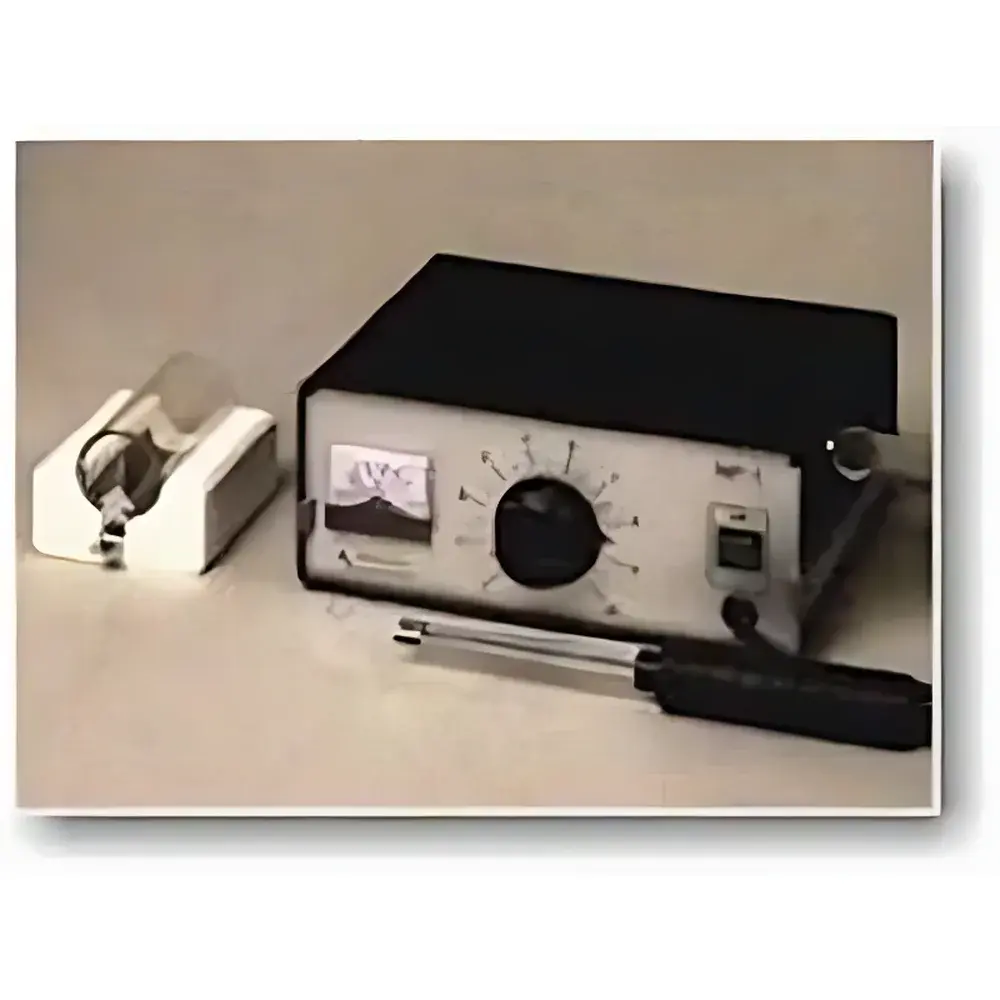
MP-1 Combustion Rate Tester
| Origin | Germany |
|---|---|
| Manufacturer Type | Authorized Distributor |
| Origin Category | Imported |
| Model | MP-1 |
| Pricing | Upon Request |
Overview
The MP-1 Combustion Rate Tester is a precision-engineered apparatus designed to quantify the propagation behavior of combustion in solid materials under standardized thermal initiation conditions. It operates on the principle of controlled linear flame spread along a geometrically defined sample geometry—specifically, a triangular cross-section combustion strip—enabling reproducible determination of combustion front velocity, ignition response mode (flaming vs. non-flaming decomposition), and time-to-complete-propagation. This instrument implements the fundamental test methodology outlined in the United Nations Manual of Tests and Criteria, Part III, Section 33.2.1 (Test N.1), as well as the Chinese national standard GB/T 21618–2008 “Test Method for Burning Rate of Flammable Solids”. Its primary engineering purpose is to support hazard classification of powders, granules, and pastes in accordance with UN Transport Regulations (UN 4.1), IATA Dangerous Goods Regulations, and domestic regulatory frameworks governing chemical safety data sheets (SDS) and packaging group assignment.
Key Features
- Triangular-section combustion mold (250 mm length, 10 mm height, 20 mm base width) fabricated from anodized aluminum—providing thermal stability, electrical insulation, and resistance to oxidation at elevated temperatures
- Integrated lateral boundary plates extending 2 mm above the mold’s triangular profile to constrain lateral heat loss and ensure axial flame propagation fidelity
- High-temperature gas burner system calibrated to deliver a stable ignition source ≥1000 °C with minimum flame diameter of 5 mm, meeting UN-specified thermal input requirements
- Non-porous, non-combustible quartz test plate with low thermal conductivity, minimizing substrate-mediated heat transfer and ensuring measurement integrity
- Modular sample preparation interface compatible with free-flowing powders, cohesive granules, and viscous pastes—each compacted into the mold under standardized pressure and conditioning protocols
- Real-time visual observation window and synchronized timing instrumentation enabling precise recording of ignition onset, flame front position, and full-length propagation endpoint
Sample Compatibility & Compliance
The MP-1 accommodates heterogeneous physical forms including dry powders (e.g., organic pigments, metal alloys), agglomerated granules (e.g., pharmaceutical intermediates, polymer additives), and semi-solid pastes (e.g., battery electrode slurries, pyrotechnic compositions). All test procedures conform to the dimensional tolerances, environmental controls (23 ± 2 °C, 50 ± 5% RH), and procedural sequence stipulated in UN Manual Part III and GB/T 21618. Results are directly applicable to UN packing group assignment: substances exhibiting flame propagation ≤45 s and rate >2.2 mm/s are classified as Class 4.1; metal powders propagating fully within 10 min require Class 4.1 designation; non-metallic solids passing the wet-zone barrier test for ≥4 min qualify for Packing Group III. The system supports audit-ready documentation aligned with ISO/IEC 17025 laboratory accreditation requirements.
Software & Data Management
While the MP-1 operates as a manually observed, timer-based physical test platform, it integrates seamlessly with laboratory information management systems (LIMS) via standardized digital output interfaces (RS-232 or optional USB-TTL). Timing data, operator ID, ambient condition logs, and sample metadata can be exported in CSV or XML format for traceable recordkeeping. When deployed in GLP- or GMP-regulated environments, the instrument supports 21 CFR Part 11-compliant electronic signatures through paired validated software modules—ensuring audit trails, user access control, and immutable result archiving. Calibration records, maintenance logs, and performance verification checks (e.g., burner temperature validation using thermocouple probes) are maintained per ISO/IEC 17025 Clause 6.4.
Applications
- Hazard classification of new chemical entities during REACH registration and SDS authoring
- Quality control screening of batch-to-batch consistency in energetic material synthesis
- Formulation optimization of flame-retardant additives in polymer composites
- Regulatory submission support for transport safety assessments under ADR/RID/IMDG Code
- Root-cause analysis of unexpected ignition events in powder handling facilities
- Validation of inerting or suppression system design parameters based on empirical flame speed data
FAQ
What standards does the MP-1 comply with?
The MP-1 fully implements UN Manual of Tests and Criteria, Part III, Section 33.2.1 (Test N.1) and GB/T 21618–2008.
Can the MP-1 test metal powders?
Yes—specifically engineered to evaluate propagation kinetics of reactive metal and alloy powders, including aluminum, magnesium, titanium, and ferroalloys, under standardized 10-minute observation windows.
Is automated flame tracking available?
The base configuration relies on manual visual observation and stopwatch timing; however, optional high-speed camera integration (up to 1000 fps) with edge-detection software is available for quantitative flame front velocity profiling.
What sample mass is required per test?
Approximately 12–15 g of material is needed to fill the 250 × 10 × 20 mm triangular mold to specified density—exact mass depends on bulk density and flowability.
Does the system include calibration verification tools?
Yes—a certified thermocouple probe kit and reference burner temperature validation protocol are supplied with each unit to verify ignition source compliance prior to each test series.
Related Products



