
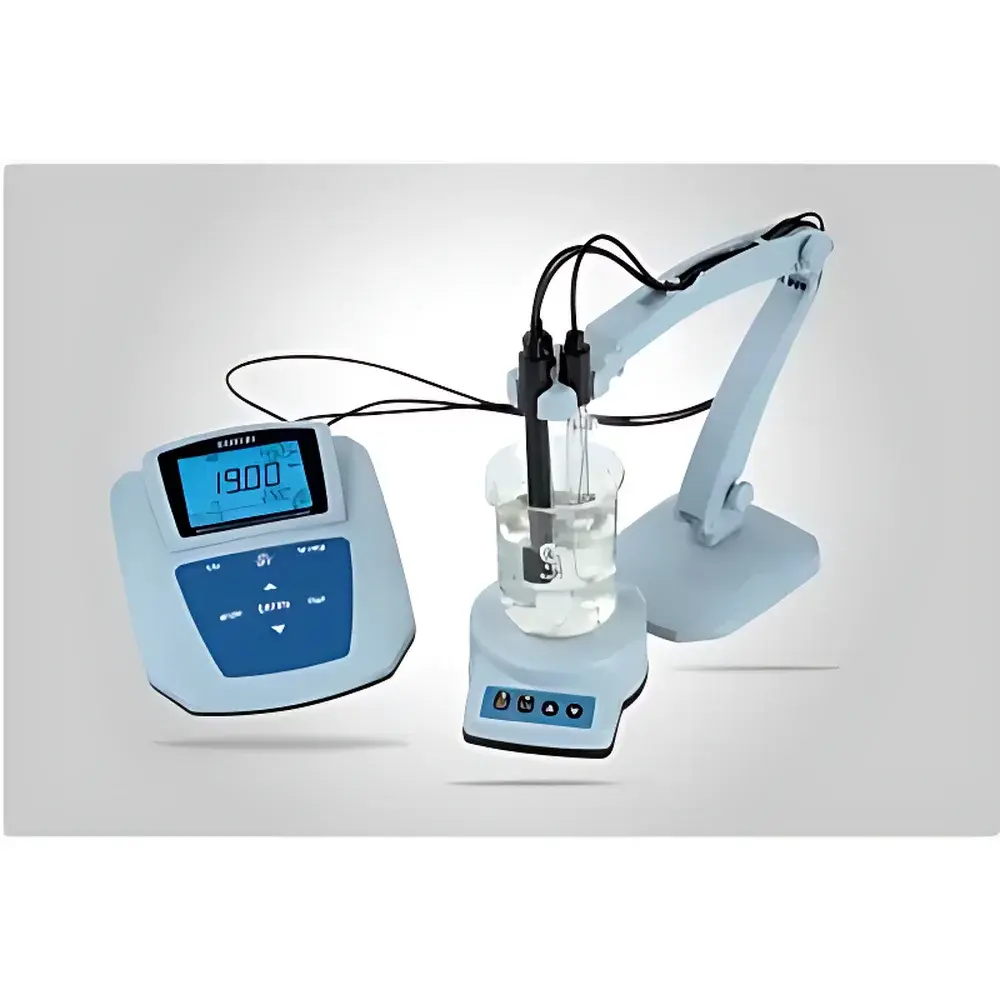
MP523-04 Fluoride Ion Concentration Meter
| Origin | Shanghai, China |
|---|---|
| Manufacturer Type | Authorized Distributor |
| Origin Category | Domestic (China) |
| Model | MP523-04 |
| Price | USD 920 (FOB Shanghai) |
| Instrument Type | Fluoride-Specific Ion Meter |
| pH Range | −2.000–19.999 |
| pH Accuracy | ±0.002 pH |
| Fluoride pF Range (Meter) | 0.00–9.00 pF |
| Fluoride pF Range (with Electrode Pair) | 1.00–7.00 pF |
| Fluoride Accuracy | ±0.01 pF |
| Temperature Compensation | 0–50 °C (for F⁻) |
| mV Range | ±1999.9 mV |
| mV Resolution | 0.1 mV |
| mV Accuracy | ±0.1% FS |
| Temp. Range | −10–110 °C |
| Temp. Accuracy | ±0.5 °C (5–60 °C), ±1.0 °C (elsewhere) |
| Data Storage | 600 sets |
| Interface | RS232 |
| Power | DC 9 V / 300 mA |
| Dimensions & Weight | 160 × 190 × 70 mm / 880 g |
| IP Rating | IP54 |
| GLP Compliance | Yes |
Overview
The MP523-04 Fluoride Ion Concentration Meter is a benchtop potentiometric analyzer engineered for precise, trace-level quantification of fluoride ions (F⁻) in aqueous environmental and industrial samples. It operates on the principle of ion-selective electrode (ISE) potentiometry, utilizing a solid-state lanthanum fluoride (LaF₃) crystal membrane in the F502 fluoride-selective electrode to generate a Nernstian response proportional to the logarithmic activity of free F⁻ ions. Coupled with a double-junction reference electrode (6211-M) and integrated temperature compensation via MP500 thermistor, the system delivers high reproducibility across variable sample matrices—including drinking water, groundwater, wastewater effluents, and industrial process streams. Designed for routine compliance monitoring, the instrument meets core requirements of ISO 10304-1 (determination of anions by ion chromatography—reference method context), ASTM D4192 (standard test method for fluoride in water by ion-selective electrode), and supports GLP-aligned data integrity through timestamped storage, audit-ready calibration logs, and RS232 traceability.
Key Features
- Four selectable concentration units—pF, mol/L, mg/L, and ppm—switchable in real time during measurement or calibration without recalibration.
- Two-point automatic calibration with user-defined standard concentrations; includes 100 mL pF1.00 stock solution for flexible dilution-based standard preparation.
- Integrated 901 Smart Stirrer with fixed-speed control ensures consistent hydrodynamic conditions at the electrode surface, minimizing boundary layer effects and improving signal stability.
- Simultaneous multi-parameter capability: concurrent measurement of F⁻ concentration, pH (via 201T-M tri-combination electrode), redox potential (mV), and temperature—all with independent auto-compensation algorithms.
- GLP-compliant operation: full calibration history logging (date, time, standards used, slope, offset), clock-synchronized data stamps, and diagnostic self-checks at power-on and before each measurement cycle.
- Dust- and splash-resistant enclosure (IP54 rated); all BNC and mini-DIN ports protected by silicone caps to prevent electrolyte ingress and contact corrosion.
Sample Compatibility & Compliance
The MP523-04 is validated for use with low- to medium-ionic-strength aqueous samples. For optimal selectivity and accuracy in complex matrices (e.g., high-Ca²⁺ or Al³⁺ waters), inclusion of total ionic strength adjustment buffer (TISAB)—supplied as part of the standard kit—is mandatory to mask interfering cations and fix activity coefficients. The instrument complies with ISO/IEC 17025 general requirements for competence of testing and calibration laboratories when operated per manufacturer’s SOPs. Its data structure and RS232 output support integration into LIMS environments compliant with FDA 21 CFR Part 11 (electronic records and signatures) when paired with MP519 software and appropriate validation protocols. All electrodes meet ISE performance criteria outlined in IUPAC Technical Report on Ion-Selective Electrodes (2016).
Software & Data Management
The included MP519 PC communication software enables bidirectional data transfer via RS232 interface. Users can export up to 600 stored measurements—including raw mV, calculated pF, pH, temperature, calibration parameters, and timestamps—to CSV or Excel formats. Software features include calibration curve visualization, outlier detection flags, batch report generation, and configurable audit trails. Data files retain embedded metadata (operator ID, location tag, instrument serial number) to satisfy internal QA/QC and external accreditation audits. No cloud dependency: all processing occurs locally, preserving data sovereignty and network security.
Applications
- Regulatory monitoring of fluoride in municipal drinking water per WHO guideline values (1.5 mg/L) and EPA Method 300.0.
- Groundwater assessment in fluorosis-endemic regions (e.g., parts of India, China, East Africa).
- Effluent testing from aluminum smelters, phosphate fertilizer plants, and semiconductor etching facilities.
- Quality control of fluoride-containing dental products (toothpaste, mouth rinses) per ISO 11609.
- Educational laboratory instruction in analytical chemistry, environmental science, and electroanalytical methods.
FAQ
What is the minimum detectable fluoride concentration using the MP523-04?
The practical lower limit is approximately 0.02 mg/L (1.06 × 10⁻⁶ mol/L, ~5.7 pF) under optimized conditions with TISAB and proper electrode conditioning.
Can the instrument measure fluoride in seawater or high-salinity brines?
Not directly—high chloride and sodium activity causes significant interference and non-Nernstian response. Sample dilution plus rigorous TISAB addition may permit semi-quantitative screening, but ion chromatography is recommended for such matrices.
How often must the F502 electrode be reconditioned?
Reconditioning (10-min soak in 1 × 10⁻⁴ mol/L NaF) is advised after every 8–10 measurements in low-fluoride samples or following exposure to protein- or colloidal-rich matrices.
Does the MP523-04 support password-protected method locking for regulated labs?
No—method parameters are user-editable without authentication. For 21 CFR Part 11 compliance, method templates must be managed externally via MP519 software with local OS-level access controls.
Is the RS232 interface optically isolated?
No—it is electrically coupled. Use of an isolated USB-to-RS232 adapter is recommended in electrically noisy industrial environments.







