
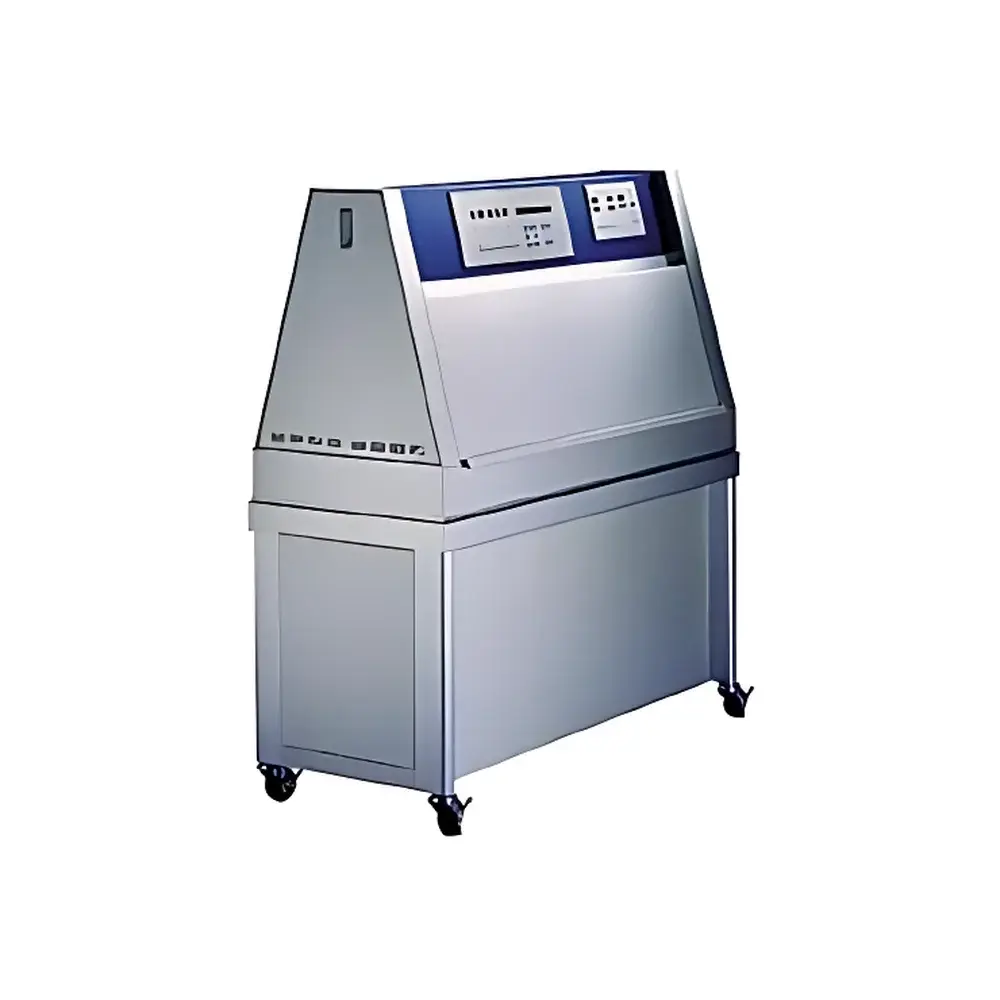
Q-LAB QUV/cw Cold-White Fluorescent UV Weathering Tester
| Brand | Q-LAB |
|---|---|
| Origin | USA |
| Model | QUV/cw |
| UV Wavelength Range | 320–400 nm |
| Light Source Type | Cold-White Fluorescent Lamps |
| Irradiance Control | SOLAR EYE® Visible-Light Monitoring System |
| Condensation Capability | Yes (with controlled humidity cycle) |
| Sample Capacity | Up to 48 specimens (75 mm × 150 mm) |
| Lamp Lifetime | Approx. 5,000 hours |
| Compliance | ASTM G154, ISO 4892-3, IEC 60068-2-5, JIS D 0205, SAE J2020 (where applicable for visible-light exposure protocols) |
Overview
The Q-LAB QUV/cw Cold-White Fluorescent UV Weathering Tester is an engineered environmental test chamber designed specifically for evaluating material performance under indoor lighting conditions—particularly those dominated by cold-white fluorescent illumination. Unlike standard UV-accelerated testers that rely exclusively on UV-emitting lamps (e.g., UVA-340 or UVB-313), the QUV/cw utilizes commercially available cold-white fluorescent tubes to replicate the spectral output typical of office, retail, and residential interior environments. Its core measurement principle is photostability assessment via controlled visible-light irradiation combined with cyclic condensation, enabling quantitative evaluation of color shift, gloss loss, chalking, embrittlement, and surface oxidation in polymers, coatings, textiles, and packaging materials exposed to non-solar, artificial lighting. The system operates on a closed-loop irradiance control architecture using the SOLAR EYE® sensor, which continuously monitors and regulates visible-light intensity (not UV) to ensure repeatability across laboratories and over time.
Key Features
- Cold-white fluorescent lamp array optimized for spectral match to common commercial indoor lighting (CIE 15:2018-compliant emission profile)
- SOLAR EYE® irradiance feedback system calibrated for visible-light (400–500 nm) monitoring and automatic lamp output compensation
- Programmable condensation cycle simulating dew formation through controlled temperature differentials between specimen surface and saturated air
- Microprocessor-based controller with preloaded test protocols compliant with ASTM G154 Cycle 5 and ISO 4892-3 Method A (visible-light mode)
- Self-diagnostic firmware with real-time error logging, maintenance alerts, and automated shutdown upon cycle completion or fault detection
- Robust stainless-steel chamber construction with insulated double-wall design for thermal stability and reduced energy consumption
- Integrated sample tray configuration accommodating up to 48 standard 75 mm × 150 mm specimens without repositioning
- No water spray function—designed explicitly for indoor light stability testing where moisture ingress is not representative of service conditions
Sample Compatibility & Compliance
The QUV/cw supports flat, rigid, or semi-rigid specimens up to 3 mm thickness, including painted metal panels, plastic sheets, laminated composites, printed labels, and synthetic fabrics. It meets the operational requirements of multiple international standards governing indoor lightfastness testing—including ASTM D4303 (pigment lightfastness), ISO 105-B02 (textile color fastness to artificial light), and JIS L 0841 (Japanese textile durability standard). While not intended for outdoor weathering simulation, its condensation capability allows limited evaluation of humidity-assisted photochemical degradation pathways relevant to enclosed environments. All Q-LAB instruments are manufactured under ISO 9001-certified quality management systems and support GLP-compliant data integrity when paired with optional Q-LAB’s VTS software with 21 CFR Part 11 audit trail functionality.
Software & Data Management
The QUV/cw operates via an embedded 32-bit microcontroller with a high-contrast LCD interface supporting multilingual menu navigation (English, Spanish, French, German, Chinese). Test parameters—including irradiance setpoint (W/m² in visible range), condensation duration, cycle count, and ramp profiles—are stored in non-volatile memory. Optional Q-LAB VTS (Validation & Test Software) enables remote monitoring, electronic signature capture, automated report generation (PDF/CSV), and full compliance with FDA 21 CFR Part 11 requirements for regulated industries. Raw irradiance logs, temperature history, and system status events are timestamped and exportable for third-party statistical analysis or internal QA review.
Applications
This instrument is routinely deployed in R&D labs and QC departments across automotive interiors (dashboard trim, seat fabrics), consumer electronics (front-panel overlays, logo decals), pharmaceutical packaging (blister foil laminates), museum conservation (textile and pigment stability studies), and architectural finishes (interior wall coatings). Its ability to decouple visible-light exposure from UV stress makes it uniquely suited for validating claims such as “indoor lightfast for 5 years” or “no yellowing under office lighting.” Users also leverage it for comparative benchmarking of pigment systems, stabilizer packages, and substrate formulations prior to field deployment.
FAQ
Does the QUV/cw simulate sunlight?
No—it is purpose-built for indoor fluorescent lighting simulation and does not reproduce solar UV spectra. For sunlight simulation, Q-LAB recommends QUV/se or QUV/spray models equipped with UVA-340 lamps.
Can the QUV/cw perform water spray cycles?
No. Water spray functionality is exclusive to the QUV/spray model. The QUV/cw lacks plumbing, nozzles, and associated pressure regulation hardware.
Is condensation used during visible-light testing?
Yes, but conditionally: condensation cycles may be enabled to assess synergistic effects of visible light and ambient humidity—though most industry protocols for indoor lightfastness omit condensation per ISO 105-B02 Annex A.
How is irradiance calibrated on the QUV/cw?
Using NIST-traceable calibration services provided by Q-LAB or authorized partners; the SOLAR EYE sensor measures irradiance in the 400–500 nm band and adjusts lamp power to maintain user-defined setpoints within ±5% tolerance.
What lamp type is required for QUV/cw operation?
Cold-white fluorescent T8 or T5 lamps meeting ANSI C78.81 specifications; Q-LAB supplies certified replacement lamps (part number LU-0823) to ensure spectral consistency across service life.



