
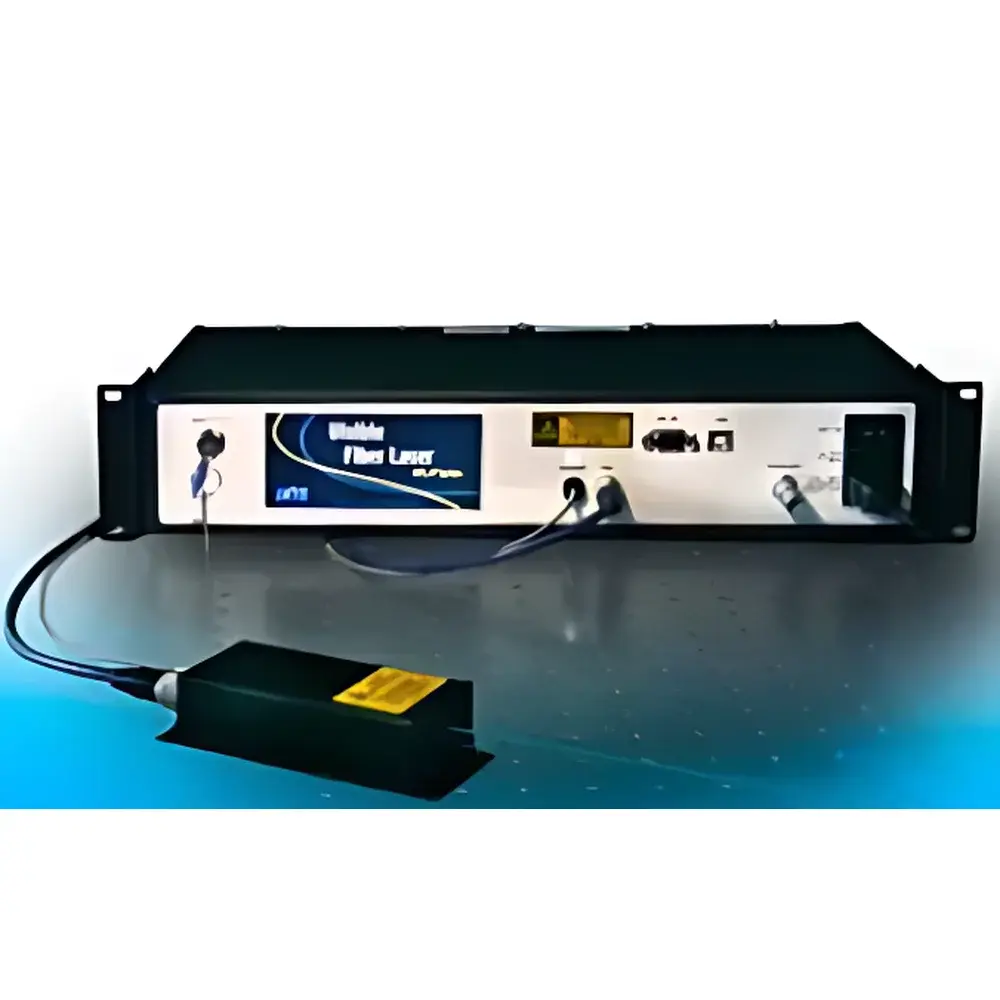
MPB VFL-P-200-589 Continuous-Wave Fiber Laser
| Brand | MPB |
|---|---|
| Origin | Canada |
| Model | VFL-P-200-589 |
| Wavelength | 589 nm |
| Output Power | 200 mW |
| Beam Mode | TEM₀₀ |
| M² | ≤1.1 |
| Polarization | Linear, vertical to baseplate |
| Beam Divergence (full angle) | <5 mrad |
| Power Stability (rms, over 8 h) | ±0.5% |
| Wavelength Stability | ±0.02 nm |
| Cooling | Air-cooled |
| Interfaces | RS232, USB |
| Form Factor | Benchtop or 2RU Rackmount (19", 23", ETSI compatible) |
| Safety | Interlock-enabled (benchtop), Emergency Stop + Integrated Transformer (rackmount) |
Overview
The MPB VFL-P-200-589 is a continuous-wave (CW), single-frequency fiber laser engineered for high-stability scientific and industrial applications requiring precise 589 nm yellow-orange emission. Unlike diode-pumped solid-state (DPSS) alternatives, this laser employs MPB’s proprietary nonlinear frequency conversion architecture—combining high-brightness Yb-doped fiber amplifiers with resonant second-harmonic generation (SHG) in periodically poled lithium niobate (PPLN)—to deliver narrow-linewidth (<100 kHz), diffraction-limited output at 589 nm. Its TEM₀₀ spatial profile (M² ≤1.1), low beam divergence (<5 mrad full angle), and vertical linear polarization are maintained across the full power tuning range (20–100% of rated output). Designed for integration into optical systems where spectral purity, pointing stability, and long-term repeatability are critical—including sodium guide star adaptive optics, resonance Raman spectroscopy, and photodynamic therapy validation—the VFL-P-200-589 meets stringent requirements for laboratory-grade metrology and regulated biomedical instrumentation.
Key Features
- Stable CW output at 589 nm with wavelength accuracy ±0.02 nm (typ.) over 8-hour operation, traceable to NIST-calibrated wavemeters
- Diffraction-limited beam quality (TEM₀₀, M² ≤1.1) enabling efficient coupling into single-mode fibers and high-resolution optical setups
- Dual form-factor design: compact benchtop unit with safety interlock and integrated thermal management, or 2RU rackmount version compliant with 19″, 23″, and ETSI standards—including emergency stop circuitry and built-in AC/DC transformer
- Real-time digital control via RS232 and USB interfaces, supporting remote power modulation, status monitoring, and firmware updates
- Intuitive graphical user interface (GUI) for parameter configuration, diagnostic logging, and compliance reporting—compatible with Windows and Linux environments
- Air-cooled architecture eliminating need for external chillers or water lines, reducing system footprint and operational overhead
Sample Compatibility & Compliance
The VFL-P-200-589 is designed for use with standard optical components rated for visible-wavelength lasers (e.g., fused silica lenses, dielectric mirrors with >99.5% reflectivity at 589 nm, and AR-coated windows). Its Class 4 laser classification per IEC 60825-1:2014 requires implementation of engineering controls including interlocked enclosures, beam path shielding, and operator training per ANSI Z136.1. The device supports GLP/GMP-aligned operation through audit-trail-capable software logs, timestamped power and temperature records, and configurable access levels. While not pre-certified for FDA 21 CFR Part 11, its data export protocols (CSV, XML) and electronic signature-ready GUI facilitate validation in regulated life science and clinical research environments.
Software & Data Management
MPB’s LaserControl Suite provides full instrument orchestration: real-time monitoring of output power, head temperature, pump diode current, and internal humidity; automated calibration routines for power linearity and wavelength drift compensation; and export of time-synchronized datasets for post-acquisition analysis in MATLAB, Python (via PyVISA), or LabVIEW. All operational events—including power toggles, interlock triggers, and thermal warnings—are logged with ISO 8601 timestamps and stored locally on non-volatile memory. Software binaries and documentation comply with ISO/IEC 17025:2017 Annex A.3 for measurement software validation, and support optional integration with LIMS platforms via OPC UA or RESTful API endpoints.
Applications
- Sodium guide star astronomy: Precise excitation of mesospheric sodium layer (D₂ line at 589.158 nm) for wavefront sensing in large-aperture telescopes
- Resonance-enhanced Raman spectroscopy: Selective vibrational mode excitation in biological chromophores (e.g., retinal, bilirubin) and transition-metal complexes
- Ophthalmic diagnostics: Confocal scanning laser ophthalmoscopy (cSLO) and adaptive optics retinal imaging requiring minimal phototoxicity at 589 nm
- Flow cytometry calibration: Reference source for fluorescence compensation and detector linearity verification using yellow-emitting fluorophores (e.g., PE-Cy5.5, BODIPY FL)
- Thin-film metrology: Ellipsometric characterization of transparent conductive oxides and perovskite layers under non-absorbing illumination conditions
- Laser-assisted microfabrication: High-precision ablation of polymer substrates and biodegradable scaffolds with reduced thermal damage relative to 532 nm sources
FAQ
Is the 589 nm output tunable across a range, or fixed at a single wavelength?
The VFL-P-200-589 delivers a fixed-wavelength output centered at 589.000 nm ±0.02 nm (typ.), optimized for atomic sodium D₂-line interaction. It is not wavelength-tunable.
What is the maximum allowable back-reflection into the laser output port?
Back-reflection must be limited to <−30 dB relative to output power to prevent mode instability or pump diode damage; an optical isolator is recommended for free-space coupling configurations.
Does the rackmount version include redundant cooling fans or temperature monitoring?
Yes—the 2RU variant integrates dual-speed DC fans with independent thermal sensors at the amplifier stage and SHG crystal mount, with automatic fan ramping and fault logging via the GUI.
Can the laser be synchronized to external TTL triggers for pulsed operation?
No—this is a strictly CW source. For gated or modulated output, external acousto-optic or electro-optic modulators must be used in the beam path.
Are calibration certificates provided with each unit, and what standards are referenced?
Each unit ships with a factory calibration report traceable to NRC Canada (National Research Council) standards, including measured wavelength (using a High-Finesse WS7 wavemeter), power stability (Thorlabs S142C photodiode + Keithley 2450), and beam profiling (Ophir NanoScan).




