
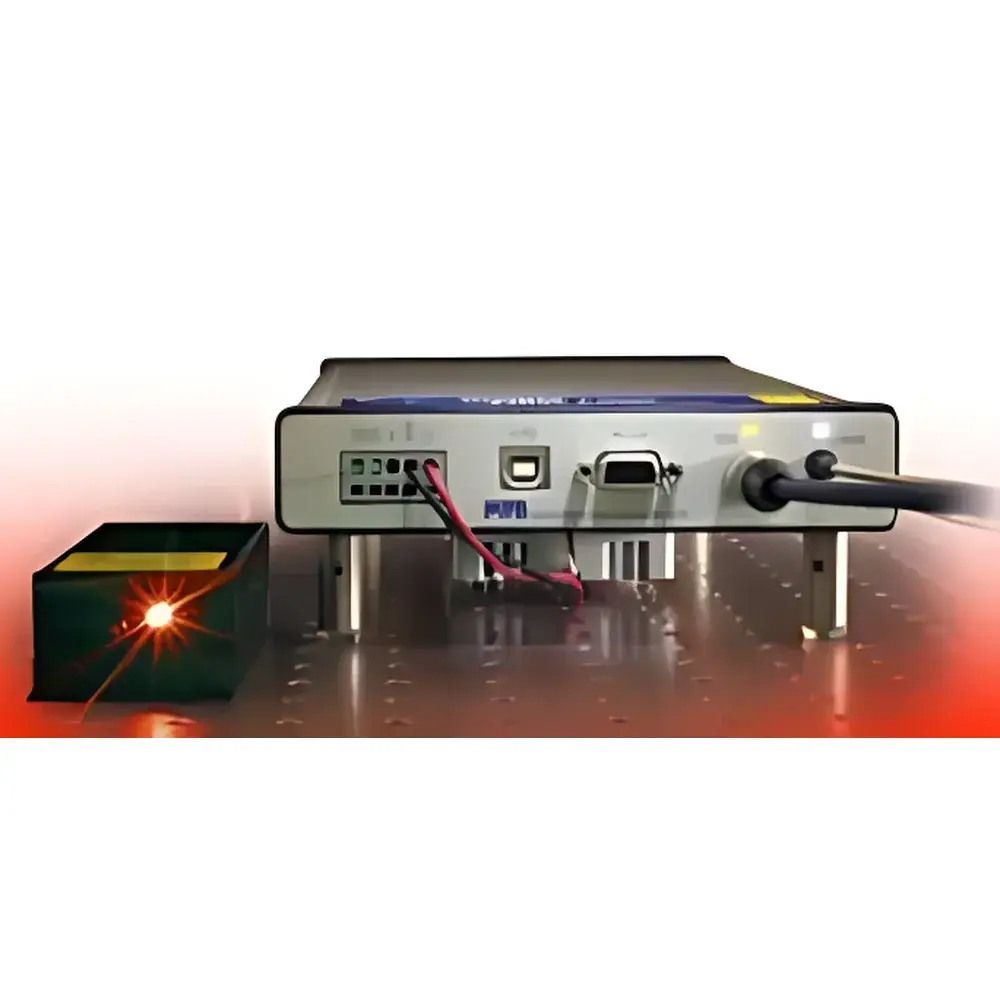
MPB VFL-P Series 620 nm Single-Mode Fiber-Coupled Laser System
| Brand | MPB |
|---|---|
| Origin | Canada |
| Model | VFL-P-200-620, VFL-P-300-620, VFL-P-500-620, VFL-P-1000-620, 2RU-VFL-P-1000-620, 2RU-VFL-P-1500-620 |
| Output Power Options | 200–1500 mW (CW) |
| Wavelength | 620 ± 0.02 nm |
| Beam Quality (M²) | ≤1.1 |
| Polarization | Linear, vertical to baseplate |
| Beam Divergence (Full Angle) | <5 mrad |
| Power Stability (RMS, 8h) | ±0.5% |
| Power Tunability | 20–100% via analog/digital interface |
| Cooling | Air-cooled |
| Interfaces | RS232, USB, Analog Modulation Input (0–5 V) |
| Safety | IEC 60825-1 Class 4 compliant |
Overview
The MPB VFL-P Series is a high-stability, single-mode, continuous-wave (CW) fiber-coupled laser system operating at a precisely controlled wavelength of 620 nm. Engineered for demanding photonic applications requiring narrow spectral bandwidth and exceptional temporal and spatial coherence, this laser leverages MPB Communications’ proprietary visible-wavelength fiber laser technology—based on frequency-doubled ytterbium-doped fiber amplification and optimized nonlinear conversion stages. Unlike conventional diode lasers, the VFL-P platform delivers diffraction-limited TEM00 output with M² ≤ 1.1, enabling efficient coupling into single-mode fibers and high-resolution optical setups. Its fixed 620 nm emission falls within the orange-red region of the visible spectrum—strategically positioned for optimal excitation of key fluorophores (e.g., Texas Red®, mCherry, Cy3.5) while minimizing autofluorescence and phototoxicity in live-cell imaging. The system is designed for integration into ISO/IEC 17025-accredited laboratories and complies with laser safety standards per IEC 60825-1:2014 (Class 4), including mandatory interlock circuits and emission indicators.
Key Features
- Stable CW output across six power variants: 200 mW, 300 mW, 500 mW, 1000 mW (standard and 2RU rack-mount), and 1500 mW (2RU only)
- Ultra-narrow wavelength drift: ±0.02 nm (typ.) over 8 hours under constant ambient conditions
- TEM00 spatial mode with linear polarization oriented vertically relative to the mechanical baseplate—ensuring consistent orientation for polarized optics integration
- Dual-format mechanical design: compact benchtop unit with safety interlock; 2RU (3.5″ height) rack-mount version compliant with 19″, 23″, and ETSI rack standards—including integrated transformer, front-panel emergency stop, and reinforced thermal management
- Multi-interface control architecture: RS232 and USB for host PC communication; 0–5 V analog input for real-time power modulation (bandwidth >10 kHz)
- Intuitive graphical user interface (GUI) supporting remote parameter configuration, power ramping profiles, and diagnostic logging
- Air-cooling architecture with intelligent thermal feedback—no external chiller required, reducing footprint and operational complexity
Sample Compatibility & Compliance
The VFL-P Series is compatible with standard SMF-28 or HI1060 single-mode fibers (FC/APC or FC/PC connectors optional) and integrates seamlessly into OEM optical benches, confocal platforms, and automated cytometry systems. All models meet RoHS 2011/65/EU and REACH (EC 1907/2006) material restrictions. For regulated environments—including clinical diagnostics, pharmaceutical QC, and GLP-compliant research—the laser supports audit-ready operation: firmware logs timestamped power settings, interlock status, and thermal sensor readings. While not inherently 21 CFR Part 11 compliant, the system’s digital interfaces and deterministic behavior enable validation under FDA-aligned quality systems when paired with validated host software and procedural controls.
Software & Data Management
MPB provides the VFL Control Suite—a Windows-based application offering full instrument control, real-time power monitoring, and automated calibration routines. Data export is supported in CSV and HDF5 formats for traceable analysis in MATLAB, Python (NumPy/Pandas), or LabVIEW environments. The embedded microcontroller implements non-volatile storage for up to 10,000 operational events (e.g., power-on cycles, interlock triggers, temperature excursions), facilitating root-cause analysis during equipment qualification (IQ/OQ/PQ). Firmware updates are delivered via signed binary packages with SHA-256 verification to ensure integrity and prevent unauthorized modification.
Applications
- Fluorescence Microspectroscopy: Stable 620 nm excitation enables quantitative ratiometric imaging and lifetime decay measurements in widefield, confocal, and light-sheet modalities
- Flow Cytometry: High-brightness, low-noise output supports multi-parameter detection of tandem dyes and quantum dot conjugates with minimal spillover
- Ophthalmic Instrumentation: Used in adaptive optics retinal imaging systems where precise wavelength definition minimizes chromatic aberration and improves Strehl ratio
- Thin-Film Characterization: Serves as a probe source in ellipsometry and photothermal deflection spectroscopy for sub-monolayer sensitivity on semiconductor and dielectric stacks
- Laser Sintering R&D: Enables selective photopolymerization studies of acrylate- and thiol-ene-based resins with tailored absorption cross-sections at 620 nm
- Bioanalytical Assay Development: Supports time-resolved fluorescence resonance energy transfer (TR-FRET) and singlet oxygen quantum yield determination in photochemical studies
FAQ
Is the 620 nm output tunable across a wavelength range?
No. The VFL-P Series is a fixed-wavelength laser system optimized for 620 nm ±0.02 nm. It does not incorporate grating or temperature-tuning mechanisms for spectral adjustment.
What is the typical warm-up time to achieve specified power and wavelength stability?
Full thermal stabilization occurs within 15 minutes of cold start at 23 °C ambient; specifications assume operation after this period.
Can the laser be modulated at frequencies above 100 kHz?
The analog modulation input supports bandwidths up to 10 kHz. For higher-frequency modulation (e.g., MHz-range), external AOM or EOM integration is required.
Are OEM integration kits available for custom mechanical or electrical interfacing?
Yes—MPB offers configurable mounting brackets, fiber termination options (including polarization-maintaining fiber), and custom firmware builds for embedded controller integration.
Does the 2RU version support redundant power supplies or hot-swap modules?
Standard 2RU units feature a single internal AC/DC converter. Redundant PSU configurations and hot-swap capability are available under MPB’s Custom Integration Program (CIP) upon request.






