
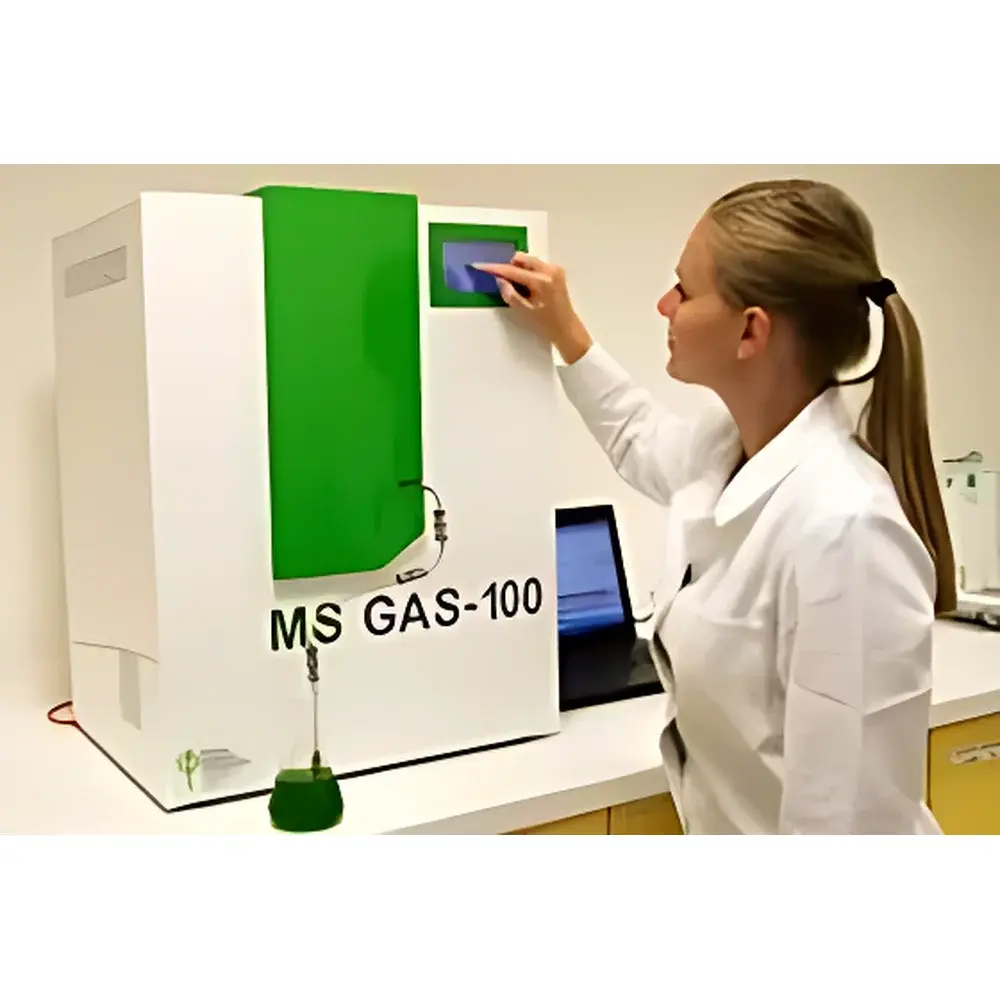
MS GAS-100 Gas Analysis Mass Spectrometer
| Origin | Europe |
|---|---|
| Manufacturer Type | Authorized Distributor |
| Origin Category | Imported |
| Model | MS GAS-100 |
| Pricing | Available Upon Request |
Overview
The MS GAS-100 Gas Analysis Mass Spectrometer is a high-sensitivity, benchtop residual gas analyzer (RGA) engineered for real-time, quantitative analysis of gaseous and volatile compounds—including permanent gases, isotopes, solvents, and volatile organic compounds (VOCs)—in research-grade gas exchange studies. Based on electron ionization (EI) quadrupole mass spectrometry, the system delivers rapid, selective detection across three configurable mass ranges (1–100 amu, 1–200 amu, and 1–300 amu), enabling precise isotopic ratio monitoring (e.g., 18O2, 13C-labeled CO2) and trace-level VOC quantification in complex matrices. Designed for long-term unattended operation in plant physiology, microbial metabolism, biofuel development, and environmental monitoring labs, the MS GAS-100 integrates vacuum integrity management, active background suppression, and dual-mode inlet flexibility to ensure measurement stability, reproducibility, and analytical robustness under variable sample conditions.
Key Features
- Modular electron impact ion source with open or closed configuration and dual yttriated iridium filaments—providing extended operational lifetime and redundancy for continuous 24/7 acquisition.
- Quadrupole mass analyzer optimized for residual gas analysis (RGA), with mass resolution sufficient for baseline separation of adjacent isotopes (e.g., 12CH4 vs. 13CH4, N2+ vs. CO+).
- Dual-detector architecture: Faraday cup (detection limit <10 ppm) for high-dynamic-range quantification and secondary electron multiplier (SEM) (detection limit <100 ppb) for trace-species monitoring.
- Integrated cryogenic water suppression module featuring an electronically controlled Stirling cooler (operating down to –80 °C), enabling sustained reduction of H2O+ background and extending ion source lifetime over multi-week deployments.
- Heated vacuum chamber (up to 90 °C, 100 W embedded heater) for active outgassing control and removal of adsorbed contaminants.
- Two interchangeable inlet options: PDMS-based membrane probe for dissolved gas analysis (aqueous samples, cell suspensions, whole-plant headspace) and precision needle-valve inlet for direct gas-phase sampling.
- Real-time pressure monitoring via dual high-vacuum gauges—protecting the quadrupole from overpressure events during inlet actuation or system transients.
Sample Compatibility & Compliance
The MS GAS-100 supports direct analysis of ambient air, headspace gases, bioreactor off-gas, liquid-phase dissolved volatiles (via membrane interface), and sealed-chamber effluents. It complies with standard laboratory safety protocols for vacuum instrumentation and meets electromagnetic compatibility (EMC) requirements per IEC 61326-1. Its firmware architecture supports audit-trail logging and user-access controls compatible with GLP-compliant workflows. While not certified for clinical or regulated manufacturing environments (e.g., FDA 21 CFR Part 11), its data acquisition framework aligns with ISO/IEC 17025 documentation practices for accredited testing laboratories conducting environmental, physiological, or biochemical gas exchange studies.
Software & Data Management
The system is operated via an integrated 10.1-inch capacitive touchscreen running a Linux-based embedded OS with upgradable firmware (BIOS). All hardware parameters—including heater/cooler setpoints, valve sequencing, detector gain, and scan parameters—are configurable through intuitive graphical menus. The external workstation runs proprietary acquisition software supporting TCP/IP communication over Gigabit Ethernet. Users can define custom measurement sequences (e.g., time-resolved isotopic tracing, multi-point calibration routines), export raw .mzML-compatible spectra, and generate time-series concentration plots with internal standard normalization. Data files include metadata tags for instrument state, calibration history, and operator ID—facilitating traceability in collaborative research settings.
Applications
- Photosynthetic gas exchange in algae and higher plants (O2, CO2, C2H4, ethylene) coupled with FMT150 photobioreactors or FluorCam chlorophyll fluorescence imaging systems.
- Microbial metabolic profiling: H2, CH4, ethanol, and short-chain hydrocarbons in cyanobacterial or yeast cultures.
- Isotopic tracer studies: 15N2 fixation kinetics, 18O2-mediated photorespiration quantification, and 13C-bicarbonate assimilation dynamics.
- Environmental gas monitoring: Real-time detection of SO2, NOx, H2S, CS2, and VOCs (benzene, toluene, acetone) in soil headspace or wastewater aeration tanks.
- Bioprocess optimization: Online monitoring of fermentation off-gas composition to infer metabolic shifts and substrate utilization efficiency.
FAQ
What mass ranges are supported, and how are they selected?
The MS GAS-100 offers three factory-configurable mass ranges: 1–100 amu, 1–200 amu, and 1–300 amu. Selection is performed during initial system setup and requires recalibration; switching between ranges is not runtime-configurable.
Can the system quantify isotopic ratios such as 13C/12C in CO2?
Yes—the quadrupole resolution and dual-detector sensitivity support quantitative isotopic ratio analysis at natural abundance levels when combined with appropriate calibration standards and dwell-time optimization.
Is the membrane inlet compatible with aqueous biological samples?
Yes—the PDMS probe enables non-invasive, continuous sampling of dissolved gases from liquid cultures, suspension media, or rhizosphere solutions without introducing contamination or disturbing physiological conditions.
How does the Stirling cryo-module improve long-term stability?
By maintaining the water trap at –80 °C, it suppresses H2O+ signal interference and prevents ice buildup on the ion source, thereby reducing calibration drift and extending maintenance intervals to >4 weeks under typical operation.
Does the system support remote operation and integration with third-party controllers?
Yes—via TCP/IP Ethernet interface and documented SCPI-like command set, enabling synchronization with environmental chambers, gas mixers, or fluorescence imaging platforms using LabVIEW, Python, or MATLAB scripts.
Related Products






