
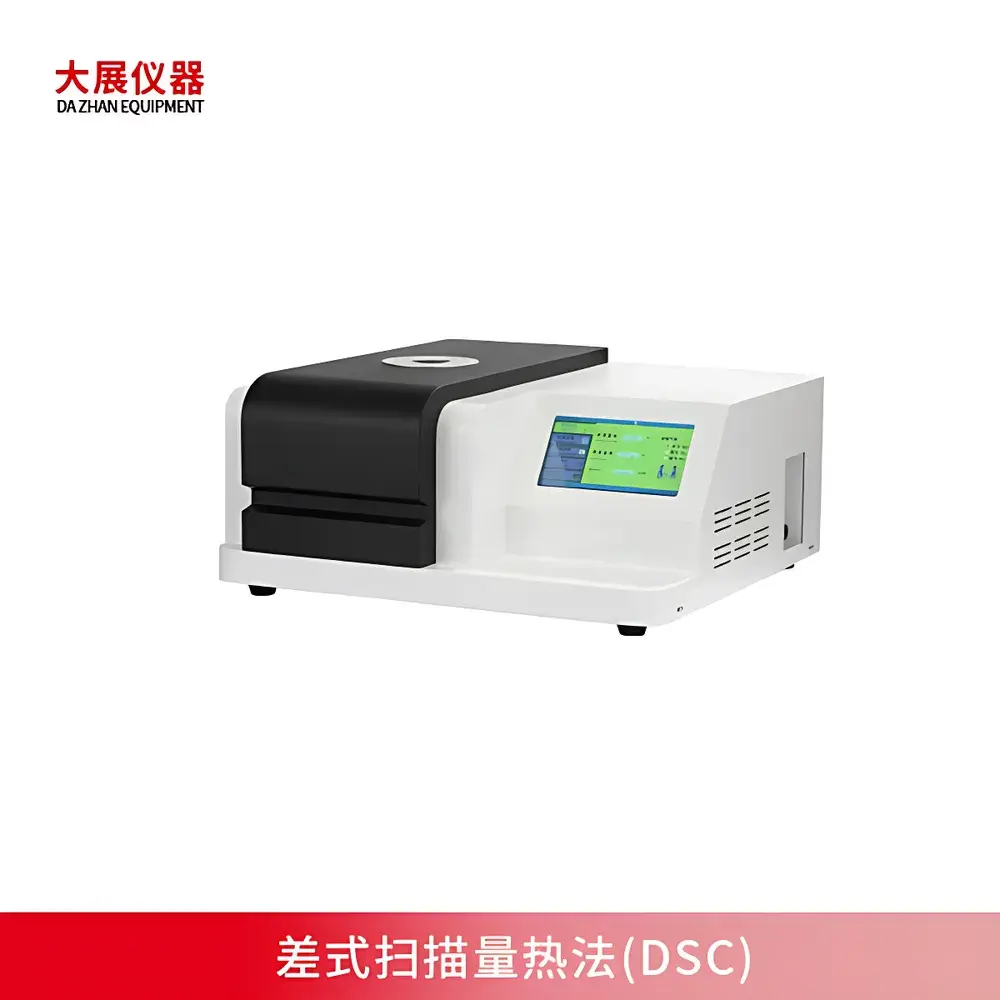
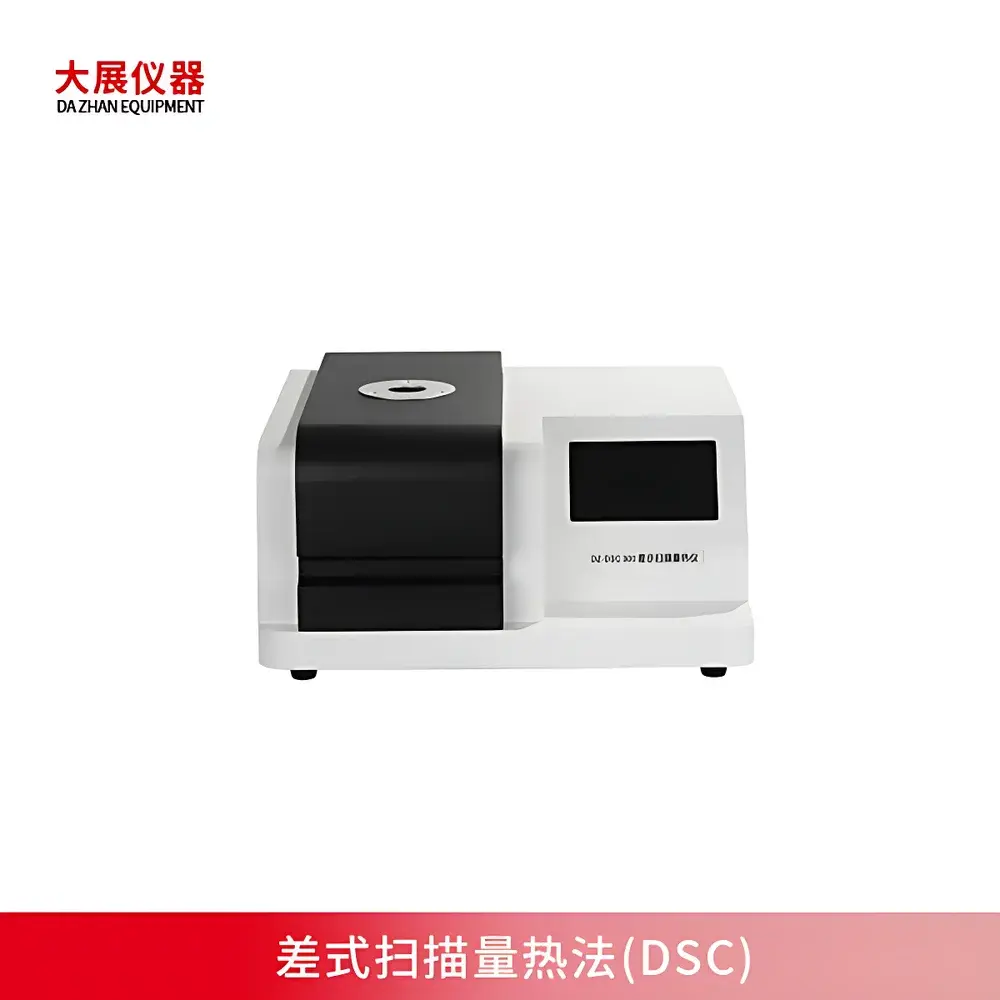
Nanjing Dazhan DZ-DSC300 Differential Scanning Calorimeter
| Brand | Nanjing Dazhan |
|---|---|
| Origin | Jiangsu, China |
| Manufacturer Type | Manufacturer |
| Country of Origin | China |
| Model | DZ-DSC300 |
| Sample Capacity | Single |
| Instrument Type | Differential Scanning Calorimeter (DSC) |
| Temperature Range | Ambient to 600 °C |
| Heating/Cooling Rate | 0.1–100 K/min |
| Temperature Accuracy | ±0.001 °C |
| Temperature Stability | ±0.01 °C |
| DSC Signal Range | 0 to ±600 mW |
| DSC Resolution | 0.01 µW |
| DSC Sensitivity | 0.001 mW |
| Atmosphere Control | Dual-gas automatic switching (N₂, air, or optional inert/oxidizing gases) |
| Gas Flow Rate | 0–300 mL/min (customizable) |
| Gas Pressure Rating | ≤5 MPa |
| Display | 7-inch 24-bit color LCD touchscreen |
| Data Interface | Standard USB |
| Calibration Standards Included | Indium, Tin, Lead |
| Power Supply | AC 220 V / 50 Hz (custom voltage available) |
Overview
The Nanjing Dazhan DZ-DSC300 Differential Scanning Calorimeter is a precision thermal analysis instrument engineered for quantitative measurement of heat flow differences between a sample and an inert reference as a function of temperature or time. Operating on the principle of heat-flux DSC, the system employs a symmetrical, embedded furnace architecture with triple-layer thermal shielding to minimize thermal lag and maximize baseline stability. This design enables high-fidelity detection of endothermic and exothermic transitions—including glass transitions (Tg), melting (Tm), crystallization (Tc), oxidative induction time (OIT), and polymer curing kinetics—across a broad operational range from ambient to 600 °C. The instrument supports both dynamic (ramped) and isothermal protocols under programmable gas atmospheres, making it suitable for routine quality control and advanced materials research in regulated environments.
Key Features
- Embedded dual-zone furnace with triple-lid thermal insulation, delivering superior temperature homogeneity and reduced thermal drift (±0.01 °C stability).
- High-resolution heat-flux sensor fabricated using thermal fusion bonding—eliminating micro-weld inconsistencies and improving signal-to-noise ratio and long-term sensitivity (0.001 mW).
- Full-range programmable temperature control: six-segment heating/cooling/holding profiles with ramp rates from 0.1 to 100 K/min and user-defined isothermal dwell times.
- Dual-mode operation: local control via 7-inch capacitive touchscreen interface or remote operation via PC-based software with real-time data streaming and parameter synchronization.
- Integrated dual-gas manifold with automated switching logic; compatible with N₂, synthetic air, O₂, Ar, or custom gas blends (0–300 mL/min, pressure-rated to 5 MPa).
- 24-bit analog-to-digital conversion with EMI-shielded acquisition circuitry, ensuring robust performance in electromagnetically noisy laboratory settings.
- Comprehensive calibration suite: certified reference materials (Indium, Tin, Lead) included; multi-point temperature calibration and DSC sensitivity verification supported in software.
Sample Compatibility & Compliance
The DZ-DSC300 accommodates standard aluminum, gold-plated aluminum, or hermetic stainless-steel crucibles (60–100 µL capacity), supporting solid powders, films, fibers, gels, and small-volume liquids (≤20 mg typical). Its modular crucible holder allows rapid exchange without tooling. The system meets essential requirements for ISO 11357 (Plastics — Differential Scanning Calorimetry), ASTM E794 (Melting and Crystallization Temperatures), and ASTM D3418 (Transition Temperatures of Polymers). While not pre-certified for FDA 21 CFR Part 11, its audit-trail-capable software architecture—supporting user access levels, electronic signatures, and immutable raw-data archiving—enables validation per GxP (GLP/GMP) standards when deployed with documented SOPs and IQ/OQ/PQ protocols.
Software & Data Management
The proprietary DZ-Analysis Suite provides intuitive workflow navigation, real-time thermogram overlay, baseline subtraction (tangent, step, or polynomial), peak integration (onset, peak max, enthalpy), and comparative analysis across batches. All raw data are stored in vendor-neutral ASCII format (.csv) alongside metadata (instrument ID, operator, date/time stamp, calibration history, gas flow logs). Software includes built-in compliance features: configurable user roles, password-protected method editing, change-tracking logs, and exportable PDF reports with embedded digital signatures. Data integrity is reinforced via checksum validation and optional network backup to NAS or LIMS-integrated storage.
Applications
- Thermal characterization of pharmaceutical excipients and active ingredients: polymorph screening, hydrate/dehydrate behavior, amorphous content quantification, and compatibility studies.
- Polymer science: determination of degree of crystallinity (via ΔHf normalization), crosslink density estimation, degradation onset temperature (Td), and oxidative stability (OIT/OOT) under controlled atmospheres.
- Materials development: phase diagram mapping of metal alloys and composites, reaction enthalpy of curing systems (epoxies, polyurethanes), and low-molecular-weight organic purity assessment (van’t Hoff method).
- Food science: fat crystallization kinetics, starch gelatinization profiling, and shelf-life prediction via accelerated oxidation modeling.
- Academic and industrial R&D: validation of thermal models, benchmarking against reference instruments, and method transfer across laboratories.
FAQ
What calibration standards are supplied with the DZ-DSC300?
Indium (Tm = 156.60 °C), Tin (Tm = 231.93 °C), and Lead (Tm = 327.46 °C) are provided as primary temperature standards; enthalpy calibration is performed using certified Indium (ΔHf = 28.45 J/g).
Can the instrument operate under vacuum or high-purity inert gas?
Yes—the dual-gas manifold supports fully automated switching between two independent gas lines; optional vacuum-compatible crucibles and sealing kits are available for sub-atmospheric applications.
Is the software compliant with 21 CFR Part 11?
The base software supports ALCOA+ principles (Attributable, Legible, Contemporaneous, Original, Accurate); full Part 11 compliance requires site-specific validation, including electronic signature configuration and audit trail review procedures.
What is the minimum detectable heat flow change?
The system achieves a DSC resolution of 0.01 µW and a sensitivity limit of 0.001 mW under optimal conditions (stable ambient, calibrated sensor, low-noise crucible loading).
How is temperature accuracy verified during routine use?
Multi-point temperature calibration is performed using the included standards at ≥3 points across the operating range; software auto-corrects deviations using piecewise linear interpolation, traceable to NIST-traceable reference materials.



