
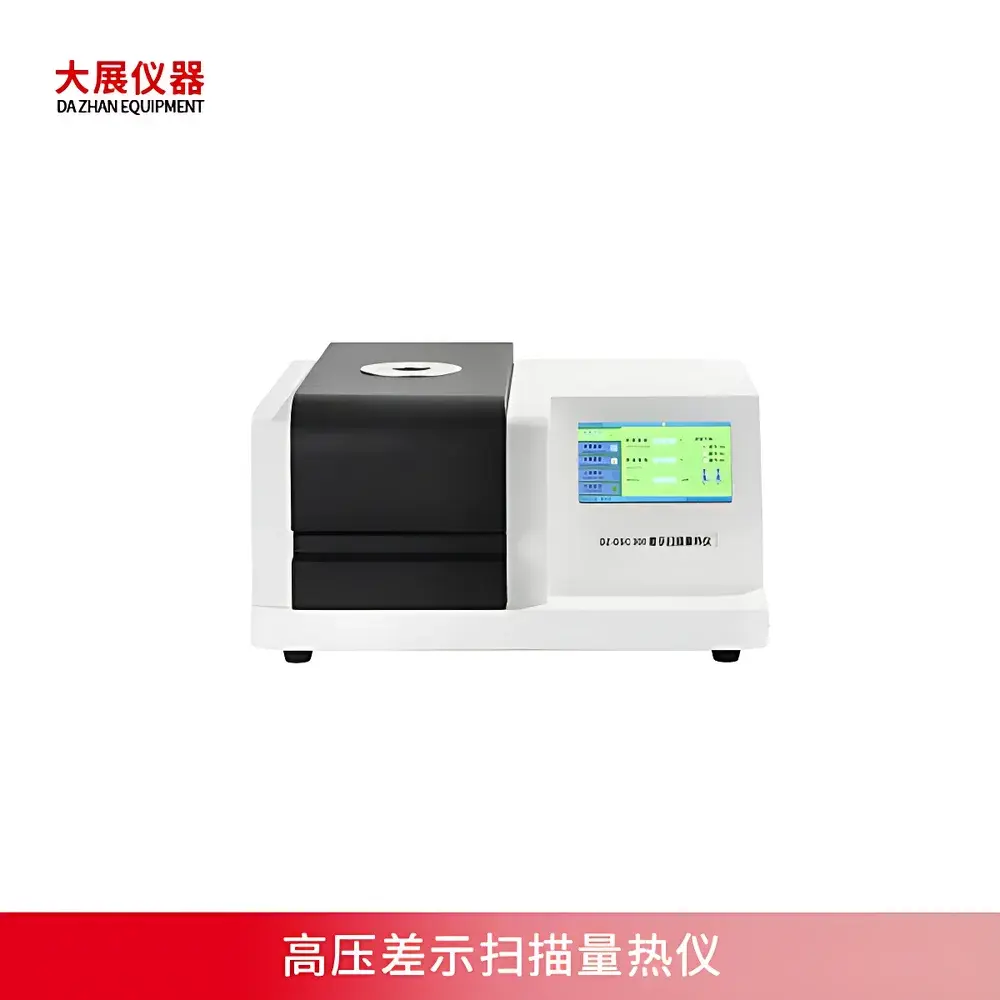
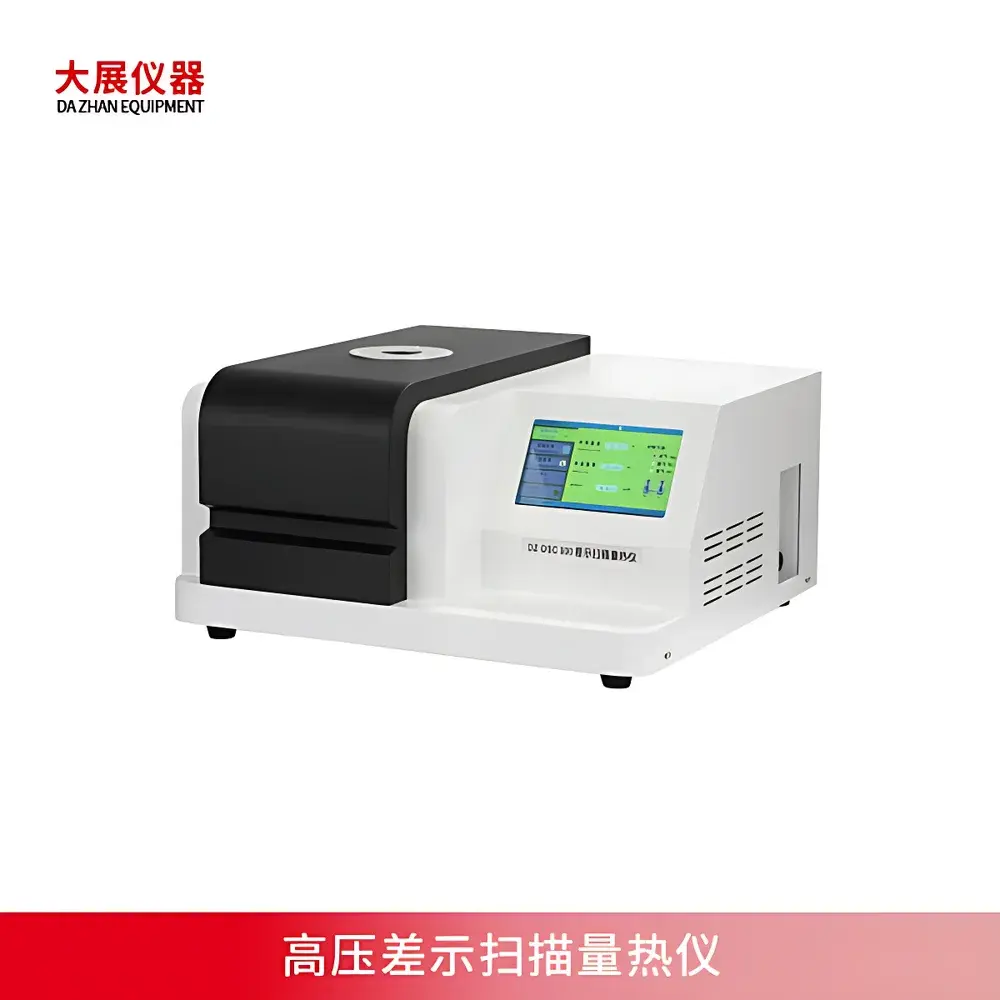
Nanjing Dazhan DZ-DSC300 High-Pressure Differential Scanning Calorimeter
| Brand | Nanjing Dazhan |
|---|---|
| Origin | Jiangsu, China |
| Manufacturer Type | Direct Manufacturer |
| Country of Origin | China |
| Model | DZ-DSC300 |
| Sample Capacity | Single |
| Instrument Type | DSC |
| Temperature Range | Ambient to 600 °C |
| Heating/Cooling Rate | 0.1–100 K/min |
| Temperature Accuracy | ±0.001 °C |
| Temperature Stability | ±0.01 °C |
| DSC Signal Range | 0 to ±600 mW |
| DSC Resolution | 0.01 µW |
| DSC Sensitivity | 0.001 mW |
| Atmosphere Control | Dual-gas automatic switching (programmable) |
| Gas Flow Rate | 0–300 mL/min (customizable) |
| Maximum Gas Pressure | ≤5 MPa |
| Display | 7-inch 24-bit color LCD touchscreen |
| Data Interface | Standard USB |
| Calibration Standards Included | Indium, Tin, Lead |
| Software Features | Multi-point temperature calibration, six-segment programmable thermal protocol |
Overview
The Nanjing Dazhan DZ-DSC300 High-Pressure Differential Scanning Calorimeter is a precision thermal analysis instrument engineered for quantitative measurement of heat flow differences between a sample and an inert reference as a function of temperature or time under controlled pressure and atmosphere conditions. Based on the heat-flux DSC principle, it employs a high-stability, integrated furnace architecture with advanced thermal shielding to minimize environmental perturbations and ensure exceptional baseline reproducibility. Designed for rigorous laboratory environments—including polymer R&D, pharmaceutical stability studies, energetic materials characterization, and metallurgical phase analysis—the DZ-DSC300 supports high-pressure gas atmospheres (up to 5 MPa) via dual-channel automated gas switching, enabling oxidation induction time (OIT), decomposition kinetics, and pressure-dependent transition studies in compliance with ASTM E794, ISO 11357, and USP <1151> thermal analysis guidelines.
Key Features
- Integrated high-efficiency furnace with optimized thermal mass and low-thermal-loss insulation, delivering superior baseline flatness and long-term drift stability (±0.01 °C temperature fluctuation over 24 h).
- High-resolution heat-flux sensor fabricated using thermal fusion bonding—replacing conventional spot-welded thermopile junctions—to achieve enhanced signal-to-noise ratio and DSC sensitivity of 0.001 mW.
- Programmable six-segment thermal protocol engine supporting independent ramp, hold, and cool steps with user-defined rates (0.1–100 K/min) and dwell durations, fully compliant with GLP audit requirements for traceable method storage and execution.
- Dual-gas manifold with electro-pneumatic valves enables seamless, software-triggered switching between inert (e.g., N₂, Ar) and reactive (e.g., O₂, air) atmospheres during a single run—critical for accelerated aging, oxidative stability, and combustion onset analysis.
- 7-inch 24-bit color capacitive touchscreen interface with intuitive icon-driven navigation; supports both local operation and synchronized remote control via USB-connected PC software with real-time data mirroring.
- Shielded analog acquisition circuitry with differential input stage and 24-bit ADC ensures electromagnetic interference (EMI) resilience in shared lab environments, meeting IEC 61326-1 emission and immunity standards.
Sample Compatibility & Compliance
The DZ-DSC300 accommodates standard 40–50 µL hermetic aluminum, gold-plated, or stainless-steel crucibles (including high-pressure variants rated to 10 MPa), permitting sealed or vented analysis of solids, powders, gels, and small-volume liquids. It complies with essential regulatory frameworks for quality-controlled thermal testing: temperature calibration traceability is supported through supplied certified reference materials (Indium, Tin, Lead), and software implements multi-point correction per ASTM E967 and ISO/IEC 17025 metrological requirements. The system’s firmware and data handling architecture support 21 CFR Part 11-compliant electronic records when used with validated software configurations—including user access controls, audit trails, and electronic signatures—making it suitable for GMP and pharmaceutical QC laboratories.
Software & Data Management
Bundled Windows-based analysis software provides full instrument control, real-time curve visualization, peak integration (onset, peak, endset), baseline subtraction, and kinetic modeling (e.g., Ozawa-Flynn-Wall, Kissinger). Raw data are stored in vendor-neutral ASCII format with embedded metadata (timestamp, operator ID, method name, gas configuration, calibration history). All thermal events are timestamped with microsecond resolution, and the software enforces version-controlled method templates with password-protected editing rights. Audit trail logs capture every parameter change, file export action, and calibration event—retained for ≥36 months by default—ensuring full data integrity for internal audits and regulatory inspections.
Applications
- Determination of glass transition temperature (Tg), cold crystallization, melting enthalpy (ΔHf), and recrystallization behavior in thermoplastics and biopolymers.
- Oxidative induction time (OIT) and oxidative onset temperature (OOT) assessment per ASTM D3895 and ISO 11357-6 for stabilizer efficacy evaluation in polyolefins and elastomers.
- Cure kinetics and degree of crosslinking quantification in epoxy, silicone, and UV-curable resins under nitrogen or air.
- Thermal stability screening of battery cathode/anode materials, propellants, and pyrotechnic formulations under elevated pressure (≤5 MPa) and controlled oxygen partial pressure.
- Polymorphic transition analysis in active pharmaceutical ingredients (APIs) and excipients, including hydrate/dehydrate events and amorphous content estimation.
FAQ
What pressure range does the DZ-DSC300 support for high-pressure experiments?
The instrument is configured for gas pressures up to 5 MPa using certified high-pressure crucibles and a reinforced gas delivery module. Custom pressure-rated furnace inserts and sealing kits are available upon request.
Is the system compatible with FDA 21 CFR Part 11 requirements?
Yes—when deployed with validated software settings, role-based user accounts, electronic signatures, and enabled audit trail logging, the DZ-DSC300 meets core technical controls outlined in 21 CFR Part 11 for electronic records and signatures.
Can the DSC sensitivity be verified independently by the user?
Yes—built-in multi-point temperature calibration routines allow users to validate sensor response using supplied In, Sn, and Pb standards; sensitivity verification is performed via standardized heat capacity step calibration using sapphire.
Does the instrument support purge gas flow rate programming during a run?
Yes—gas flow is dynamically adjustable across all program segments via software, with linear ramping or step changes between 0–300 mL/min, and optional extended-range modules support up to 1000 mL/min.
What maintenance is required for long-term baseline stability?
Routine maintenance includes quarterly furnace cavity inspection, annual thermocouple calibration verification, and biannual cleaning of gas inlet filters; no consumable sensors require replacement under normal operating conditions.



