
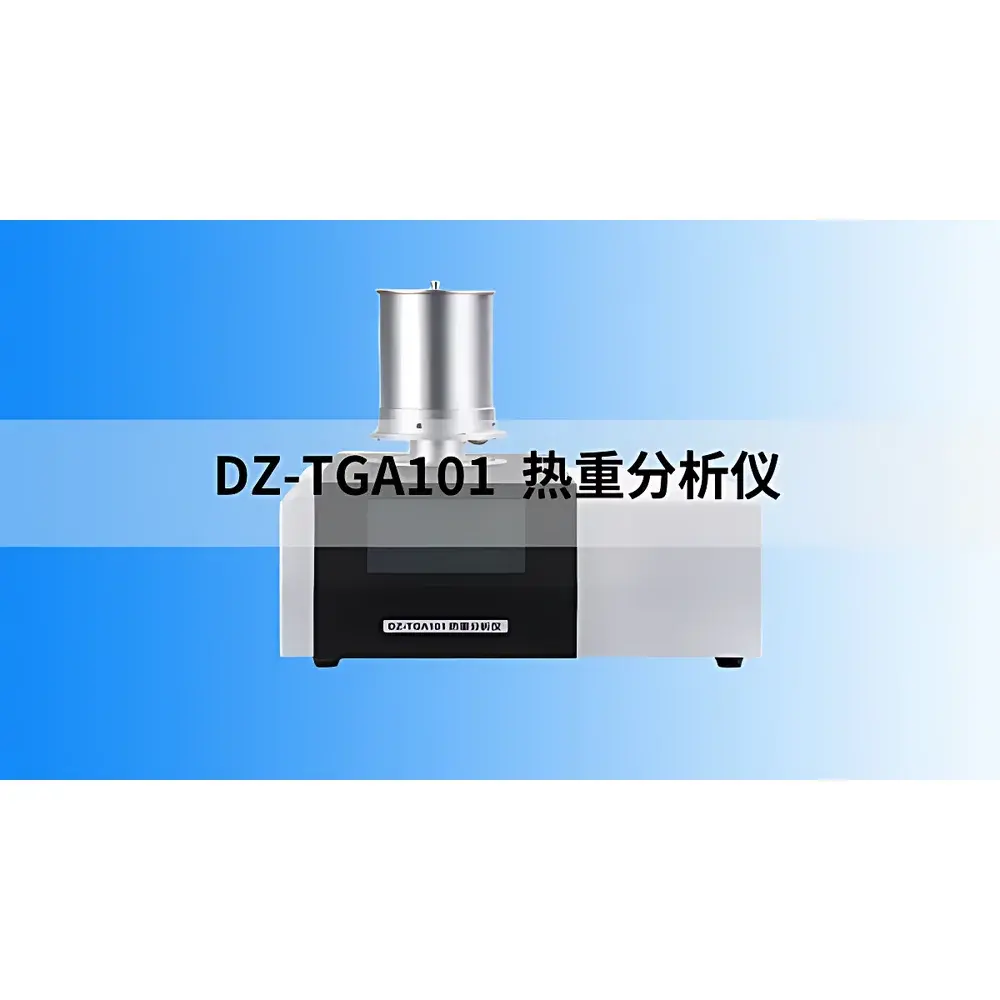
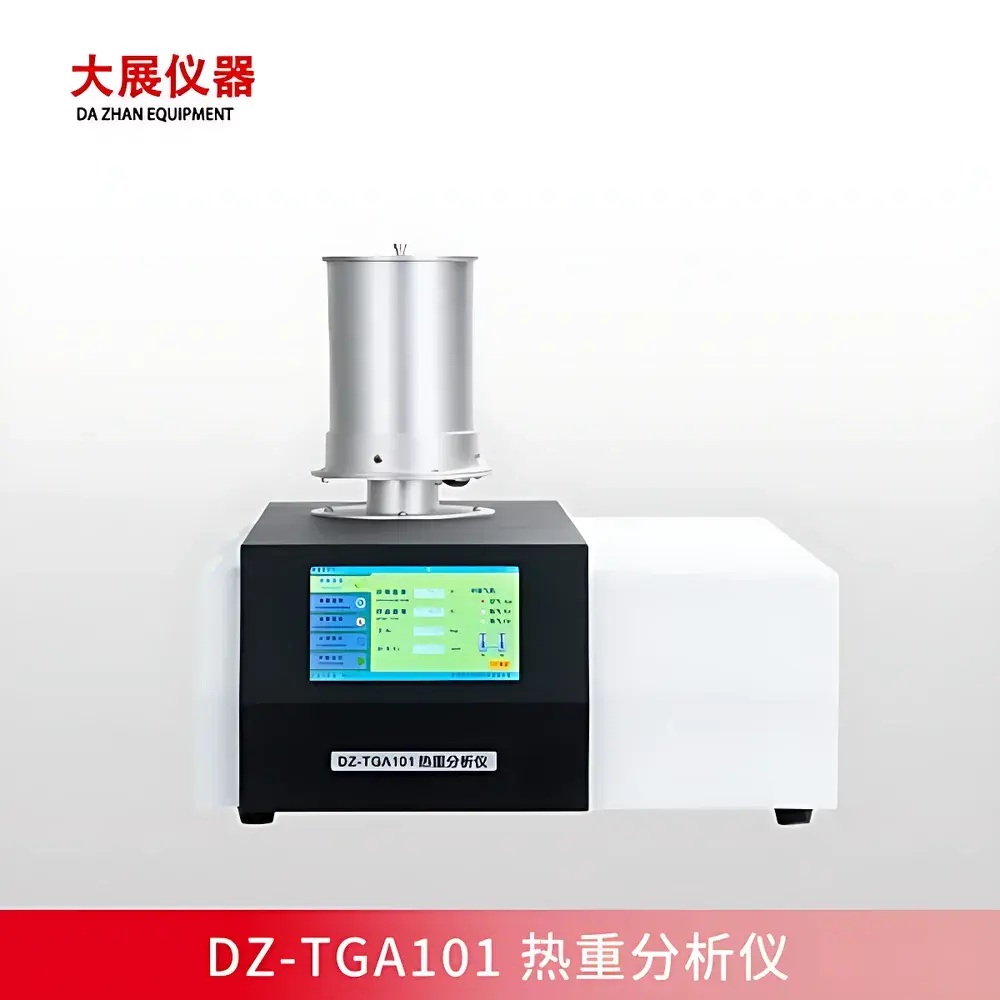
Nanjing Dazhan DZ-TGA101 Thermogravimetric Analyzer
| Brand | Nanjing Dazhan |
|---|---|
| Origin | Jiangsu, China |
| Manufacturer Type | Direct Manufacturer |
| Origin Category | Domestic (China) |
| Model | DZ-TGA101 |
| Operating Environment | Ambient Pressure |
| Sample Capacity | Single Sample |
| Instrument Type | General-Purpose |
| Temperature Range | Room Temperature to 1200 °C |
| Temperature Resolution | 0.01 °C |
| Temperature Stability | ±0.1 °C |
| Heating/Cooling Rate | 0.1–100 °C/min |
| Dynamic Weighing Range | 0.01 mg to 2 g (extendable to 30 g) |
| Mass Accuracy | 0.01 mg |
| Mass Resolution | 0.1 µg |
| Isothermal Hold Time | 0–500 min (expandable to 72 h) |
| Cooling Time | ≤15 min (from 1000 °C to 100 °C) |
| Atmosphere Control | Dual-gas inlet with integrated mass flow meters |
| Display | 7-inch Chinese-language LCD touchscreen |
| Data Interface | Standard USB port |
| Software | Proprietary TGA analysis suite with multi-point temperature calibration, TG/DTG curve processing, Excel export, PDF report generation, and audit-ready experimental logging |
| Power Supply | AC 220 V, 50 Hz (customizable) |
Overview
The Nanjing Dazhan DZ-TGA101 Thermogravimetric Analyzer is a precision laboratory instrument engineered for quantitative measurement of mass change in solid or liquid samples as a function of temperature or time under controlled atmospheric conditions. Based on the fundamental principle of thermogravimetry—where sample mass is continuously monitored during programmed thermal cycles—the DZ-TGA101 enables rigorous assessment of thermal stability, decomposition kinetics, oxidative behavior, moisture loss, volatilization, filler content, and compositional evolution. Its operational envelope spans from ambient temperature up to 1200 °C, supporting both dynamic heating/cooling protocols and extended isothermal holds—critical for evaluating long-term material degradation, catalyst deactivation, or polymer crosslinking. The system employs a high-stability microbalance with 0.01 mg accuracy and 0.1 µg resolution, coupled with a dual-zone furnace architecture that isolates thermal gradients from the weighing mechanism via water-jacketed thermal shielding and physically separated power/cooling modules.
Key Features
- High-temperature furnace with dual-row wound nickel-chromium alloy heating elements, ensuring uniform thermal distribution and extended service life beyond 1100 °C.
- Custom-fabricated platinum–rhodium alloy sample holder and sensor assembly, optimized for oxidation resistance, mechanical rigidity, and minimal thermal drift at elevated temperatures.
- Top-opening furnace design with vertical lift mechanism—eliminating lateral stress on the sample rod during loading and reducing risk of mechanical damage during routine operation.
- Water-cooled thermal barrier between furnace chamber and main chassis, actively suppressing conductive and radiative heat transfer to the microbalance housing.
- Dual independent gas lines with integrated digital mass flow controllers (MFCs), enabling seamless switching between inert (N₂, Ar), oxidative (air, O₂), or reductive (H₂, CO) atmospheres, with programmable flow rates from 0 to 200 mL/min.
- 7-inch capacitive touchscreen interface with native Chinese UI, supporting real-time TG/DTG visualization, parameter setup, and local data storage—complemented by full-featured PC software for advanced curve fitting and compliance reporting.
Sample Compatibility & Compliance
The DZ-TGA101 accommodates standard ceramic, alumina, and aluminum crucibles (including hermetic variants), supporting sample masses from 0.5 mg to 2 g—scalable to 30 g with optional high-capacity configurations. It complies with core methodology standards including ASTM E1131 (standard test method for compositional analysis by thermogravimetry), ISO 11358 (plastics—thermogravimetry of polymers), and USP (residual solvents). The instrument’s hardware architecture and embedded firmware support GLP/GMP-aligned workflows: all thermal and mass data are timestamped, user-authenticated, and stored with immutable metadata. Optional software modules provide 21 CFR Part 11–compliant electronic signatures, audit trails, and role-based access control for regulated environments.
Software & Data Management
The proprietary TGA Analysis Suite delivers comprehensive post-run processing—including derivative thermogravimetry (DTG), peak deconvolution, onset/midpoint/endset temperature identification, mass-loss step quantification, and kinetic modeling (e.g., Flynn–Wall–Ozawa, Kissinger). Raw data exports directly to .csv and .xlsx formats; graphical reports are generated in publication-ready PDF with customizable annotations, scale markers, and multi-curve overlays. All experiments are archived with full environmental logs (temperature setpoint, actual furnace temp, balance output, gas flow rates, timestamps). Firmware and application updates are delivered free-of-charge via secure HTTPS download, with version-controlled changelogs and backward-compatible data file handling.
Applications
The DZ-TGA101 serves as a foundational tool across R&D, quality assurance, and failure analysis laboratories. In polymer science, it characterizes thermal degradation thresholds, char yield, and plasticizer volatility. For pharmaceuticals, it verifies excipient compatibility, residual solvent content, and hydrate/dehydrate transitions per ICH Q1A–Q1E guidelines. In catalysis, it quantifies active-phase loading, coke deposition, and reducibility profiles. Ceramics and metallurgical labs use it to determine sintering onset, oxide formation, and stoichiometric deviations in mixed-metal oxides. Additionally, it supports ASTM D3850 (decomposition temperature of plastics), ISO 14890 (optical fiber coatings), and EN 13438 (fire-retardant additive efficiency testing).
FAQ
What is the maximum operating temperature and certified accuracy at 1000 °C?
The DZ-TGA101 is rated for continuous operation up to 1200 °C. At 1000 °C, temperature accuracy is maintained within ±0.3 °C (calibrated per ISO/IEC 17025 traceable procedures), with short-term stability better than ±0.1 °C over 30 minutes.
Can the system perform simultaneous TGA-DTA or TGA-DSC measurements?
No—the DZ-TGA101 is a dedicated thermogravimetric platform. However, its modular design allows integration with external differential thermal analyzers via synchronized trigger signals and shared atmosphere control.
Is the software validated for use in FDA-regulated laboratories?
The base software meets functional requirements for GxP environments. Full 21 CFR Part 11 validation packages—including IQ/OQ/PQ protocols, configuration management records, and security assessments—are available upon request and installation oversight by certified validation engineers.
How is baseline drift corrected during long-duration isothermal experiments?
The instrument implements automatic buoyancy compensation using pre-measured gas density curves and real-time ambient pressure input. Additionally, software-supported multi-point baseline correction allows manual or algorithmic subtraction of instrumental drift across extended holds (up to 72 hours).
What maintenance intervals are recommended for optimal performance?
Furnace insulation inspection and thermocouple verification are advised every 500 operational hours; microbalance recalibration is required quarterly or after any mechanical shock event. Gas line filters should be replaced every 6 months under continuous use.



