
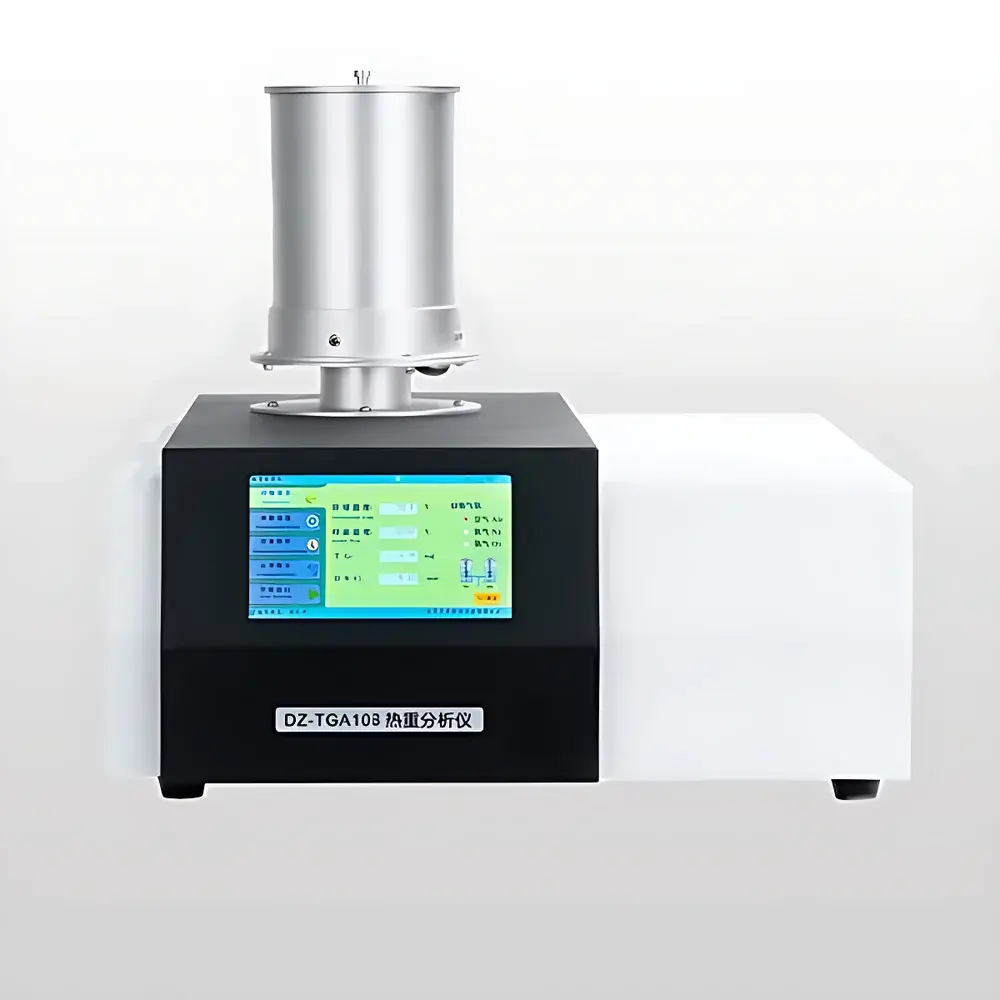
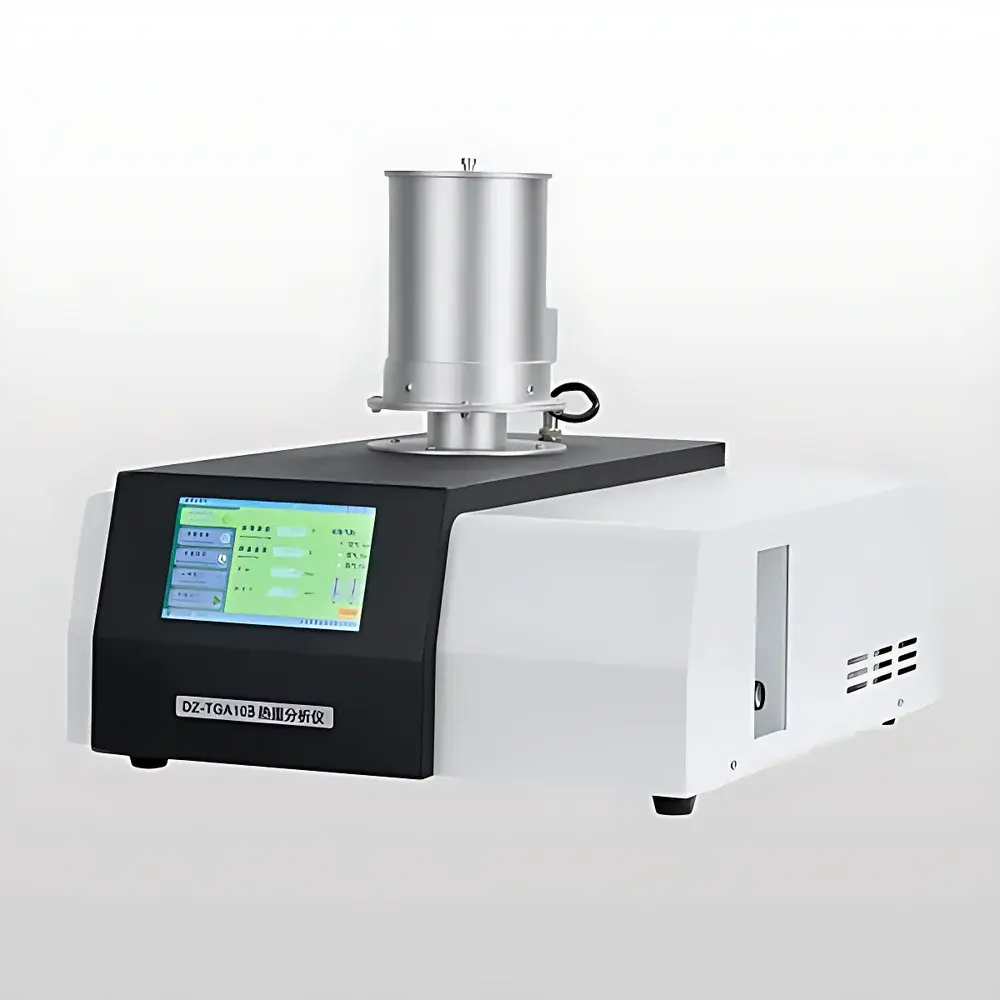
Nanjing Dazhan DZ-TGA103 Thermogravimetric Analyzer
| Brand | Nanjing Dazhan |
|---|---|
| Origin | Jiangsu, China |
| Manufacturer Type | Direct Manufacturer |
| Product Category | Domestic |
| Model | TGA-103 |
| Price Range | USD 12,500–16,800 (FOB) |
| Operating Environment | High-Temperature |
| Sample Capacity | Single Sample |
| Instrument Type | General-Purpose |
| Temperature Range | Ambient to 1350 °C |
| Temperature Accuracy | ±0.01 K |
| Balance Sensitivity | 0.01 mg |
| Heating/Cooling Rate | 0.1–100 °C/min |
| Maximum Sample Mass | 30 g |
Overview
The Nanjing Dazhan DZ-TGA103 Thermogravimetric Analyzer is a precision-controlled, general-purpose thermal analysis instrument engineered for high-reproducibility mass-change measurement under controlled temperature programs and defined atmospheric conditions. Based on the fundamental principle of thermogravimetry (TGA), it continuously monitors sample mass as a function of temperature or time during heating, cooling, or isothermal holds. This enables quantitative characterization of thermal stability, decomposition kinetics, oxidative/reductive behavior, moisture/volatile loss, filler content, and compositional evolution in solid and powdered materials. Designed for routine QC laboratories and R&D environments, the DZ-TGA103 delivers robust performance across polymer science, pharmaceutical development, catalysis, metallurgy, ceramics, and advanced composites—where compliance with ASTM E1131, ISO 11358, and USP <41> thermal analysis guidelines is routinely required.
Key Features
- High-stability dual-row nickel-chromium alloy furnace with optimized thermal uniformity and minimal electromagnetic interference—rated for continuous operation up to 1350 °C.
- Custom-engineered platinum-group alloy sample holder and sensor assembly, offering exceptional resistance to oxidation, corrosion, and thermal drift at elevated temperatures.
- Physically decoupled thermal architecture: water-cooled chassis isolates the microbalance and electronics from furnace heat leakage, ensuring long-term baseline stability and signal fidelity.
- Top-opening furnace design with vertical sample insertion—minimizes mechanical stress on the suspension rod and eliminates risk of bending or misalignment during loading.
- Modular furnace configuration supports optional replacement with alternative geometries (e.g., quartz tube variants) for specialized gas-phase reaction studies or enhanced atmosphere control.
- Dedicated 8-bit microcontroller manages independent water circulation and power regulation—fully synchronized with, yet electrically isolated from, the main 32-bit ARM Cortex-M3 control unit for noise-free signal acquisition.
- 24-bit quadruple-channel analog-to-digital conversion for simultaneous, high-resolution sampling of TG mass signal, DSC heat flow (if equipped), furnace temperature, and reference thermocouple output.
Sample Compatibility & Compliance
The DZ-TGA103 accommodates single samples within a mass range of 1 mg to 30 g, supporting crucibles made from alumina, platinum, quartz, or inert graphite—selected per application-specific reactivity and temperature requirements. Its integrated dual-gas manifold includes mass-flow-controlled inlet for inert (N₂, Ar), oxidizing (air, O₂), reducing (H₂, CO), static, or dynamic atmospheres, with real-time switching capability. The system meets essential functional criteria for GLP-compliant thermal analysis workflows, including audit-trail-ready parameter logging, user-access-level controls, and timestamped raw data export—facilitating alignment with FDA 21 CFR Part 11 readiness when deployed with validated software configurations.
Software & Data Management
Control and analysis are executed via proprietary Windows-based software communicating bidirectionally over USB 2.0. The interface supports full remote instrument commissioning—including ramp rate definition, isothermal dwell duration (0–300 min), multi-step temperature programs, and real-time atmosphere sequencing. All calibration routines (mass, temperature, buoyancy correction) are accessible directly through the 7-inch 24-bit color touchscreen—eliminating dependency on external PCs during daily setup. Raw TG curves are stored in ASCII-compatible .csv format; processed outputs include derivative (DTG) plots, mass-loss step identification, onset/peak/endset temperature annotation, and quantitative residue calculation. Software updates are provided free of charge and maintain backward compatibility with legacy experiment files.
Applications
- Quantification of polymer degradation onset, char yield, and filler content (e.g., CaCO₃, SiO₂) in thermoplastics and elastomers per ASTM D3850.
- Stability assessment of active pharmaceutical ingredients (APIs) and excipients under ICH Q1A(R3) accelerated storage conditions.
- Decomposition profiling of metal-organic frameworks (MOFs), battery cathode precursors, and catalyst supports under controlled oxygen partial pressures.
- Thermal oxidation kinetics of carbon fiber composites and ceramic matrix materials used in aerospace structural components.
- Moisture, solvent, and volatile organic compound (VOC) quantification in coatings, adhesives, and ink formulations.
- Residue analysis in ash-content determination for coal, biomass, and waste-derived fuels per ISO 1171 and ASTM D3174.
FAQ
What is the maximum operating temperature and certified accuracy of the DZ-TGA103?
The furnace is rated for continuous operation up to 1350 °C, with temperature accuracy specified at ±0.01 K under isothermal conditions and ±0.1 K across dynamic ramps.
Can the instrument perform simultaneous DSC-TGA measurements?
The DZ-TGA103 hardware platform supports optional DSC module integration; however, standard configuration is dedicated TGA-only. Dual-signal acquisition capability is built into the 24-bit ADC subsystem.
Is the software compliant with 21 CFR Part 11 for regulated laboratories?
Out-of-the-box, the software provides electronic signatures, audit trails, and secure user authentication—meeting foundational requirements. Full Part 11 validation support (including IQ/OQ/PQ documentation) is available upon request with qualified installation partners.
What cooling performance can be expected from ambient to 100 °C after a 1000 °C run?
Using the integrated water-cooling circuit, the system achieves ~15-minute cooldown from 1000 °C to 100 °C under standard nitrogen purge conditions.
Are calibration standards and procedures traceable to national metrology institutes?
Yes—certified reference materials (e.g., NIST SRM 780 for temperature, SRM 1978 for mass) are supported; calibration protocols align with ISO/IEC 17025 principles for accredited thermal analysis labs.



