
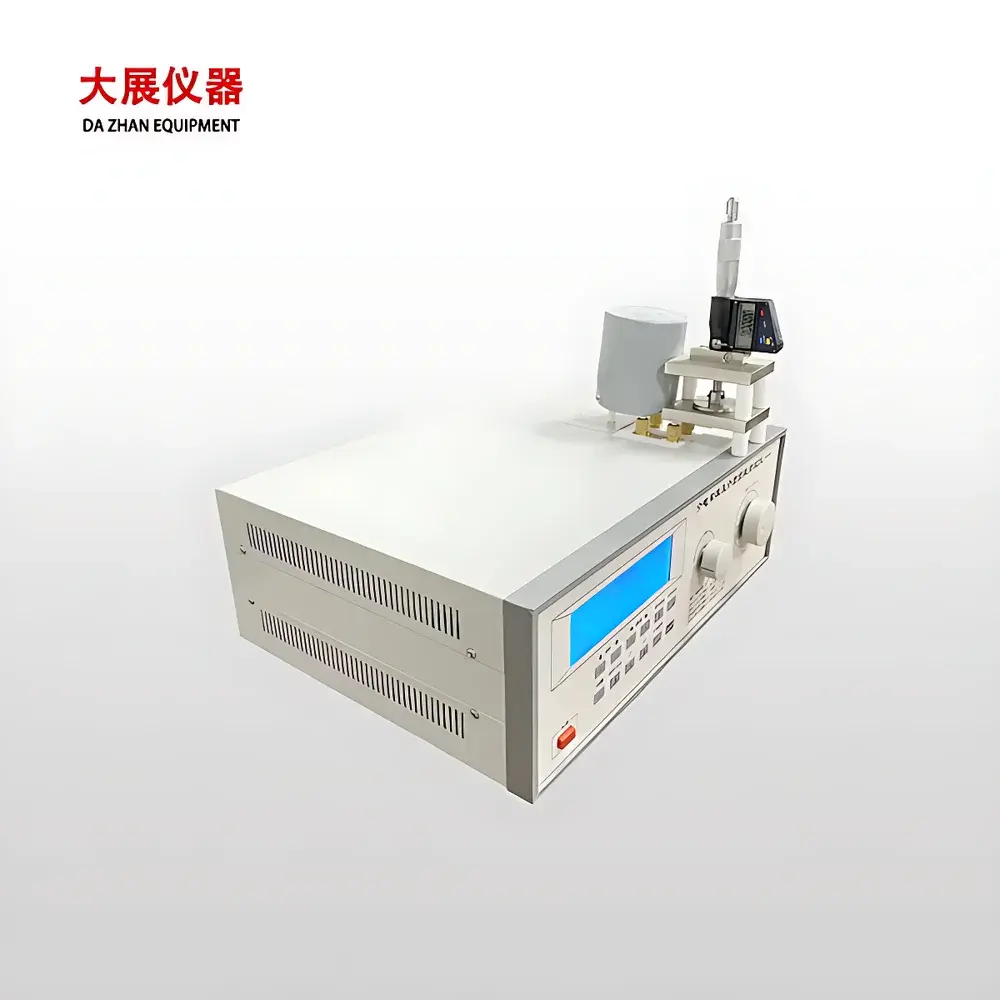
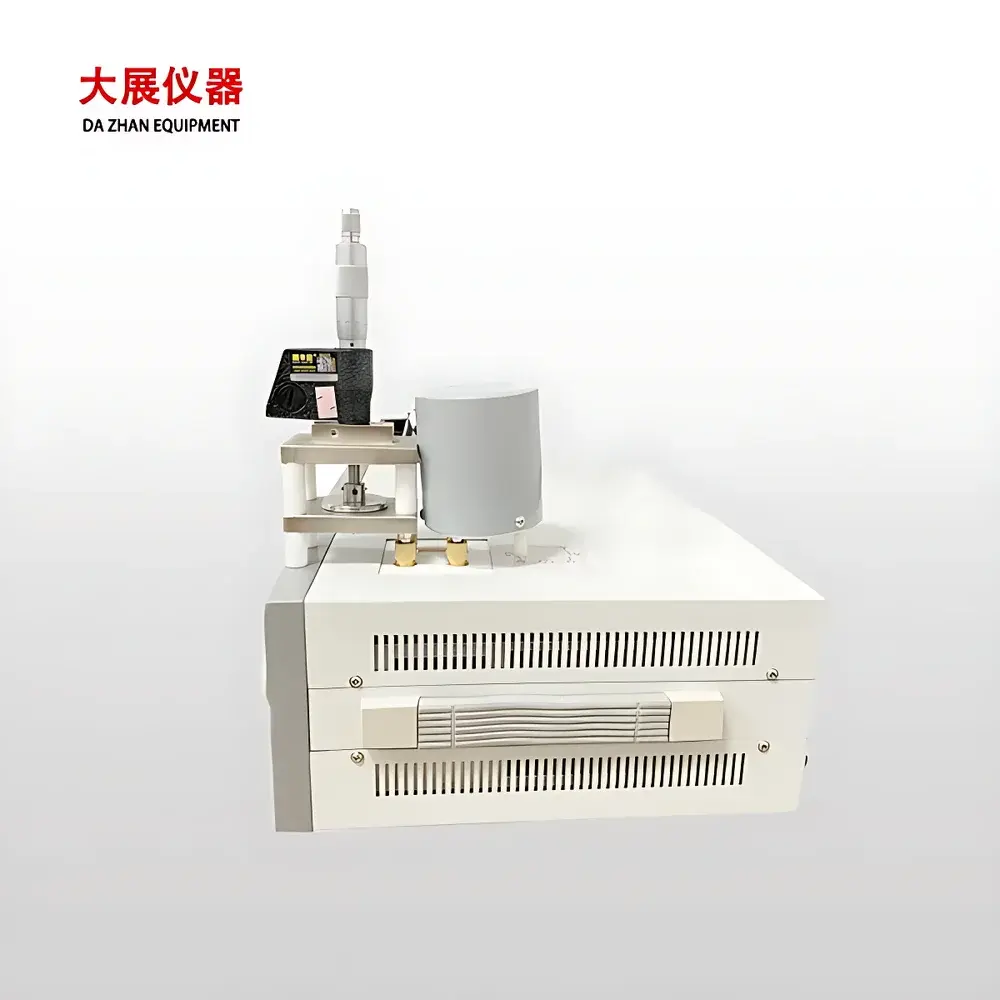
Nanjing Dazhan DZ5001 Precision Dielectric Constant and Loss Tangent Analyzer
| Brand | Nanjing Dazhan |
|---|---|
| Origin | Jiangsu, China |
| Manufacturer Type | Direct Manufacturer |
| Model | DZ5001 |
| Frequency Range | 10 kHz – 100 MHz |
| Frequency Accuracy | ±3×10⁻⁵ (6-digit resolution) |
| Q Factor Range | 1–1000 |
| Q Resolution | 0.1 (4-digit display) |
| Q Measurement Error | <5% |
| Inductance Range | 1 nH – 140 mH |
| Inductance Resolution | 0.1 nH |
| Inductance Error | <3% |
| Main Capacitance | 17–240 pF (silver-plated monolithic) |
| Capacitance Direct Measurement Range | 1 pF – 25 nF |
| Capacitance Resolution | 0.1 pF |
| Capacitance Accuracy | ±1 pF or <1% |
| Automatic Residual Inductance Compensation | Yes |
| Sample Thickness Range | 0.1–10 mm |
| tanδ Resolution | 1×10⁻⁴ |
| εᵣ Resolution | 1×10⁻³ |
| Compliance | GB/T 1693–2007 |
Overview
The Nanjing Dazhan DZ5001 Precision Dielectric Constant and Loss Tangent Analyzer is a high-stability, resonant-frequency-based impedance measurement system engineered for accurate determination of complex permittivity (ε* = ε′ − jε″) and dissipation factor (tan δ = ε″/ε′) in solid dielectric materials. Operating on the principle of series-resonant cavity perturbation with automatic Q-factor tracking, the instrument utilizes a digitally synthesized DDS signal source (10 kHz to 100 MHz) coupled with high-fidelity 12-bit ADC sampling to resolve subtle variations in material response under controlled electric field excitation. Its architecture integrates precision LCR resonance detection with real-time compensation for parasitic inductance—including lead and fixture contributions—enabling traceable, repeatable measurements essential for R&D laboratories validating new ceramic, polymer, and oxide-based insulators per international material characterization protocols.
Key Features
- Wide-frequency coverage (10 kHz–100 MHz) with 6-digit frequency resolution (±3×10⁻⁵), supporting broadband dielectric spectroscopy across low-loss and moderate-loss regimes.
- Automated residual inductance compensation algorithm—dynamically subtracts fixture and probe inductance in real time, eliminating systematic error sources common in high-precision εᵣ/tan δ evaluation.
- Integrated silver-plated monolithic tuning capacitor (17–240 pF) with ±1 pF absolute accuracy and 0.1 pF resolution; motorized stepping drive enables fully automated resonance search.
- Direct capacitance measurement capability up to 25 nF—eliminates need for external bridge configurations when evaluating thick or high-permittivity samples.
- LCD-driven real-time display of primary parameters: resonant frequency (F), inductance (L), capacitance (C), quality factor (Q), tuned inductance (Lt), tuned capacitance (Ct), relative permittivity (εᵣ), and sample thickness (Tn).
- Dual-mode operation: manual tuning for investigative work and auto-scan mode with acoustic-optical Q-pass/fail alert (configurable threshold: 5–1000).
Sample Compatibility & Compliance
The DZ5001 is optimized for flat, homogeneous, non-magnetic solid dielectrics with thicknesses between 0.1 mm and 10 mm—ideal for ceramics (alumina, titanates), polymer films (polyimide, PET, PTFE), glass substrates, and sintered metal oxides. Electrode configuration follows parallel-plate geometry per IEC 60250 and ASTM D150 standards, with optional calibration using NIST-traceable reference standards. The system complies fully with GB/T 1693–2007 (“Determination of Dielectric Constant and Dissipation Factor of Solid Electrical Insulating Materials”) and supports audit-ready documentation workflows compatible with GLP and ISO/IEC 17025 laboratory accreditation requirements.
Software & Data Management
While the DZ5001 operates as a stand-alone benchtop analyzer with full local LCD control, it features RS-232 serial interface for data export to external PCs. Raw parameter sets (F, C, L, Q, εᵣ, tan δ) are timestamped and structured in ASCII CSV format for integration into MATLAB, Python (NumPy/Pandas), or LabVIEW environments. Built-in memory stores up to 200 measurement records with user-defined sample IDs. All firmware logic adheres to deterministic real-time execution—no operating system dependencies—ensuring immunity to host-level software drift or timing jitter during critical resonance capture.
Applications
- Quality assurance of high-k dielectrics in multilayer ceramic capacitor (MLCC) manufacturing.
- Development of low-loss substrate materials for RF/microwave PCBs and antenna modules.
- Characterization of ferroelectric thin films and relaxor perovskites in academic solid-state physics research.
- Evaluation of moisture absorption effects on epoxy molding compounds via time-dependent tan δ monitoring.
- Validation of thermal aging behavior in aerospace-grade polyimide insulators per MIL-STD-202 test methods.
- Correlation studies between microstructure (grain size, porosity) and bulk permittivity in sintered ceramics.
FAQ
What measurement principle does the DZ5001 employ?
It uses series-resonant LCR circuit analysis with automatic Q-factor tracking, where sample-induced shifts in resonant frequency and bandwidth yield εᵣ and tan δ via calibrated cavity perturbation models.
Can the DZ5001 measure liquid or powder samples?
No—it is designed exclusively for rigid, planar solid specimens requiring parallel-plate electrode contact. Liquids and powders require alternative techniques such as coaxial probe or guarded electrode cells.
Is the instrument compliant with FDA 21 CFR Part 11 for regulated labs?
The DZ5001 itself does not include electronic signature or audit trail functionality; however, exported CSV data may be incorporated into validated LIMS or ELN systems meeting Part 11 requirements.
How is calibration performed?
Calibration is executed using certified air-dielectric and short-circuit references per GB/T 1693–2007 Annex B, followed by verification with traceable standard capacitors (e.g., IET Labs 1412 series).
Does the system support temperature-controlled sample stages?
The base unit does not integrate environmental chambers, but its electrical interface and mechanical mounting allow third-party integration with programmable thermal stages (e.g., Linkam LTS420) via external trigger synchronization.



