
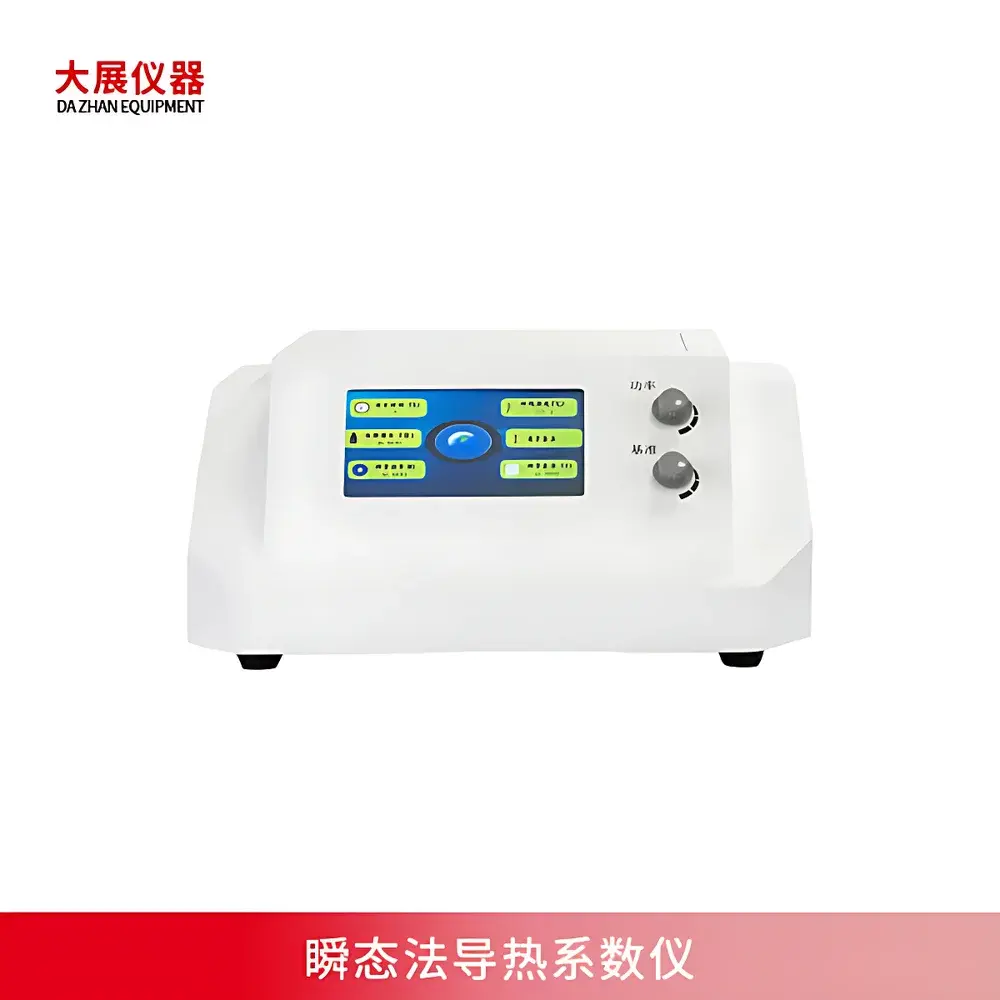
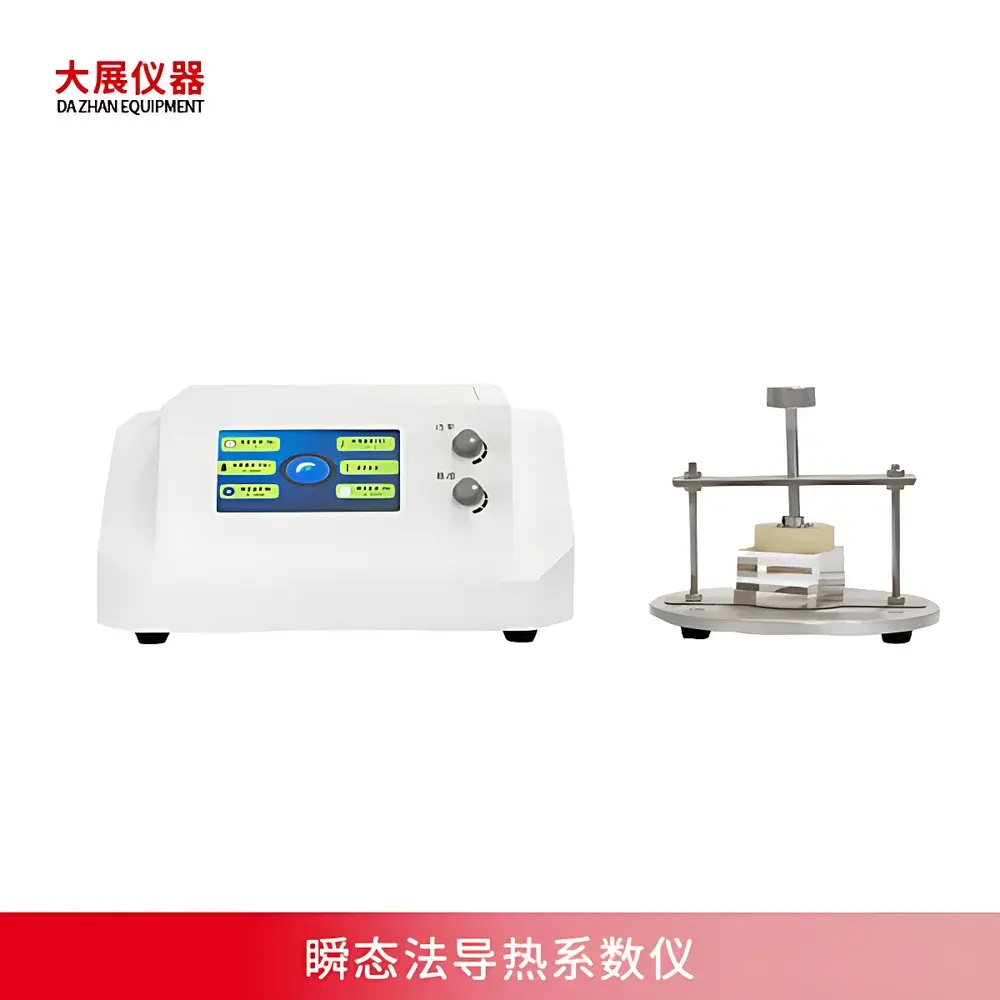
Nanjing Dazhan DZDR-S Transient Plane Source (TPS) Thermal Conductivity Analyzer
| Brand | Nanjing Dazhan |
|---|---|
| Origin | Jiangsu, China |
| Manufacturer Type | Direct Manufacturer |
| Instrument Type | Transient Plane Source Method |
| Sample Throughput | Single sample per test |
| Test Environment | Ambient temperature (standard) |
| optional range | −40 °C to 300 °C |
| Thermal Conductivity Range | 0.0001–300 W/(m·K) |
| Accuracy | ±3% |
| Repeatability | ≤3% |
| Sample Forms | Liquids, metals, pastes, gels, coatings, thin films, powders, insulating materials, composites |
| Probe Options | 7.5 mm, 15 mm, and 50 mm diameter sensors |
| Minimum Sample Dimensions | ≥15×15×3.75 mm (7.5 mm probe), ≥30×30×7.5 mm (15 mm probe), ≥50×50×7.5 mm (50 mm probe) |
| Test Duration | 5–160 s |
| Power Supply | AC 220 V, <500 W |
Overview
The Nanjing Dazhan DZDR-S Transient Plane Source (TPS) Thermal Conductivity Analyzer is a precision instrument engineered for rapid, non-destructive measurement of thermal conductivity across a broad spectrum of solid, liquid, and semi-solid materials. It operates on the transient plane source principle—a well-established, ISO/ASTM-aligned method (ISO 22007-2, ASTM D5470) that applies a known amount of heat via a thin, symmetrically sandwiched sensor acting simultaneously as both heater and temperature sensor. During the short-duration heating pulse (5–160 s), the sensor records the time-dependent temperature rise, from which thermal conductivity is derived using analytical solutions to the heat diffusion equation. This physics-based approach eliminates the need for steady-state equilibration, significantly reducing test duration while maintaining high reproducibility—particularly critical in QC laboratories, R&D environments, and material certification workflows where throughput and traceability are paramount.
Key Features
- Three interchangeable TPS probes (7.5 mm, 15 mm, 50 mm) enable optimized contact-area matching for diverse sample geometries—from small-volume liquids and pastes to large-format insulation panels and metallic substrates.
- Dual-control architecture supports both standalone operation via integrated color touchscreen and synchronized PC-based control—ensuring flexibility in lab integration and remote monitoring scenarios.
- Non-invasive measurement protocol preserves sample integrity; specimens remain unaltered and reusable across multiple tests, supporting longitudinal studies and batch validation.
- Thermal conductivity range spans six orders of magnitude (0.0001–300 W/(m·K)), covering low-conductivity aerogels and foams through high-conductivity copper alloys and graphite composites.
- Compliant with international standards for transient thermal analysis: fully compatible with data reduction protocols specified in ISO 22007-2 and ASTM D5470, enabling audit-ready reporting for GLP/GMP-regulated environments.
- Modular thermal enclosure option extends operational temperature range from −40 °C to 300 °C, facilitating low-temperature cryogenic characterization or high-temperature stability assessment under controlled ambient conditions.
Sample Compatibility & Compliance
The DZDR-S accommodates heterogeneous sample forms without requiring phase-specific accessories or calibration re-runs: bulk solids (metals, ceramics, polymers), soft solids (greases, thermal interface materials), dispersions (colloids, slurries), thin-film coatings (<100 µm), porous insulation boards, and granular powders (with optional custom powder cell). All measurements adhere to ISO 22007-2 Annex A guidelines for sensor-sample interfacial resistance mitigation and contact pressure standardization. The system meets essential electromagnetic compatibility (EMC) and electrical safety requirements per IEC 61010-1, and its firmware architecture supports 21 CFR Part 11-compliant electronic signatures and audit trails when deployed with validated software configurations.
Software & Data Management
Bundled DZDR Analysis Suite provides real-time curve fitting, automatic baseline correction, multi-probe calibration management, and export-ready reporting in PDF, CSV, and XML formats. Raw thermogram data is timestamped and stored with full metadata (probe ID, ambient humidity/temperature, operator ID, sample ID). The software implements automated uncertainty propagation per GUM (Guide to the Expression of Uncertainty in Measurement), calculates expanded uncertainty at k=2, and logs all parameter modifications for full traceability. Optional LIMS integration enables direct data ingestion into enterprise quality systems, satisfying ISO/IEC 17025 documentation requirements for accredited testing laboratories.
Applications
- Quality assurance of thermal interface materials (TIMs) in electronics packaging and battery module assembly.
- Rapid screening of insulating aerogels, mineral wool, and vacuum insulation panels for building envelope certification (EN 12667, ASTM C518).
- Characterization of phase-change materials (PCMs) and nanofluids for thermal energy storage applications.
- Batch-to-batch consistency verification of conductive polymer composites used in EMI shielding and flexible electronics.
- Research-grade thermal property mapping of anisotropic composites, layered structures, and functionally graded materials.
- Validation of thermal models in multiphysics simulation platforms (e.g., ANSYS Mechanical, COMSOL Multiphysics) using experimentally derived k-values.
FAQ
What standards does the DZDR-S comply with?
The instrument implements measurement algorithms and data reduction procedures aligned with ISO 22007-2 and ASTM D5470. Its calibration traceability follows NIST-traceable reference materials, and software features support compliance with ISO/IEC 17025 and FDA 21 CFR Part 11 when configured per validation protocols.
Can the DZDR-S measure anisotropic materials?
Yes—by orienting samples relative to the planar sensor axis and conducting orthogonal measurements, users can derive directional thermal conductivity components. For rigorous anisotropy quantification, complementary use with laser flash diffusivity analyzers is recommended.
Is powder measurement possible without sample compaction?
The optional custom powder cell maintains defined packing density and interfacial contact during transient heating, minimizing air-gap artifacts. Results reflect effective thermal conductivity under controlled consolidation pressure, consistent with ASTM D7984 practices.
How is probe calibration performed?
Each probe is factory-calibrated against certified reference materials (e.g., Pyroceram 9606, Inconel 600). Users may perform periodic verification using supplied secondary standards; calibration certificates include uncertainty budgets and environmental sensitivity coefficients.
Does the system support automated sequential testing?
The DZDR Analysis Suite includes scripting functionality for unattended multi-sample runs, including auto-loading triggers, pass/fail threshold evaluation, and conditional branching based on intermediate results—ideal for production-line deployment.



