
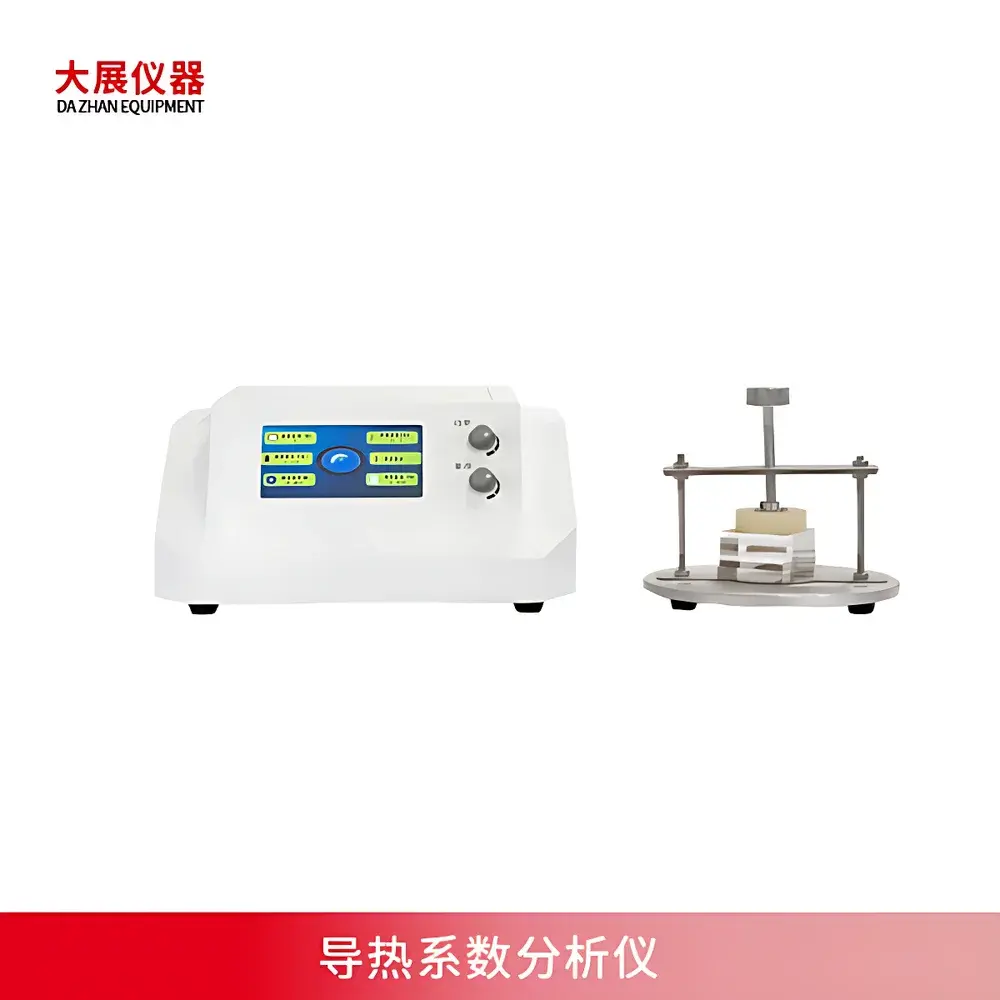
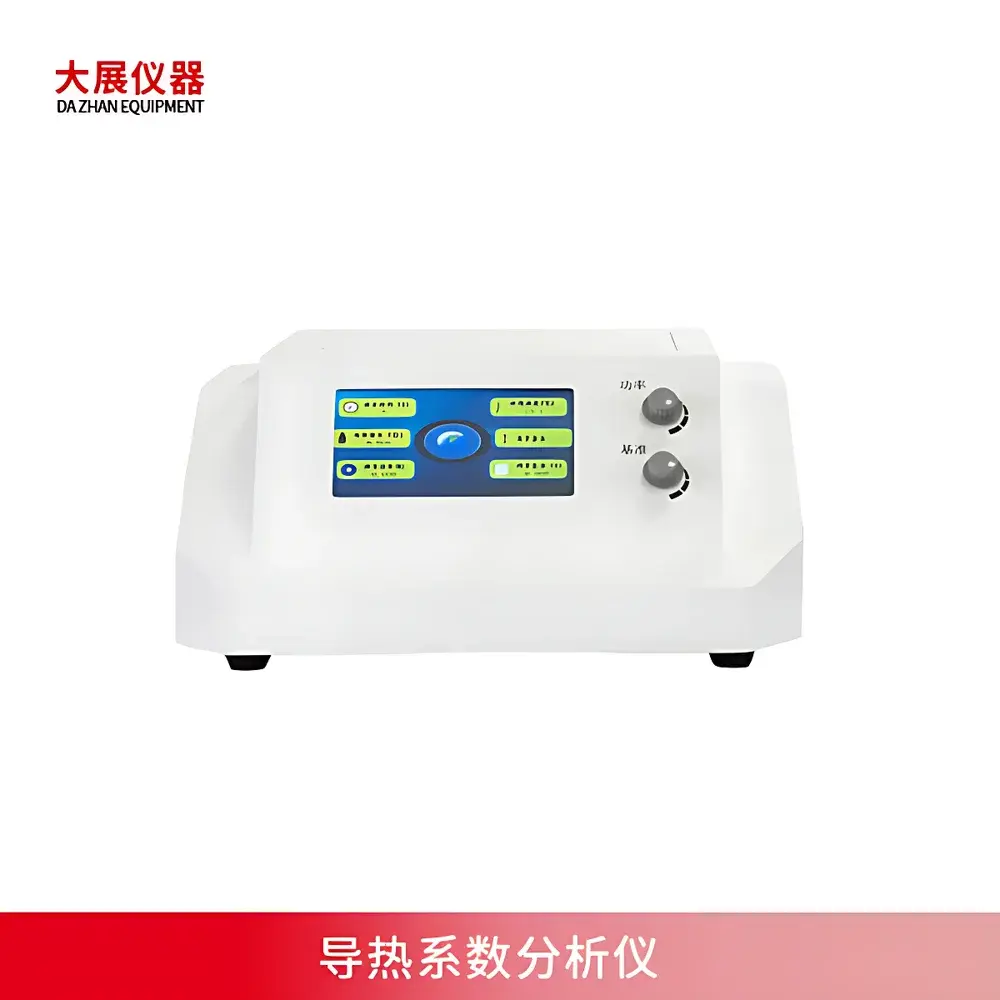
Nanjing Dazhan DZDR-S Transient Plane Source (TPS) Thermal Conductivity Analyzer
| Brand | Nanjing Dazhan |
|---|---|
| Origin | Jiangsu, China |
| Manufacturer Type | Manufacturer |
| Country of Origin | China |
| Model | DZDR-S |
| Instrument Type | Transient Plane Source (TPS) Method |
| Sample Throughput | Single sample per test |
| Test Environment | Ambient temperature (standard) |
| optional range | −40 °C to 300 °C |
| Thermal Conductivity Range | 0.0001–300 W/(m·K) |
| Accuracy | ±3% |
| Repeatability | ≤3% |
| Sample Forms | Solids (bulk, granular, coated, thin-film), metals, liquids, pastes, gels, powders, and insulating materials |
| Probe Options | 7.5 mm (No. 1), 15 mm (No. 2), 50 mm (No. 3) |
| Measurement Time | 5–160 s |
| Power Supply | AC 220 V |
| Max. Power Consumption | <500 W |
| Minimum Sample Dimensions | ≥15×15×3.75 mm (No. 1), ≥30×30×7.5 mm (No. 2), ≥50×50×7.5 mm (No. 3) |
| Powder Test Kit | Optional custom container included |
Overview
The Nanjing Dazhan DZDR-S Transient Plane Source (TPS) Thermal Conductivity Analyzer is a precision instrument engineered for rapid, non-destructive determination of thermal conductivity across a broad spectrum of material classes. It operates on the well-established transient plane source principle—a standardized method defined in ISO 22007-2 and ASTM D7984—where a thin, sandwiched sensor simultaneously serves as both a resistive heater and a temperature sensor. Upon application of a constant current pulse, the sensor induces a controlled thermal transient into the sample; the resulting temperature rise over time is recorded and mathematically inverted using analytical solutions to Fourier’s heat conduction equation. This approach eliminates steady-state equilibration delays and enables reliable measurements within 5–160 seconds—making it particularly suitable for high-throughput quality control labs, R&D environments, and academic thermal transport studies.
Key Features
- High-speed TPS measurement with real-time data acquisition and embedded thermal modeling algorithms.
- Three interchangeable probe configurations (7.5 mm, 15 mm, and 50 mm diameter) optimized for varying sample geometries and thermal diffusivity ranges.
- Non-invasive, non-destructive testing—samples remain intact and reusable after analysis, critical for precious or limited-quantity materials.
- Integrated temperature control capability (standard ambient operation; optional extended range from −40 °C to 300 °C) supporting low-temperature insulation characterization and high-temperature ceramic or metal evaluation.
- Robust mechanical architecture with thermally stable sensor mounting and electromagnetic shielding to minimize environmental drift and electrical noise.
- Compliance-ready design: supports audit trails, user access levels, and timestamped raw data export—facilitating alignment with GLP and GMP documentation requirements.
Sample Compatibility & Compliance
The DZDR-S accommodates heterogeneous sample forms without requiring phase-specific calibration or hardware modification: solid blocks, foams, coatings, thin films (≥100 µm), metallic alloys, polymer composites, hydrated gels, viscous pastes, colloidal suspensions, and dry or conditioned powders (with optional custom powder cell). Each probe size corresponds to empirically validated minimum sample dimensions to ensure one-dimensional heat flow assumptions hold—verified per ISO 22007-2 Annex A. All measurements adhere to traceable reference standards (e.g., NIST SRM 1470a, certified graphite) and are fully compatible with ISO/IEC 17025 accredited reporting workflows. The system meets CE marking requirements for electromagnetic compatibility (EMC Directive 2014/30/EU) and low-voltage safety (LVD Directive 2014/35/EU).
Software & Data Management
The DZDR-S is operated via Windows-based DZDR Analysis Suite v3.x, which provides full control over pulse duration, sampling rate (up to 10 kHz), curve-fitting model selection (infinite medium, finite thickness, anisotropic correction), and automatic outlier rejection. Raw voltage vs. time datasets are stored in HDF5 format with embedded metadata (operator ID, probe ID, ambient conditions, calibration certificate ID). Export options include CSV, Excel, and PDF reports conforming to ASTM E2573 templates. Audit trail functionality logs all parameter changes, result modifications, and user logins—supporting FDA 21 CFR Part 11 compliance when deployed with network authentication and electronic signature modules.
Applications
This analyzer supports cross-disciplinary thermal property characterization in materials science laboratories, polymer engineering departments, battery R&D centers (electrode and separator thermal management), building insulation certification bodies, aerospace composites QA/QC facilities, and pharmaceutical formulation units evaluating thermal stability of excipients. Typical use cases include comparative screening of nanofiller-loaded thermoplastics, validation of vacuum-insulated panel (VIP) core performance, benchmarking of phase-change material (PCM) thermal diffusivity, and regulatory submission packages for thermal interface materials (TIMs) used in power electronics packaging.
FAQ
What standards does the DZDR-S comply with?
It conforms to ISO 22007-2 (Transient Plane Source method), ASTM D7984 (Standard Test Method for Thermal Conductivity of Plastics), and supports implementation of ASTM E1225, ISO 8302, and EN 12667 where applicable.
Can the system measure anisotropic materials?
Yes—by orienting the probe normal to principal axes and applying the anisotropic fitting module in software, thermal conductivity tensors can be estimated for layered composites and crystalline ceramics.
Is calibration traceable to national standards?
Each instrument ships with a factory calibration certificate referencing NIST-traceable reference materials, and annual recalibration services are available with documented uncertainty budgets.
Does the system support automated batch testing?
Via optional LabVIEW-compatible API and digital I/O interface, users can integrate the DZDR-S into automated sample-handling platforms for unattended multi-sample sequences.
How is powder measurement performed?
A dedicated, pressure-controlled powder cell ensures consistent packing density and interfacial contact; the software applies effective medium theory corrections for void fraction based on measured bulk density.



