
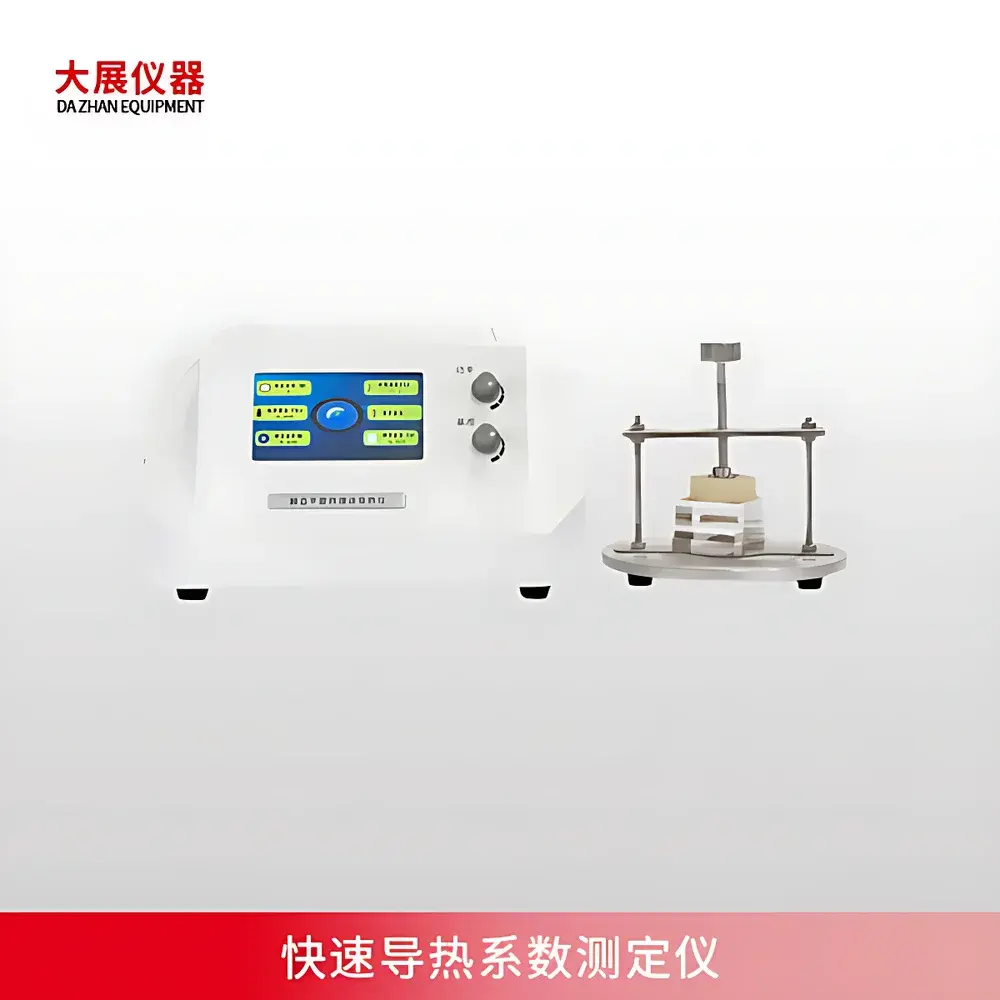
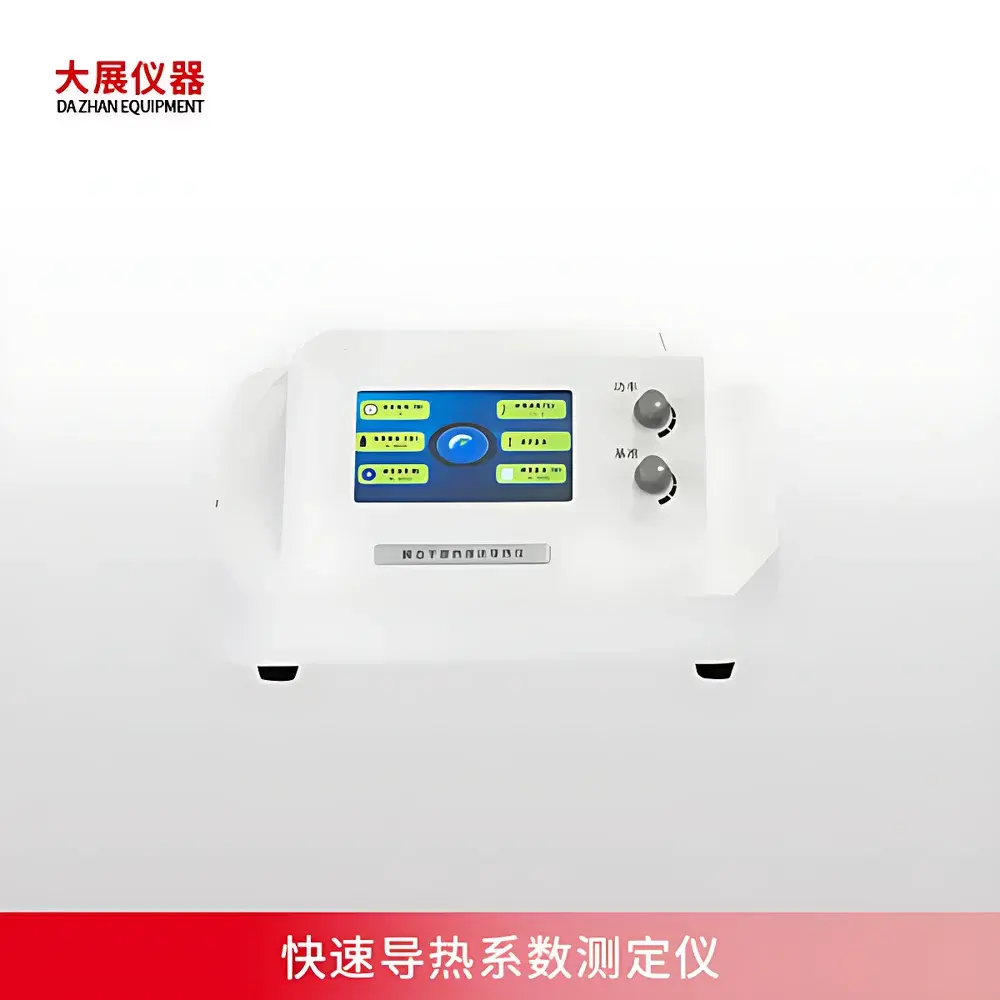
Nanjing Dazhan DZDR-S Transient Plane Source (TPS) Thermal Conductivity Analyzer
| Brand | Nanjing Dazhan |
|---|---|
| Origin | Jiangsu, China |
| Manufacturer Type | Direct Manufacturer |
| Country of Origin | China |
| Model | DZDR-S |
| Price Range | USD 5,600–9,800 (based on configuration) |
| Instrument Type | Transient Plane Source (TPS) Method |
| Sample Throughput | Single sample per test |
| Test Environment | Ambient temperature (20–25 °C), optionally up to 130 °C with heated stage (optional) |
| Thermal Conductivity Range | 0.0001–300 W/(m·K) |
| Accuracy | ±3% |
| Repeatability | ≤3% |
| Measurement Time | 5–160 s (user-configurable) |
| Probe Options | 7.5 mm, 15 mm, and 50 mm diameter dual-spiral sensors |
| Sample Compatibility | Solids (bulk, film, coating), powders (with dedicated container), gels, pastes, liquids, foams, and insulating materials |
| Minimum Sample Dimensions | ≥2× probe diameter in length/width, ≥0.5× probe diameter in thickness |
| Power Supply | AC 220 V, <500 W |
| Data Acquisition | High-resolution imported ADC chipset |
| Control Core | ARM-based embedded microprocessor |
| Compliance | Designed to support ASTM D5470, ISO 22007-2, and GB/T 10295 test protocols |
Overview
The Nanjing Dazhan DZDR-S Transient Plane Source (TPS) Thermal Conductivity Analyzer is a precision instrument engineered for direct, non-destructive measurement of thermal conductivity across an exceptionally broad range—spanning from highly insulating aerogels (0.0001 W/(m·K)) to conductive metals and composites (up to 300 W/(m·K)). Unlike steady-state or guarded-hot-plate methods, the DZDR-S employs the transient plane source technique: a thin, double-spiral nickel sensor acts simultaneously as both heat source and resistance thermometer. Upon application of a constant current pulse, the sensor’s self-heating induces a time-dependent temperature rise in the surrounding material. Thermal conductivity is derived from the slope of the log(ΔT) vs. log(t) curve during the early transient phase—typically within 5–160 seconds—ensuring high throughput without compromising physical fidelity. This principle eliminates contact resistance artifacts inherent in comparative or static methods, enabling reliable characterization of soft, irregular, or low-contact-area samples such as thermal interface materials (TIMs), battery electrode slurries, polymer coatings, and nanoparticle dispersions.
Key Features
- True TPS architecture with dual-spiral sensor geometry—optimized for uniform heat flux distribution and minimized edge effects
- Three interchangeable probe sizes (7.5 mm, 15 mm, 50 mm) to match sample geometry and thermal diffusivity requirements
- ARM-based real-time control system delivering deterministic timing, low-latency data acquisition, and robust signal processing
- High-resolution analog-to-digital conversion (ADC) chipset ensuring sub-millikelvin temperature resolution and stable baseline tracking
- Modular sample stage accommodating variable thicknesses—from ultra-thin films (≥3.75 mm for 7.5 mm probe) to bulk insulation panels—with mechanical alignment guides
- No sample machining required: flatness tolerance relaxed to ≤0.1 mm deviation over probe footprint; no polishing, cutting, or clamping needed
- Non-invasive testing preserves sample integrity—enabling repeated measurements on identical specimens under varying environmental conditions
- Embedded firmware supports user-defined pulse duration, power level, and averaging cycles—critical for method development and validation
Sample Compatibility & Compliance
The DZDR-S accommodates heterogeneous material classes without modification: rigid solids (ceramics, metals, composites), compliant solids (foams, elastomers, gels), particulate systems (dry powders, packed beds, slurries), and fluid phases (oils, solvents, ionic liquids). A dedicated powder test cell (included) maintains consistent density and interfacial contact during measurement. All configurations comply with the fundamental assumptions of ISO 22007-2 (Plastic materials — Determination of thermal conductivity and thermal diffusivity — Part 2: Transient plane source (hot disc) method) and align with ASTM D5470 (Standard Test Method for Thermal Transmission Properties of Thermally Conductive Electrical Insulation Materials). When operated with documented calibration standards (e.g., certified NIST SRM 1470a), the system supports GLP-compliant reporting and audit-ready traceability for QC/QA laboratories subject to ISO/IEC 17025 or FDA 21 CFR Part 11 requirements.
Software & Data Management
Bundled Windows-based software provides full instrument control, real-time thermogram visualization, automated curve fitting using proprietary TPS inversion algorithms, and export of raw voltage-time datasets in CSV and HDF5 formats. Each measurement record includes metadata (probe ID, ambient temperature, pulse parameters, operator ID, timestamp) and supports digital signature logging. Audit trail functionality logs all parameter changes, result modifications, and user actions—meeting ALCOA+ (Attributable, Legible, Contemporaneous, Original, Accurate, Complete, Consistent, Enduring, Available) principles. Exported reports conform to ISO 17025 Annex A.2 structure and include uncertainty budgets based on repeatability, calibration drift, and environmental fluctuation inputs.
Applications
- Thermal management R&D: TIM screening for EV battery modules, heat sink interface optimization, and die-attach material qualification
- Building science: On-site verification of insulation board performance (XPS, EPS, aerogel blankets) per EN 12667
- Academic research: Structure–property mapping of nanocomposites, phase-change materials, and porous media
- Pharmaceutical manufacturing: Thermal stability assessment of lyophilized cakes and polymer-based controlled-release matrices
- Electronics packaging: In-process validation of underfill and encapsulant thermal homogeneity
- Quality assurance: Batch release testing of graphite foils, ceramic substrates, and aerospace-grade composites
FAQ
What standards does the DZDR-S comply with?
The instrument implements core physical principles defined in ISO 22007-2 and ASTM D5470. Its operational protocol and reporting structure are designed to support compliance with ISO/IEC 17025, GLP, and FDA 21 CFR Part 11 when used with validated calibration procedures and audit-trail-enabled software.
Can the DZDR-S measure anisotropic materials?
Yes—by orienting the probe normal to the expected heat flow direction and performing orthogonal measurements, users can estimate principal thermal conductivities in layered or fiber-reinforced composites. For rigorous tensor analysis, complementary directional fixtures are available as optional accessories.
Is temperature-controlled testing possible?
The base model operates at ambient conditions (20–25 °C). An optional heated sample stage (–10 °C to +130 °C, ±0.1 °C stability) enables temperature-dependent thermal conductivity profiling per ISO 22007-4.
How is calibration verified?
Calibration is performed using traceable reference materials (e.g., NIST SRM 1470a, certified copper, Pyroceram 9606) at three points across the dynamic range. Certificate of Calibration includes uncertainty statements and measurement repeatability data.
Does the system support automated batch testing?
While the DZDR-S is optimized for single-sample precision, optional robotic sample handling integration (third-party) enables unattended sequential testing of up to 24 specimens per session—subject to custom engineering and validation.



