
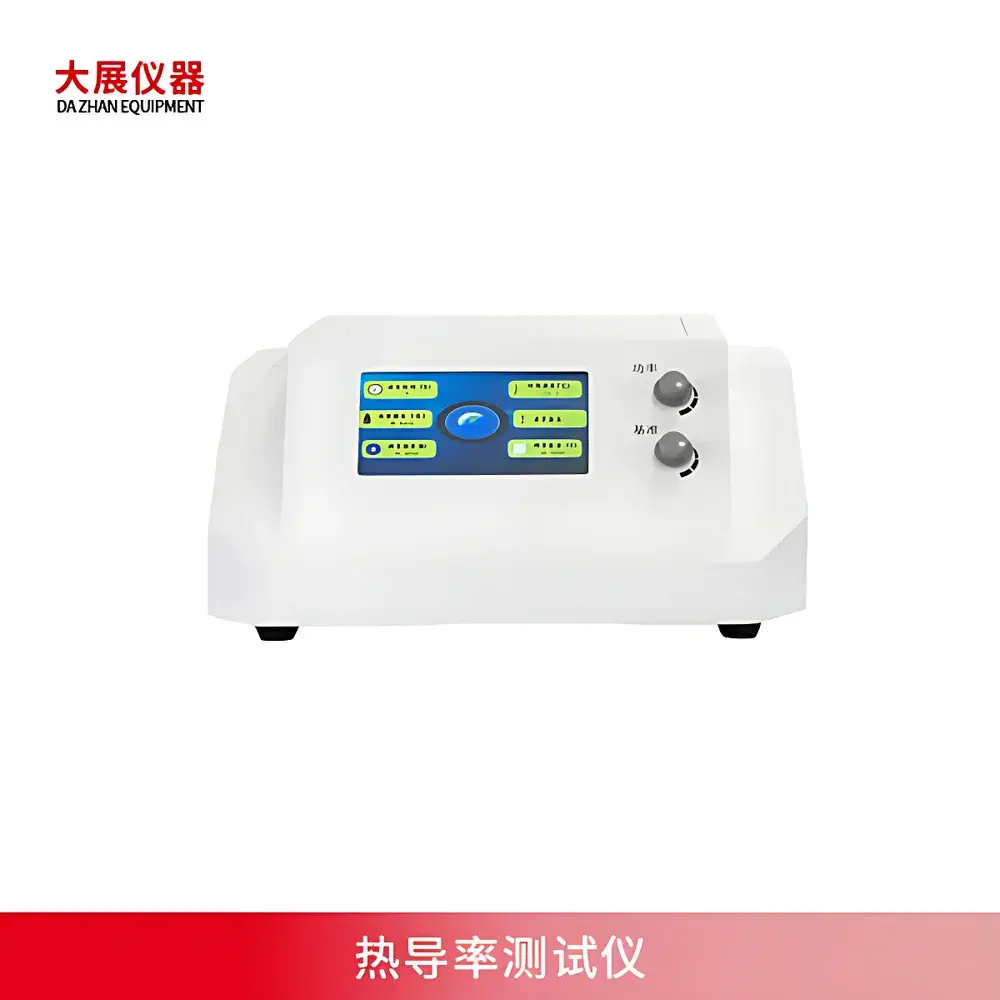
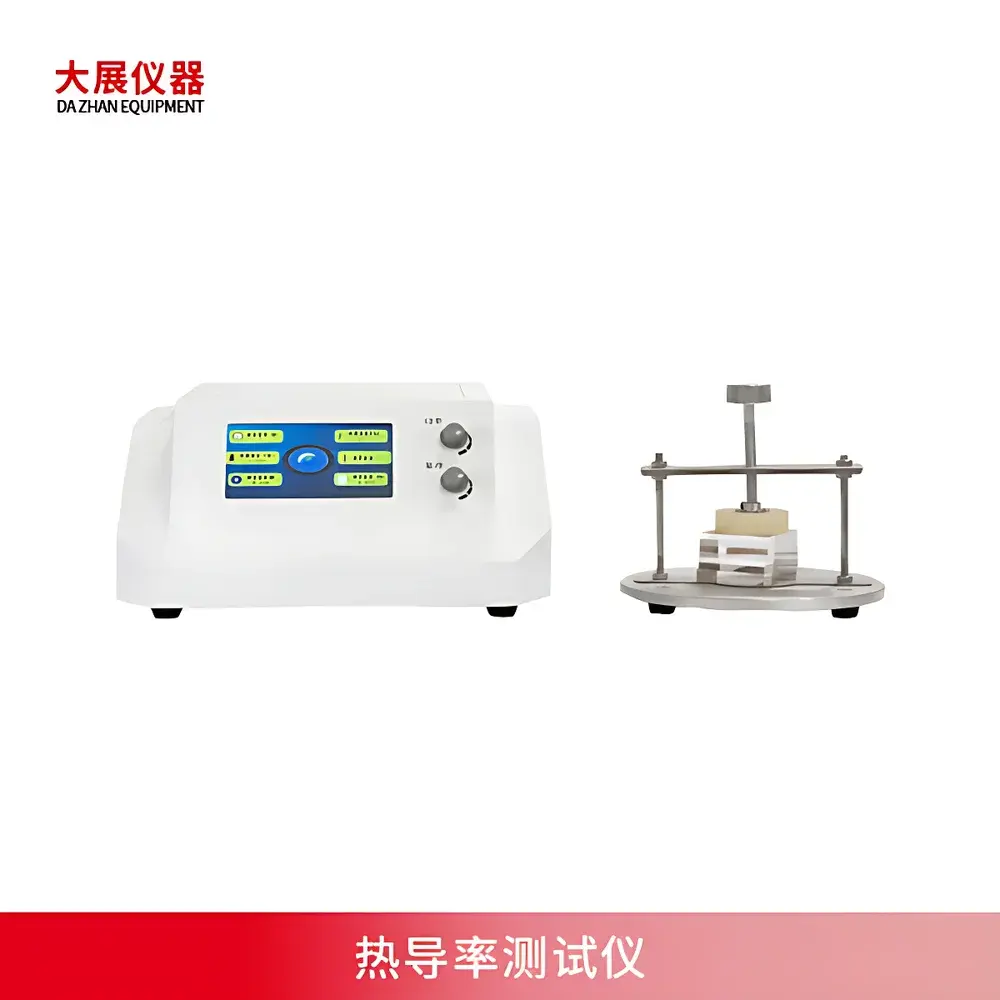
Nanjing Dazhan DZDR-S Transient Plane Source (TPS) Thermal Conductivity Analyzer
| Brand | Nanjing Dazhan |
|---|---|
| Origin | Jiangsu, China |
| Manufacturer Type | Direct Manufacturer |
| Country of Origin | China |
| Model | DZDR-S |
| Instrument Type | Transient Plane Source (TPS) Method |
| Sample Throughput | Single sample per test |
| Test Environment | Ambient temperature (20–30 °C) |
| Thermal Conductivity Range | 0.0001–300 W/(m·K) |
| Accuracy | ±3% |
| Sample Forms | Liquids, powders, thin films, gels, pastes, metals, and bulk solids |
| Probe Options | 7.5 mm, 15 mm, and 50 mm diameter dual-spiral probes |
| Measurement Duration | 5–160 s (user-configurable) |
| Repeatability | ≤3% |
| Operating Temperature Range | 20–130 °C |
| Power Supply | AC 220 V, <500 W |
| Minimum Sample Dimensions | ≥15×15×3.75 mm (for 7.5 mm probe), ≥30×30×7.5 mm (for 15 mm probe), ≥50×50×7.5 mm (for 50 mm probe) |
| Optional Accessories | Powder test cell, liquid test cup, custom probe/sample holder configurations |
Overview
The Nanjing Dazhan DZDR-S Transient Plane Source (TPS) Thermal Conductivity Analyzer is a precision instrument engineered for rapid, non-destructive measurement of thermal conductivity across an exceptionally broad range—from insulating aerogels (0.0001 W/(m·K)) to high-conductivity metals (up to 300 W/(m·K)). It operates on the transient plane source principle, a standardized method defined in ISO 22007-2 and ASTM D7984, wherein a thin, double-spiral nickel sensor acts simultaneously as both heat source and resistance thermometer. Upon application of a constant current pulse, the sensor’s time-dependent temperature rise is recorded with microsecond resolution. Thermal conductivity is derived directly from the slope of the log(temperature rise) versus log(time) curve within the linear regime—eliminating reliance on steady-state assumptions or complex boundary condition modeling. This first-principles approach ensures traceable, physics-based results without calibration against reference standards, making the DZDR-S suitable for R&D labs, QC/QA departments, and materials certification workflows requiring ISO/IEC 17025-compliant data generation.
Key Features
- Multi-probe modular design: Interchangeable 7.5 mm, 15 mm, and 50 mm dual-spiral probes enable optimized measurement sensitivity and spatial resolution for diverse sample geometries—from small lab-scale polymer films to industrial-grade metal billets.
- True non-destructive testing: The TPS method imposes minimal thermal perturbation; samples remain structurally intact and fully reusable after analysis—critical for precious or limited-quantity specimens in academic and pharmaceutical research.
- No specialized sample preparation: Accepts irregular surfaces, soft pastes, granular powders (with optional containment cell), and low-viscosity liquids (using dedicated liquid cup). Minimal dimensional requirements ensure compatibility with as-manufactured parts and prototype materials.
- High-speed acquisition architecture: Integrated high-resolution analog-to-digital converters capture sensor resistance transients at up to 10 kHz sampling rate, enabling robust signal-to-noise ratio even during sub-10-second measurements.
- Thermal stability control: Built-in ambient temperature monitoring and compensation algorithms correct for minor environmental drift during extended test sequences—ensuring consistency across multi-sample batches.
- Modular mechanical stage: Adjustable sample platform accommodates thicknesses from 1 mm to 50 mm without recalibration; clamping force is mechanically decoupled from thermal contact pressure to avoid sample deformation artifacts.
Sample Compatibility & Compliance
The DZDR-S supports heterogeneous material classes under ambient and elevated conditions (20–130 °C), including thermoplastics, ceramics, composites, phase-change materials, battery electrode slurries, thermal interface materials (TIMs), and metallurgical alloys. Its TPS methodology complies with ISO 22007-2:2015 (Plastics — Determination of thermal conductivity and thermal diffusivity — Part 2: Transient plane source (hot disc) method) and aligns with ASTM D7984-16 (Standard Test Method for Thermal Conductivity of Solids by Transient Plane Source Technique). Data integrity meets GLP/GMP documentation requirements: all raw sensor voltage vs. time traces, environmental logs, and operator metadata are timestamped and stored in immutable binary format. Optional audit trail modules support 21 CFR Part 11-compliant electronic signatures and user-level access controls for regulated environments.
Software & Data Management
Bundled DZDR-Analysis software provides real-time visualization of transient resistance curves, automatic baseline correction, and ISO 22007-2–compliant regression fitting. Export options include CSV (raw time-series), PDF reports (with uncertainty propagation per GUM guidelines), and XML (for LIMS integration). Batch processing mode enables unattended sequential analysis of up to 99 samples with programmable probe selection, dwell time, and pass/fail thresholds. All measurement parameters—including applied power, duration, probe ID, and ambient temperature—are embedded in file headers for full traceability. Software validation documentation (IQ/OQ protocols) is available upon request for laboratory accreditation purposes.
Applications
- Quality assurance of thermal interface materials (TIMs) in electronics packaging
- Development and screening of insulation foams and aerogel composites
- Characterization of anisotropic conductive adhesives and solder pastes
- Thermal property mapping of additively manufactured metal components
- Stability assessment of phase-change materials (PCMs) across thermal cycling
- Validation of finite-element thermal models using experimentally derived k-values
- Regulatory submissions requiring ISO 22007-2–validated thermal data (e.g., medical device thermal management dossiers)
FAQ
What standards does the DZDR-S comply with?
It implements the transient plane source method per ISO 22007-2:2015 and ASTM D7984-16, with traceable calibration procedures aligned with national metrology institute (NMI) guidelines.
Can the instrument measure anisotropic materials?
Yes—by rotating the probe orientation relative to sample geometry and performing orthogonal measurements, directional thermal conductivity components can be resolved with appropriate sample mounting fixtures.
Is temperature-controlled testing possible?
The base system operates at ambient temperature; optional heated sample stage accessories extend operational range to 130 °C with ±0.5 °C stability, enabling thermal conductivity vs. temperature profiling.
How is probe calibration maintained?
Each probe is factory-characterized using certified reference materials (e.g., Pyroceram 9606, graphite); no field recalibration is required. Drift verification is performed automatically during startup via internal reference resistors.
Does the software support automated reporting for regulatory audits?
Yes—PDF reports include full uncertainty budgets, instrument identification, operator ID, environmental logs, and digital signatures; audit trail modules log all user actions with timestamps and IP addresses.



