
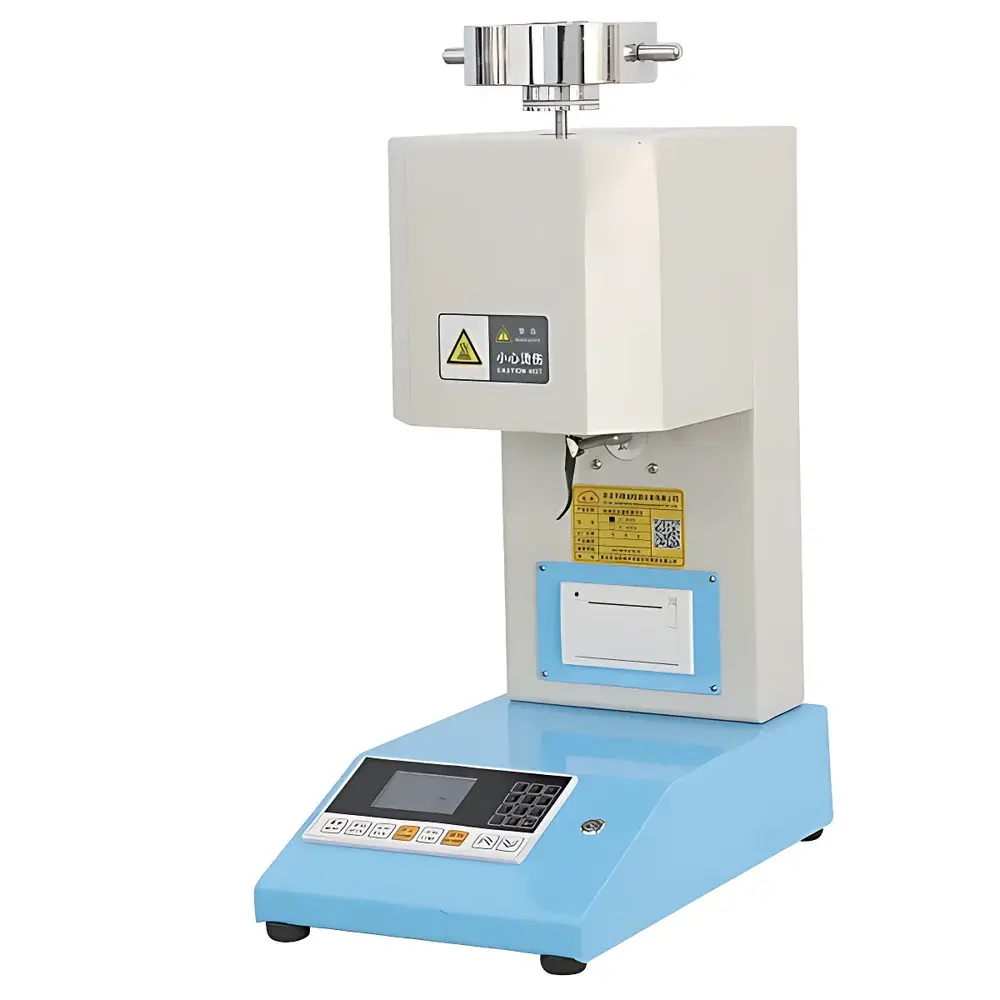
Nanjing Dazhan JC-400C Melt Flow Indexer
| Brand | Nanjing Dazhan |
|---|---|
| Origin | Jiangsu, China |
| Manufacturer Type | Direct Manufacturer |
| Country of Origin | China |
| Model | JC-400C |
| Temperature Range | Ambient to 400 °C |
| Temperature Accuracy | ±0.5 °C |
| Temperature Resolution | 0.1 °C |
| Die Diameter | Φ2.095 ±0.005 mm |
| Die Length | 8.000 ±0.025 mm |
| Barrel Diameter | Φ9.550 ±0.025 mm |
| Barrel Length | 152 ±0.1 mm |
| Piston Head Diameter | 9.475 ±0.015 mm |
| Piston Head Length | 6.350 ±0.100 mm |
| Temperature Recovery Time | <4 min |
| Cutting Mode | Manual or Automatic |
| Display | Chinese LCD |
| Power Supply | AC 220 V ±10%, 50 Hz |
Overview
The Nanjing Dazhan JC-400C Melt Flow Indexer is a precision-engineered instrument designed for the quantitative determination of melt mass flow rate (MFR) and melt volume flow rate (MVR) of thermoplastic polymers under standardized loading and temperature conditions. Based on the fundamental principle of extrusion rheometry—where molten polymer is forced through a calibrated capillary die under controlled load and temperature—the JC-400C delivers repeatable, traceable, and standards-compliant results essential for quality control, material specification verification, and process development in polymer manufacturing. Its architecture integrates a high-stability heating system with advanced fuzzy PID temperature control, enabling rapid thermal equilibration (<4 minutes post-filling), minimal overshoot, and sustained thermal uniformity across the barrel and die assembly. The instrument complies fully with ISO 1133:2011 (Parts 1 & 2), ASTM D1238–22, and GB/T 3682–2018—ensuring global test method harmonization and data acceptability in regulatory submissions, interlaboratory comparisons, and supplier qualification programs.
Key Features
- High-temperature capability up to 400 °C (with optional upgrade path to 450–500 °C), supported by a corrosion-resistant 304 stainless steel or alloy heating cylinder—critical for long-term stability when testing aggressive fluoropolymers (e.g., PTFE, FEP, PFA) and high-performance engineering resins.
- Precision-machined die assembly meeting strict dimensional tolerances: capillary diameter Φ2.095 ±0.005 mm, length 8.000 ±0.025 mm; barrel ID Φ9.550 ±0.025 mm, length 152 ±0.1 mm; piston head Φ9.475 ±0.015 mm—ensuring adherence to ISO/ASTM geometric specifications.
- Integrated real-time temperature monitoring with 0.1 °C resolution and ±0.5 °C accuracy across the full operating range, verified via NIST-traceable calibration protocols.
- Dual cutting modes: manual trigger for operator-defined timing or programmable automatic cut intervals (e.g., 10–120 s), supporting both single-point MFR and multi-interval MVR calculations per ISO 1133-2 Annex A.
- Intuitive Chinese-language LCD interface with persistent parameter memory—recalls prior test settings (load, temperature, cut interval, preheat time) upon power-up, reducing setup errors and improving workflow efficiency.
- Built-in thermal printer provides immediate hard-copy output of test parameters, sample identification, timestamp, and calculated MFR/MVR values—supporting GLP documentation requirements without external software dependency.
Sample Compatibility & Compliance
The JC-400C accommodates a broad spectrum of thermoplastic materials, including low-melting commodity resins (e.g., PE, PP, PS, ABS, POM) and high-thermal-stability engineering polymers (e.g., PC, PPS, PSU, PES, and fluoroplastics). Its robust thermal design and chemically inert barrel/die surfaces enable extended-duration testing of highly corrosive melts without degradation of dimensional integrity or measurement fidelity. All operational procedures align with the procedural rigor mandated by ISO 1133 (gravimetric and volumetric methods), ASTM D1238 (Condition J, K, L, M, N), and GB/T 3682–2018. The instrument supports full audit trail generation for critical parameters—including temperature ramp profiles, dwell times, cut timestamps, and mass measurements—facilitating compliance with FDA 21 CFR Part 11 (when paired with validated data management software) and internal GMP/GLP quality systems.
Software & Data Management
While the JC-400C operates as a standalone unit with embedded firmware and local thermal printing, it is compatible with optional PC-based data acquisition modules that log time-stamped temperature, load, cut events, and mass entries into CSV or Excel-compatible formats. These modules support configurable test templates, user access controls, electronic signatures, and automated report generation—including statistical summaries (mean, SD, CV%) across replicate runs. All digital records adhere to ALCOA+ principles (Attributable, Legible, Contemporaneous, Original, Accurate, Complete, Consistent, Enduring, Available) for regulatory review readiness.
Applications
This indexer serves as a foundational tool across polymer value chains: raw material suppliers use it for lot-release testing against contractual MFR specifications; compounders rely on it for batch-to-batch consistency validation; injection molders correlate MFR with processing behavior (e.g., fill balance, weld line strength); and R&D laboratories employ it during formulation screening and thermal degradation studies. It is routinely deployed in third-party testing labs accredited to ISO/IEC 17025, university polymer science departments, and national inspection agencies conducting conformity assessments under China’s CCC certification framework and EU REACH substance evaluation protocols.
FAQ
What international standards does the JC-400C fully support?
ISO 1133:2011 (Parts 1 and 2), ASTM D1238–22, and GB/T 3682–2018—including all specified test conditions (e.g., 2.16 kg, 5 kg, 10 kg loads; 190 °C, 230 °C, 275 °C, 300 °C, 372 °C temperatures).
Can the JC-400C test fluoropolymers such as PTFE without performance loss?
Yes—its optional high-temperature alloy barrel and die configuration enables stable, repeatable testing of fully fluorinated resins at temperatures up to 450–500 °C, with no measurable drift in dimensional accuracy or thermal homogeneity over extended cycles.
How is temperature recovery performance validated?
Per ISO 1133 Annex B, recovery time is measured from the moment standard reference material (e.g., HDPE SRM) is loaded until the barrel zone returns to setpoint within ±0.5 °C—consistently achieving <4 minutes across the full 150–400 °C range.
Is the instrument suitable for regulated environments requiring audit trails?
In standalone mode, printed reports provide primary evidence; when integrated with optional compliant software, full electronic audit trails—including user actions, parameter changes, and calibration logs—are generated in accordance with 21 CFR Part 11 and ISO 17025 clause 7.7.
What maintenance is required to sustain long-term accuracy?
Routine verification using certified reference materials (e.g., NIST-traceable HDPE or PP standards), annual recalibration of temperature sensors and load cells by an accredited metrology lab, and periodic cleaning of the die and barrel with brass brushes and high-purity solvents per ASTM D1238 Section 7.3.





