
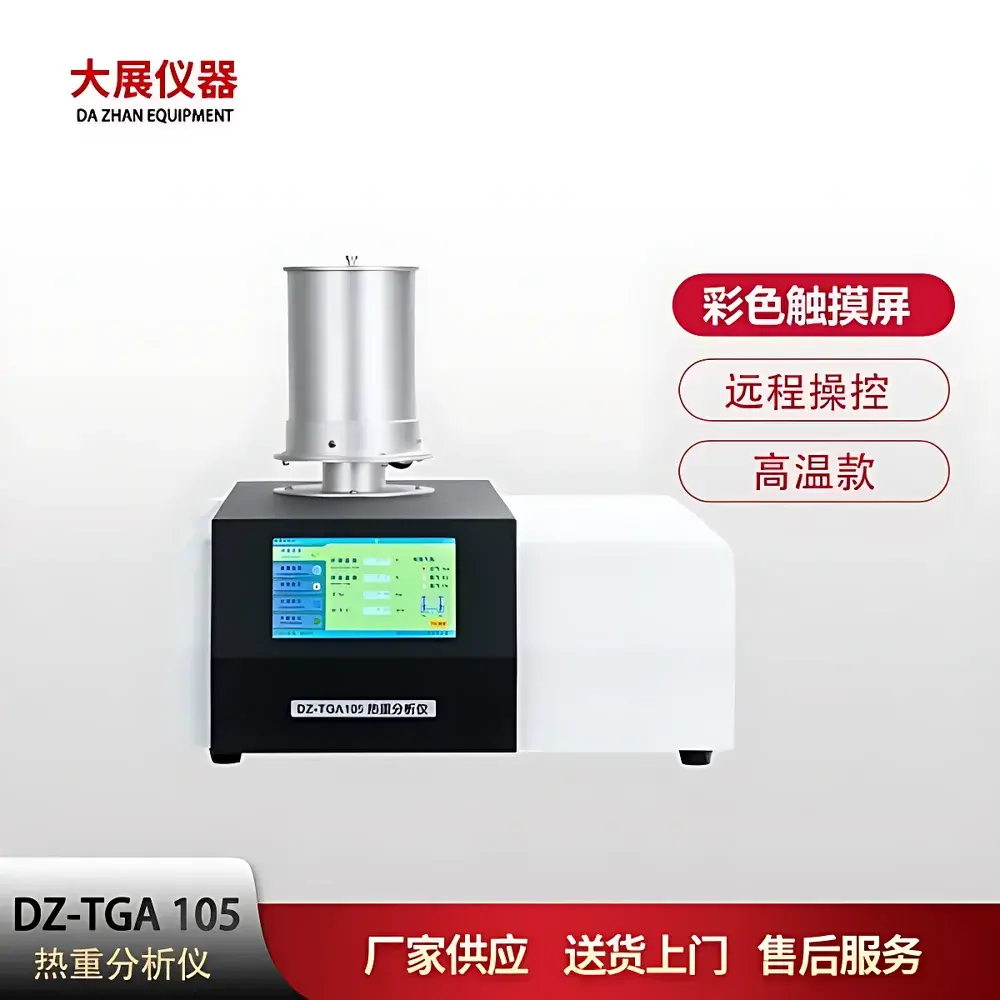
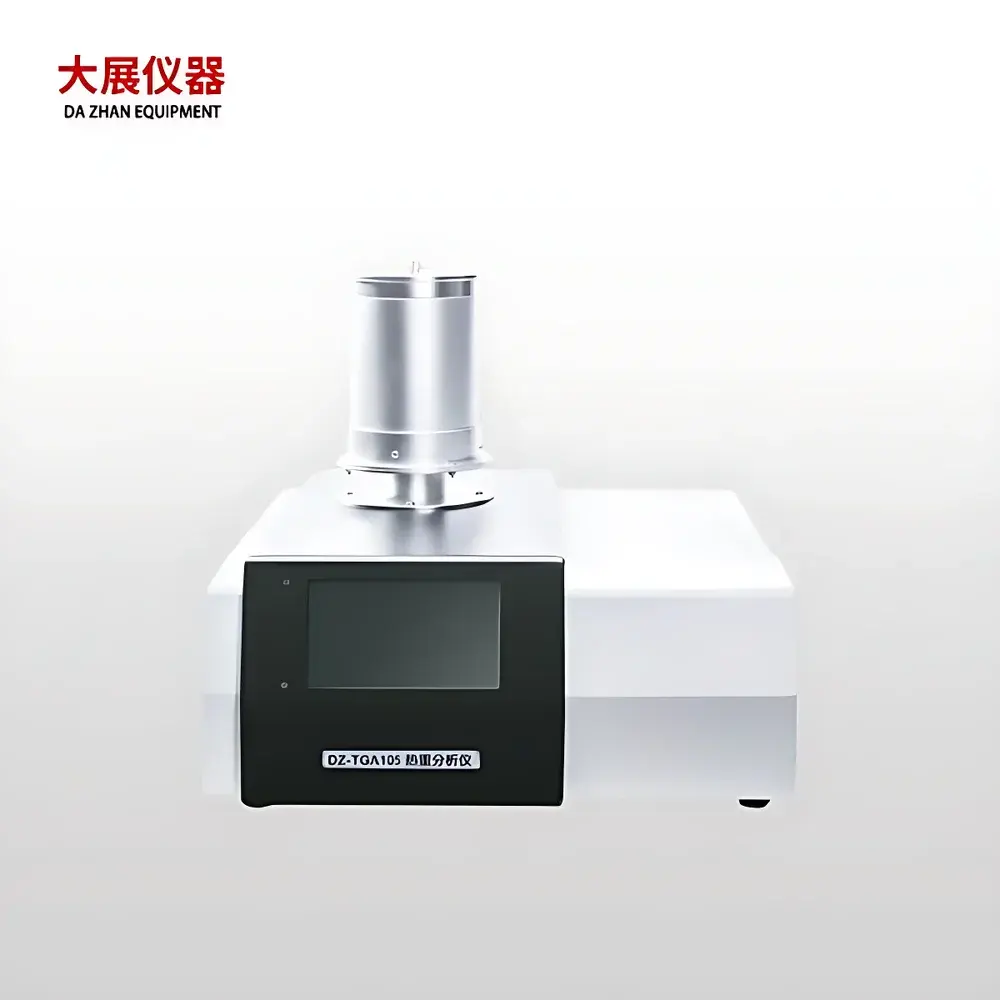
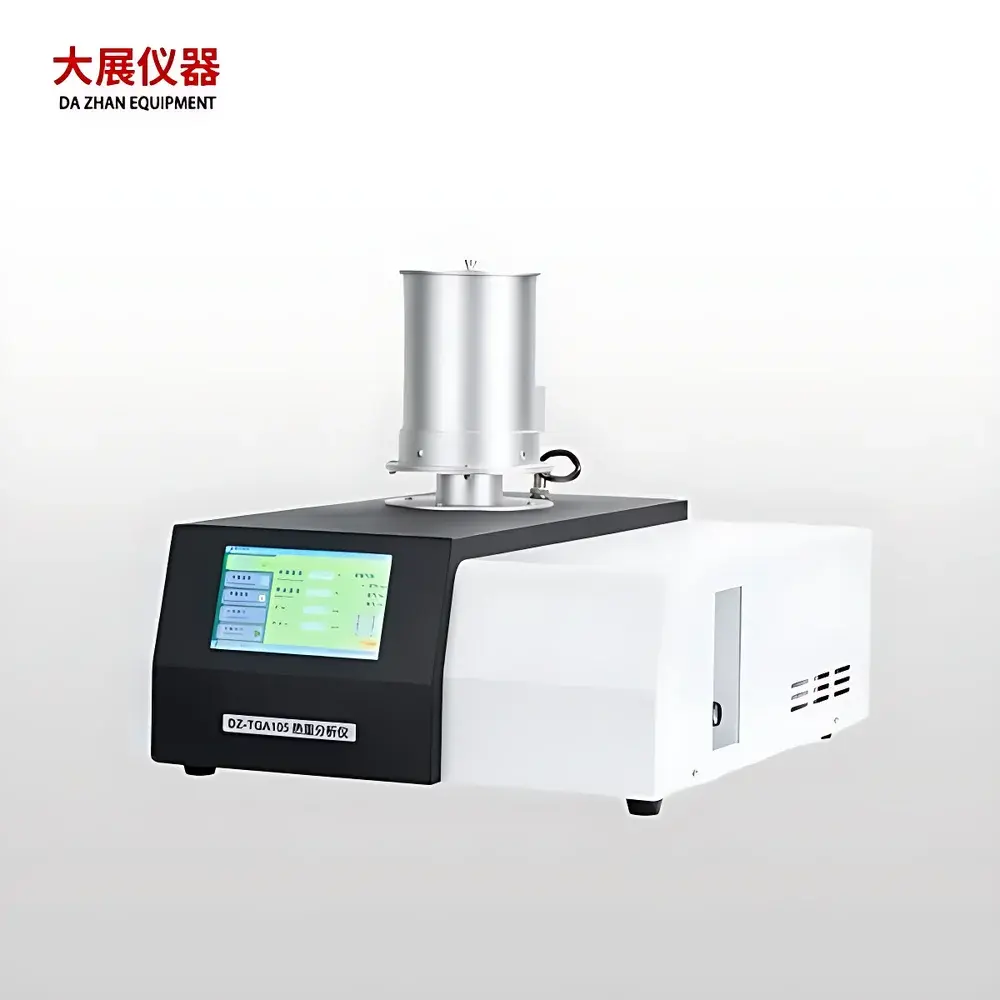
Nanjing Dazhan TGA 101 Thermogravimetric Analyzer
| Brand | Nanjing Dazhan |
|---|---|
| Origin | Jiangsu, China |
| Manufacturer Type | Direct Manufacturer |
| Country of Origin | China |
| Model | TGA 101 |
| Sample Capacity | Single-sample |
| Instrument Type | Dedicated TGA System |
| Temperature Range | Ambient to 1550 °C |
| Heating/Cooling Rate | 0.1–100 K/min |
| Maximum Sample Mass | 30 g |
| Temperature Resolution | 0.01 °C |
| Temperature Stability | ±0.1 °C |
| Balance Range | 0.1 mg–2 g (extendable to 30 g) |
| Mass Sensitivity | 0.01 mg |
| Cooling Time | ≤15 min (from 1000 °C to 100 °C) |
| Data Interface | Standard USB 2.0 |
| Power Supply | AC 220 V, 50 Hz |
Overview
The Nanjing Dazhan TGA 101 Thermogravimetric Analyzer is a precision benchtop instrument engineered for quantitative measurement of mass change as a function of temperature or time under controlled atmospheric conditions. Based on the fundamental principle of thermogravimetry—where sample mass is continuously monitored during programmed thermal cycles—the TGA 101 delivers high reproducibility in determining thermal stability, decomposition kinetics, moisture/volatile content, filler loading, and compositional analysis. Its operational range extends from ambient temperature up to 1550 °C, enabling characterization of refractory ceramics, high-performance alloys, advanced composites, and catalytic materials. The system employs a high-stability microbalance coupled with a dual-zone furnace architecture, ensuring minimal thermal lag and precise temperature tracking across the full heating/cooling profile. All thermal programs—including ramp, hold, and multi-step sequences—are fully programmable via embedded firmware and PC-based software.
Key Features
- High-resolution microbalance with 0.01 mg sensitivity and extended capacity up to 30 g, supporting both low-mass polymer films and bulk inorganic specimens.
- STM32-based embedded control system with real-time data acquisition at configurable sampling rates; synchronized capture of TG, DTG, and temperature signals via 48-bit quad-channel ADC.
- 7-inch full-color 24-bit resistive touchscreen interface with intuitive navigation, on-device calibration routines (mass & temperature), and local parameter configuration without PC dependency.
- Programmable heating/cooling rates from 0.1 to 100 K/min, with temperature stability maintained within ±0.1 °C and resolution of 0.01 °C—critical for kinetic modeling and ASTM E1131-compliant decomposition onset determination.
- Fast active cooling system achieving ≤15 min cooldown from 1000 °C to 100 °C, improving laboratory throughput without compromising thermal uniformity or sensor longevity.
- USB 2.0 bidirectional communication protocol enabling full remote operation: instrument start/stop, real-time monitoring, parameter modification, and live curve overlay directly from Windows-based software.
Sample Compatibility & Compliance
The TGA 101 accommodates standard platinum, alumina, and quartz crucibles (including sealed and vented variants), supporting inert (N₂, Ar), oxidative (air, O₂), and reducing (H₂, forming gas) atmospheres via optional gas flow modules. It is routinely deployed in R&D and QC environments where compliance with ISO 11358, ASTM E1131, ASTM E1641, and USP residual solvents protocols is required. The system’s firmware and PC software support audit-trail-enabled operation per FDA 21 CFR Part 11 guidelines when configured with user authentication, electronic signatures, and immutable data logging—making it suitable for GLP and GMP-regulated laboratories. All calibration procedures (mass, temperature, and buoyancy correction) are traceable to NIST-certified reference standards and documented in accordance with ISO/IEC 17025 requirements.
Software & Data Management
The proprietary TGA Control Suite provides comprehensive data acquisition, visualization, and post-processing capabilities. Users can generate TG, DTG, and derivative curves simultaneously; define custom baselines; calculate derivative peak temperatures, mass loss steps, and residual ash content; and export processed results to Excel (.xlsx), CSV, or PDF report formats. The software supports multi-curve overlay for comparative analysis, automatic onset/endpoint detection using tangent and inflection methods, and kinetic modeling (e.g., Flynn-Wall-Ozawa, Kissinger) for activation energy estimation. Firmware and application updates are delivered free-of-charge via secure download portal, with version history and release notes archived for regulatory documentation. Raw data files are stored in binary format with embedded metadata (operator ID, timestamp, method name, instrument serial number), ensuring full data integrity and long-term archival compatibility.
Applications
- Quantification of polymer degradation stages, filler content (e.g., CaCO₃, SiO₂), and char yield in flame-retardant formulations.
- Thermal stability assessment of pharmaceutical APIs and excipients under ICH Q1A(R3) stress conditions.
- Determination of catalyst coke burn-off profiles and metal oxide reduction behavior in heterogeneous catalysis studies.
- Moisture, solvent, and volatile organic compound (VOC) content verification in coatings, adhesives, and battery electrode slurries.
- Decomposition thermodynamics of metal-organic frameworks (MOFs), perovskites, and ceramic precursors for materials synthesis optimization.
- Residue analysis and ash composition mapping in coal, biomass, and waste-derived fuels per ISO 1171 and ASTM D3174.
FAQ
What types of atmospheres can be used with the TGA 101?
The instrument supports purging with inert (N₂, Ar), oxidizing (air, O₂), and reducing (H₂, 5% H₂/95% N₂) gases via an optional mass-flow-controlled gas module.
Is the software compliant with FDA 21 CFR Part 11?
Yes—when operated with enabled user access controls, electronic signature workflows, and audit-trail logging, the software meets core requirements for regulated environments.
Can the balance be recalibrated in-house?
Yes—both mass and temperature calibrations can be performed directly on the 7-inch touchscreen using certified reference weights and melting-point standards.
What is the minimum detectable mass change?
With 0.01 mg sensitivity and noise floor <0.005 mg RMS, the system reliably resolves sub-0.05% mass changes for 200 mg samples under stable thermal conditions.
Does the system support simultaneous DSC measurement?
No—the TGA 101 is a dedicated thermogravimetric platform; differential scanning calorimetry requires a separate DSC instrument or a hybrid TGA-DSC configuration not offered in this model line.



