
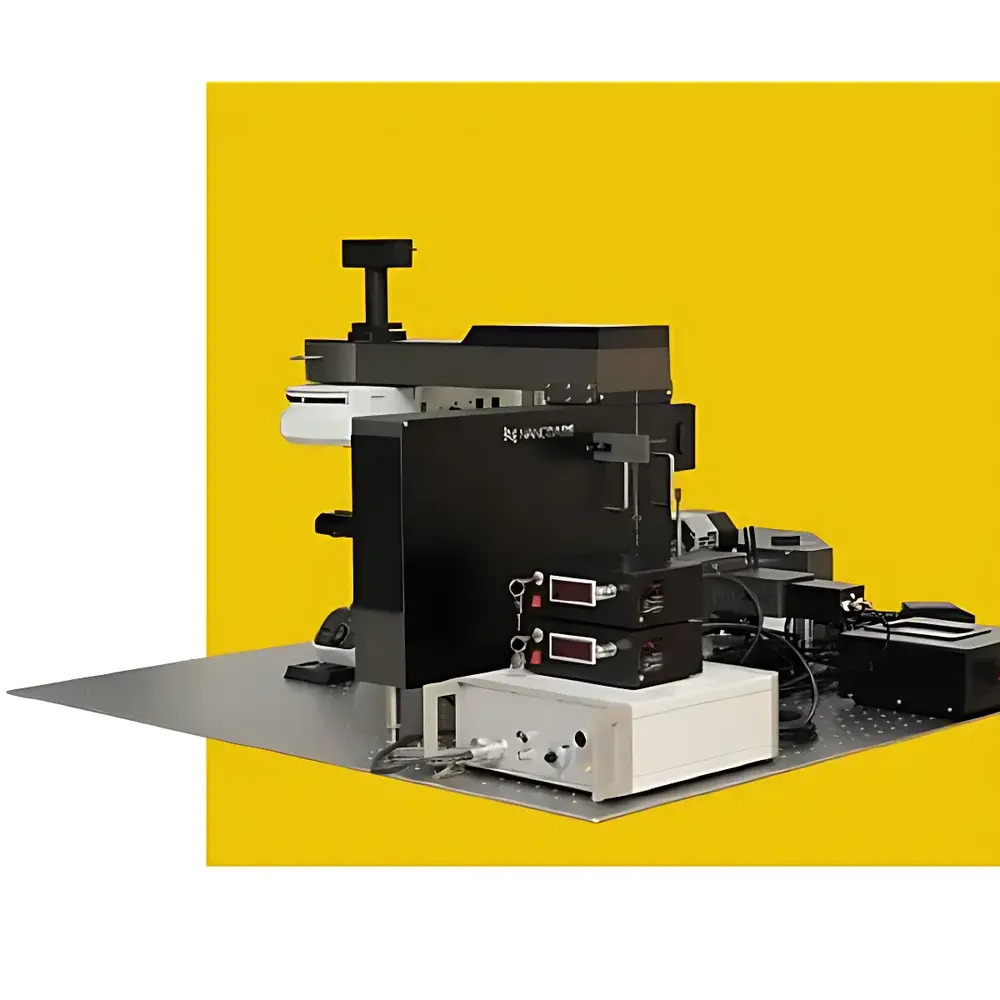
Nanobase AUT-XperRAM RF Confocal Raman Imaging System
| Brand | Nanobase |
|---|---|
| Origin | South Korea |
| Instrument Type | Confocal Micro-Raman Spectrometer with Integrated TCSPC-Based TRPL/FLIM Module |
| Spectrometer | XPE200 Transmission Grating Spectrometer (f/5, 200 mm focal length) |
| Detector | Back-Illuminated CCD (2000 × 256 pixels, 15 µm × 15 µm pixel size, −50 °C thermoelectric cooling) |
| Laser Excitation Options | 405 nm, 532 nm (standard), 633 nm, 785 nm, 1064 nm (custom) |
| Raman Mapping Mechanism | Galvo-Based Laser Scanning (no sample movement, ≤20 nm positioning accuracy, up to 200 µm × 200 µm field with 40× objective) |
| TRPL Module | PicoQuant-integrated TCSPC system (405 nm ps diode laser, SPAD detector, 25 ps time resolution, dual-channel time-tagging electronics, 40 MHz max count rate) |
| Software | NanoSpectrum Suite (supports .txt/.csv spectral export, .spm/.csv mapping export, remote monitoring via NanoControl mobile app, optional Raman library identification) |
Overview
The Nanobase AUT-XperRAM RF Confocal Raman Imaging System is a dual-modal, research-grade analytical platform engineered for correlative microspectroscopic and time-resolved photoluminescence characterization. It integrates two physically and functionally distinct measurement modalities—confocal Raman microspectroscopy and time-correlated single-photon counting (TCSPC)-based time-resolved photoluminescence (TRPL) and fluorescence lifetime imaging microscopy (FLIM)—within a single optical path and unified mechanical architecture. The system operates on the principle of inelastic light scattering (Raman) for vibrational fingerprinting of chemical composition, crystallinity, strain, and defect states, while simultaneously enabling quantitative decay kinetics analysis via pulsed excitation and photon-timing detection. Its confocal design ensures diffraction-limited spatial resolution (~0.5 µm lateral with 40× objective), axial sectioning capability (<2 µm optical slice thickness), and rejection of out-of-focus background—critical for heterogeneous samples such as layered 2D materials, semiconductor heterostructures, and biological cells. Unlike conventional stage-scanned Raman systems, the AUT-XperRAM RF employs galvanometer-based laser beam scanning, eliminating mechanical sample translation and enabling high-fidelity, vibration-insensitive mapping of large or heavy specimens without compromise to positional reproducibility.
Key Features
- High-efficiency transmission grating spectrometer (XPE200) with >90% peak diffraction efficiency across visible–NIR range, minimizing photon loss and maximizing signal-to-noise ratio (SNR) in low-light conditions.
- Back-illuminated, deep-depletion CCD detector (2000 × 256 pixels, 15 µm × 15 µm) cooled to −50 °C, delivering low dark current (<0.001 e⁻/pix/s) and enabling sub-second spectral acquisition even at low laser power (e.g., 1.4 mW on Si at 532 nm).
- Galvo-driven laser scanning module with ≤20 nm pixel positioning accuracy and configurable field sizes up to 200 µm × 200 µm (40× objective), supporting rapid Raman mapping without sample motion or piezo-stage limitations.
- Integrated TCSPC subsystem co-developed with PicoQuant (Berlin), comprising a 405 nm picosecond diode laser (31.25 kHz – 80 MHz repetition rate), single-photon avalanche diode (SPAD), dual-channel time-tagging electronics (25 ps instrument response function), and FLIM-compatible acquisition firmware.
- Fully modular optical architecture: interchangeable objectives (10×–100×, long-working-distance options), multi-wavelength laser/filter selection (405/532/633/785/1064 nm), and fiber-coupled port option for external excitation or collection paths.
- NanoSpectrum software suite with native support for synchronized acquisition, cross-correlation analysis of Raman–TRPL datasets, batch processing, spectral library matching (optional), and export in standardized formats (.txt, .csv, .spm) compliant with third-party analysis tools (e.g., MATLAB, Origin, Python SciPy).
Sample Compatibility & Compliance
The AUT-XperRAM RF accommodates a broad spectrum of solid-state and biological specimens—including monolayer TMDs (MoS₂, WS₂), graphene and h-BN flakes, perovskite thin films, silicon wafers, polymer composites, pharmaceutical crystals, fixed and live-cell cultures, and microplastic particulates—without requiring conductive coating or vacuum environments. Its non-destructive, label-free operation complies with ISO/IEC 17025 requirements for analytical instrument validation when configured with traceable calibration standards (e.g., silicon Raman shift reference, NIST-traceable lifetime standards). Data acquisition workflows support audit-trail generation and electronic signature capabilities aligned with FDA 21 CFR Part 11 principles for regulated environments. All optical components meet RoHS directives; laser safety class complies with IEC 60825-1:2014 (Class 3B/4 depending on configuration).
Software & Data Management
NanoSpectrum serves as the unified control and analysis interface for both Raman and TRPL modalities. It provides real-time spectral preview, automated focus tracking, multi-point acquisition scripting, and hardware-synchronized dual-channel TCSPC histogramming. Raw TCSPC data are stored in time-tagged event lists (TTL format), enabling post-acquisition re-binning, multi-exponential decay fitting (e.g., τ₁, τ₂, amplitude ratios), and phasor plot generation. Raman maps are saved as hyperspectral stacks with embedded metadata (laser power, integration time, objective ID, grating groove density). The NanoControl mobile application allows remote monitoring of ongoing acquisitions and preliminary inspection of map statistics (e.g., intensity distribution, FWHM variation). Export modules ensure compatibility with GLP/GMP documentation systems: spectral files include timestamped instrument parameters, user ID, and environmental logs (temperature, humidity if sensor-equipped).
Applications
This system addresses advanced characterization needs across multiple domains: (1) Semiconductor R&D—quantifying carrier recombination lifetimes in perovskite solar cells alongside phonon mode shifts indicating interfacial strain; (2) 2D materials science—correlating Raman G-band linewidth with TRPL decay heterogeneity to distinguish defect-rich grain boundaries from pristine basal planes; (3) Biophotonics—performing simultaneous Raman lipid/protein fingerprinting and FLIM-based NAD(P)H/FAD redox ratio mapping in single epithelial cells; (4) Energy storage—mapping Li-ion diffusion barriers in cathode particles via Raman phase distribution and correlating with local TRPL quenching indicative of surface degradation; (5) Nanotoxicology—identifying polymer identity in microplastics via Raman spectral libraries while assessing photochemical stability through time-resolved PL kinetics.
FAQ
What distinguishes TCSPC-based TRPL from conventional time-gated detection?
TCSPC achieves superior temporal resolution (≤25 ps) and dynamic range (>10⁴) by recording arrival times of individual photons relative to a reference laser pulse, enabling precise reconstruction of multi-exponential decays—even when lifetimes span orders of magnitude.
Can the system perform simultaneous Raman and TRPL acquisition on the same pixel?
Yes—via alternating-pulse synchronization: the 405 nm laser is modulated to deliver excitation pulses for TRPL during designated frames, while the 532 nm laser remains active for continuous Raman acquisition; NanoSpectrum aligns timestamps to enable pixel-wise correlation.
Is the galvo scanning compatible with high-magnification oil-immersion objectives?
The optical train supports standard RMS-threaded objectives up to 100×/1.4 NA; however, immersion media require careful alignment to avoid vignetting—Nanobase provides dedicated mounting adapters and alignment protocols.
How is spectral calibration maintained across temperature and humidity fluctuations?
The XPE200 spectrometer incorporates an internal neon lamp reference channel, enabling automated wavelength recalibration before each mapping session or upon user request.
Does the system support third-party detectors or lasers?
Yes—the fiber-coupled port and TTL-triggered laser interfaces comply with industry-standard SCPI and USB-TMC protocols, permitting integration with Andor iStar ICCDs, Hamamatsu PMTs, or Toptica lasers under NanoSpectrum’s device abstraction layer.




