
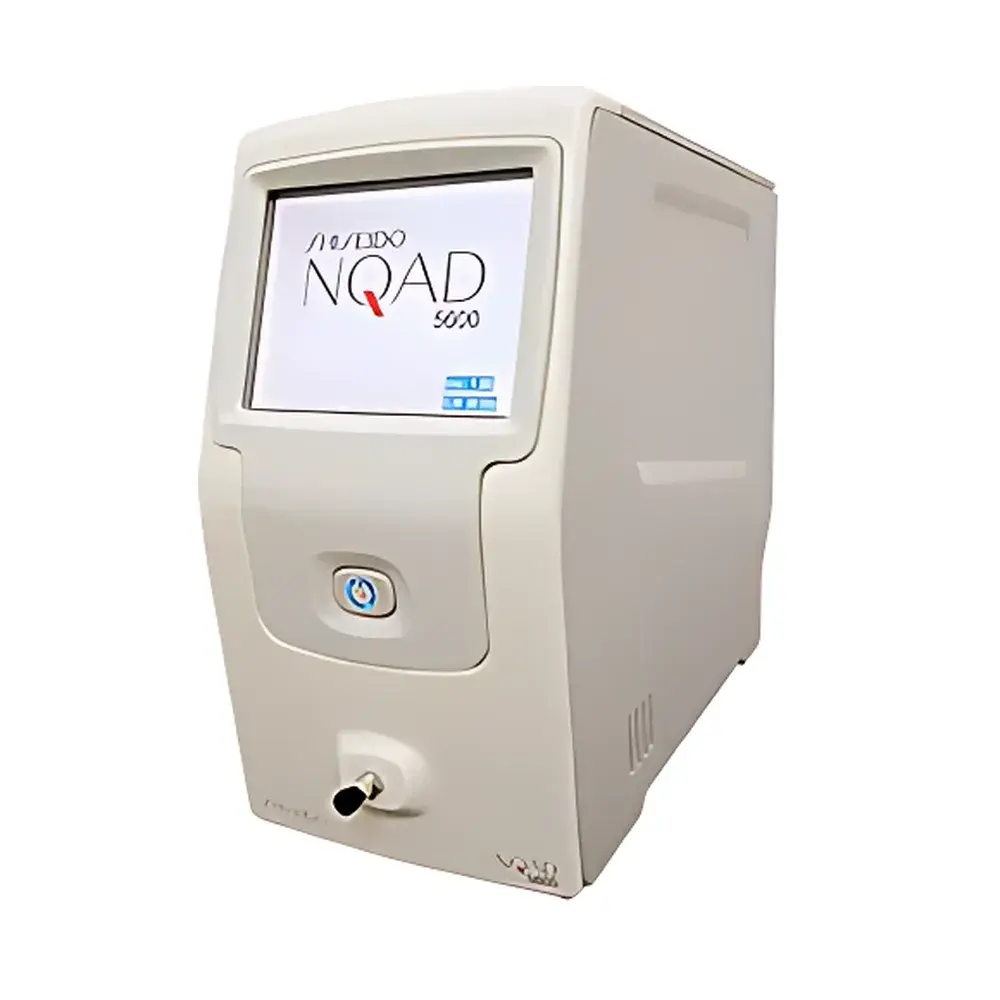
NANOSPACE F5600 NQAD Aerosol Laser Particle Counting Detector
| Brand | NANOSPACE |
|---|---|
| Origin | Japan |
| Model | F5600 |
| Detection Principle | Water Condensation Particle Counting (WCPC) coupled with nebulization and thermal desolvation |
| Light Source | Monochromatic Laser |
| Detection Mode | Universal, Non-UV, Non-Ionizing, Non-Electrochemical |
| Applicable Analytes | Non-volatile, non-UV-absorbing, non-ionizable, electrochemically inert, or structurally unknown compounds |
| Compliance Context | Designed for GLP-compliant laboratories |
Overview
The NANOSPACE F5600 NQAD (Nano Quantity Analyte Detector) is a universal, non-destructive aerosol-based laser particle counting detector engineered for liquid chromatography (LC) systems. Unlike conventional detectors—such as UV-Vis absorbance, fluorescence, or mass spectrometry—the NQAD operates on a fundamentally distinct physical principle: it converts eluting solutes into size-resolved aerosol particles via controlled nebulization, thermal desolvation, and water condensation amplification, followed by optical detection via high-sensitivity laser scattering. This approach eliminates dependence on chromophores, ionization efficiency, redox activity, or molecular mass, rendering the detector truly universal for non-volatile analytes. The core measurement relies on the linear relationship between the mass of non-volatile residue and the shift in the mode diameter of the resulting particle size distribution—quantified through calibrated WCPC response. As such, the F5600 NQAD is especially suited for purity assessment of solid-phase samples containing unknown impurities, stability-indicating method development, excipient characterization in pharmaceutical formulations, and analysis of synthetic intermediates lacking functional handles for conventional detection.
Key Features
- Universal detection capability for non-volatile compounds irrespective of UV absorption, ionizability, or electrochemical behavior
- Integrated thermally controlled nebulizer and desolvation chamber enabling consistent particle generation from diverse mobile phases (including high-water, high-salt, or viscous solvent systems)
- Water condensation particle counter (WCPC) with precisely regulated supersaturation profile to amplify sub-30 nm particles to optically detectable sizes (>100 nm) while preserving quantitative mass correlation
- Laser-based optical counting module with high pulse resolution and low background noise, optimized for stable signal integration over extended gradient runs
- Modular design compatible with standard HPLC/UHPLC systems—including compatibility with both isocratic and multi-step gradient elution protocols
- Real-time particle distribution mode tracking, enabling direct inference of relative analyte mass concentration without compound-specific calibration
Sample Compatibility & Compliance
The F5600 NQAD accepts all LC-eluted non-volatile analytes, including polymers, peptides, carbohydrates, lipids, metal complexes, inorganic salts, and small-molecule APIs with low molar absorptivity or poor ionization efficiency. It is insensitive to mobile phase additives such as trifluoroacetic acid (TFA), ammonium acetate, or sodium dodecyl sulfate (SDS), provided they are fully volatilized during desolvation. The system meets mechanical and electromagnetic compatibility requirements per IEC 61326-1. While the detector itself does not carry CE or UL certification as a standalone unit, its operational architecture aligns with ISO/IEC 17025 quality management expectations for analytical instrumentation. When deployed within a validated chromatography data system (e.g., Waters Empower, Thermo Chromeleon, or Agilent OpenLab CDS), full 21 CFR Part 11 compliance—including electronic signatures, audit trails, and user access control—is achievable through proper configuration and procedural controls.
Software & Data Management
The F5600 interfaces via analog voltage output (0–10 V) and RS-232/USB digital communication to third-party chromatography data systems. Native acquisition software (NQAD Control Suite v3.x) provides real-time particle size distribution visualization, baseline drift compensation, and automated mode-diameter extraction using Gaussian deconvolution algorithms. All raw particle count histograms and derived metrics—including peak area, mode shift magnitude, and cumulative particle volume—are stored in vendor-neutral .csv and HDF5 formats. Metadata embedding supports traceability to instrument logs, method parameters, and environmental conditions (e.g., ambient temperature, humidity). Data export modules comply with ASTM E1948 and ISO 13683 standards for analytical data interchange.
Applications
- Quantitative purity evaluation of crystalline active pharmaceutical ingredients (APIs) where unknown organic impurities lack chromophores
- Stability-indicating assay development for biodegradable polymers and peptide conjugates under accelerated degradation conditions
- Excipient profiling in generic drug product development—especially for polymeric surfactants and amorphous carriers
- Reaction monitoring in flow chemistry setups where inline UV detection fails due to solvent interference or low-concentration intermediates
- Characterization of nanoparticle formulations (e.g., lipid nanoparticles, polymeric micelles) post-size-exclusion chromatography (SEC)
- Supporting ICH Q5 and Q6A guidelines for structural characterization of complex biologics where orthogonal detection is required
FAQ
Does the F5600 NQAD require compound-specific calibration?
No. Quantitation is based on mass-proportional particle mode shift; calibration is performed once using a single non-volatile standard (e.g., sodium chloride or sucrose) across the expected concentration range.
Can it be used with aqueous mobile phases containing >90% water?
Yes. The integrated desolvation stage operates at up to 120 °C and accommodates high-water-content eluents without compromising particle formation efficiency.
Is the detector compatible with UHPLC systems operating at 1000 bar?
Yes—via appropriate low-dead-volume interface fittings and backpressure regulation; maximum recommended flow rate is 1.0 mL/min for optimal desolvation and particle growth kinetics.
What is the lower limit of detection (LOD) in mass terms?
Typical LOD is 1–5 ng on-column for most non-volatile organics, dependent on nebulization efficiency and mobile phase composition.
Does the system generate hazardous waste or require special exhaust ventilation?
It produces only clean, dry air effluent post-desolvation; no chemical scrubbing or fume hood integration is required beyond standard laboratory HVAC specifications.
Related Products





