
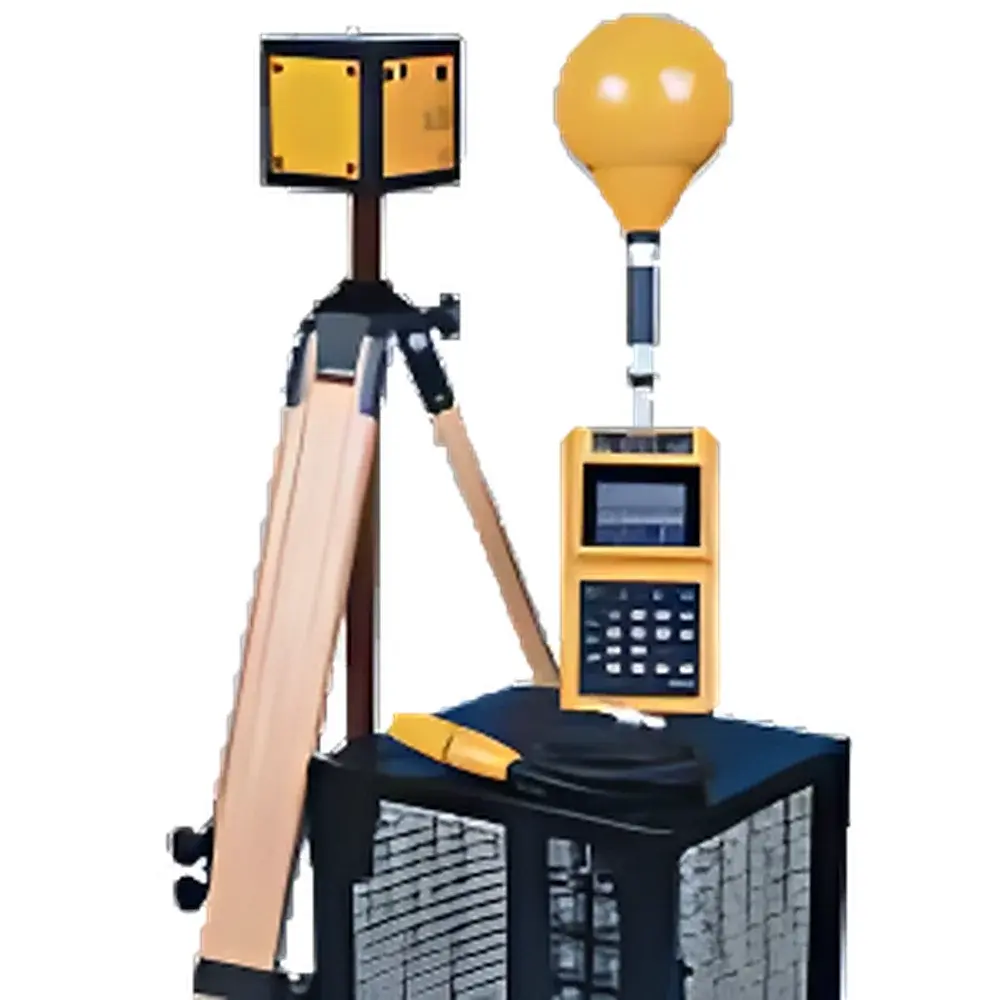
Narda EFA-300 Low-Frequency Electromagnetic Field Analyzer
| Brand | Narda |
|---|---|
| Origin | Germany |
| Model | EFA-300 |
| Frequency Range (Broadband) | 5 Hz – 32 kHz |
| Measurement Modes | RMS, Peak, Vector Peak, Time-Domain STD Weighting |
| Filter Options | Bandpass (15–2000 Hz, 0.1 Hz resolution), Bandstop (15–2000 Hz) |
| Probe Compatibility | Isotropic Magnetic Field Probes (A-type: 100 cm² |
| D-type | 30 mm diameter), Isotropic Electric Field Probe (up to 200 kV/m) |
| Typical Broadband Uncertainty | ±3% @ ≥40 nT (5–2 kHz), ±3% @ ≥5 V/m (5–2 kHz) |
| Display | 128×64 LED matrix with backlight |
| Interface | Optical RS-232 (fiber optic cable included) |
| Operating Temperature | 0–50 °C |
| Battery | Rechargeable NiMH (5×C-cell) |
| Dimensions | 110 × 200 × 60 mm |
| Weight | ~1000 g |
| Calibration Interval | 24 months |
| Optional Modules | FFT Narrowband Spectrum Analysis & Harmonic Measurement (9 harmonics), Remote PC Control Software EFT-TS |
Overview
The Narda EFA-300 Low-Frequency Electromagnetic Field Analyzer is a precision-engineered instrument designed for quantitative assessment of electric and magnetic field exposure in the 5 Hz to 32 kHz range. It operates on the principle of isotropic induction coil sensing for magnetic fields and calibrated dipole-based detection for electric fields—enabling true three-axis vector measurement without directional bias. The system complies with core international exposure assessment frameworks including ICNIRP 2010, IEEE C95.1-2019, and EU Directive 2013/35/EU for occupational and general public electromagnetic field (EMF) exposure. Its dual-mode architecture supports both broadband and frequency-selective analysis, making it suitable for regulatory compliance verification, source identification in complex multi-frequency environments (e.g., substations, traction power systems), and low-frequency EMF research under real-world ambient conditions.
Key Features
- Isotropic triaxial probe design ensures direction-independent measurements across all orientations—critical for accurate spatial averaging in non-uniform fields.
- Configurable broadband frequency bands: 5–2 kHz, 30–2 kHz, 5–32 kHz, and 30–32 kHz (±3 dB), enabling background subtraction and spectral context alignment with natural or anthropogenic noise floors.
- Dual-bandpass/bandstop filtering (15–2000 Hz, 0.1 Hz resolution) facilitates targeted frequency-domain interrogation—supporting both emission source isolation and notch-based interference mitigation analysis.
- Real-time STD-shaped time-domain weighting per six preloaded international limit curves (ICNIRP, IEEE, BGV B11, etc.), delivering immediate pass/fail evaluation against applicable exposure thresholds.
- Automatic zeroing capability maintains measurement integrity even in strong static or quasi-static field environments—eliminating manual drift correction during extended monitoring campaigns.
- Optical RS-232 interface with included 2 m and 10 m fiber-optic cables ensures galvanic isolation and immunity to ground-loop interference during long-distance or high-noise deployments.
- Onboard data logging stores up to 4000 timestamped records (RMS, peak, vector peak) with internal real-time clock—supporting GLP-aligned field documentation without external hardware.
Sample Compatibility & Compliance
The EFA-300 accommodates interchangeable isotropic probes optimized for distinct measurement scenarios: the A-type probe (100 cm² effective area) delivers enhanced sensitivity for low-field environmental surveys (typical broadband noise floor: 4 nT at 30–2 kHz), while the D-type probe (30 mm diameter) enables high-spatial-resolution mapping near conductors or within confined infrastructure spaces. The integrated electric field probe covers 0.7 V/m to 200 kV/m with ±3% uncertainty above 5 V/m—validated per IEC 61786-1:2013 Annex B. All probe calibrations are traceable to PTB (Physikalisch-Technische Bundesanstalt) standards. The instrument meets EMC immunity requirements per EN 61326-1:2013 and is certified for use in Class II, Division 2 hazardous locations when operated with approved accessories.
Software & Data Management
The optional EFT-TS remote control software provides full GUI-based configuration, real-time visualization, and post-processing of acquired datasets on Windows platforms. It supports export to CSV, TXT, and XML formats—ensuring compatibility with third-party statistical tools (e.g., MATLAB, Python pandas) and LIMS integration. Audit trails include operator ID, calibration status flags, and firmware version metadata—facilitating FDA 21 CFR Part 11–compliant workflows where electronic records require attribution and integrity assurance. Firmware updates are delivered via secure HTTPS channels, and configuration templates can be saved/reloaded to standardize multi-instrument deployments across regional monitoring networks.
Applications
The EFA-300 is routinely deployed in utility infrastructure assessment (HV transmission corridors, converter stations, rail electrification systems), occupational hygiene evaluations (induction heating facilities, welding shops, subway depots), and epidemiological EMF exposure studies requiring high-fidelity low-frequency spectral characterization. Its ability to resolve dominant harmonic content—especially 2nd through 9th harmonics of fundamental supply frequencies (50/60 Hz)—makes it indispensable for diagnosing non-linear load contributions in smart grid environments. Regulatory agencies and accredited laboratories utilize its STD-weighted mode for rapid compliance screening per national transposition of EU Directive 2013/35/EU, while academic researchers leverage its FFT module (optional) for time-resolved transient analysis in pulsed-field applications such as regenerative braking systems.
FAQ
What standards does the EFA-300 support for weighted exposure assessment?
It includes six built-in STD-shaped time-domain weighting curves aligned with ICNIRP 2010, IEEE C95.1-2019, German BGV B11, Austrian OVE E88.1, Swiss ORNI, and UK HSE guidelines.
Can the EFA-300 measure both electric and magnetic fields simultaneously?
No—measurements are sequential per selected probe input; however, synchronized dual-probe operation is achievable using external trigger logic via the optical interface.
Is the FFT spectrum analysis module required for basic compliance testing?
No—the core instrument supports broadband and bandpass/bandstop measurements out-of-the-box; FFT functionality is an optional upgrade for advanced spectral diagnostics.
How often must the EFA-300 undergo formal calibration?
Narda recommends traceable recalibration every 24 months under normal operating conditions, with interim functional checks advised prior to critical measurement campaigns.
Does the EFA-300 meet requirements for GLP or GMP-regulated environments?
Yes—when used with EFT-TS and configured with audit trail logging, it satisfies data integrity provisions of OECD GLP Principles and ISO/IEC 17025:2017 clause 7.7 for measurement traceability and record retention.
Related Products







