
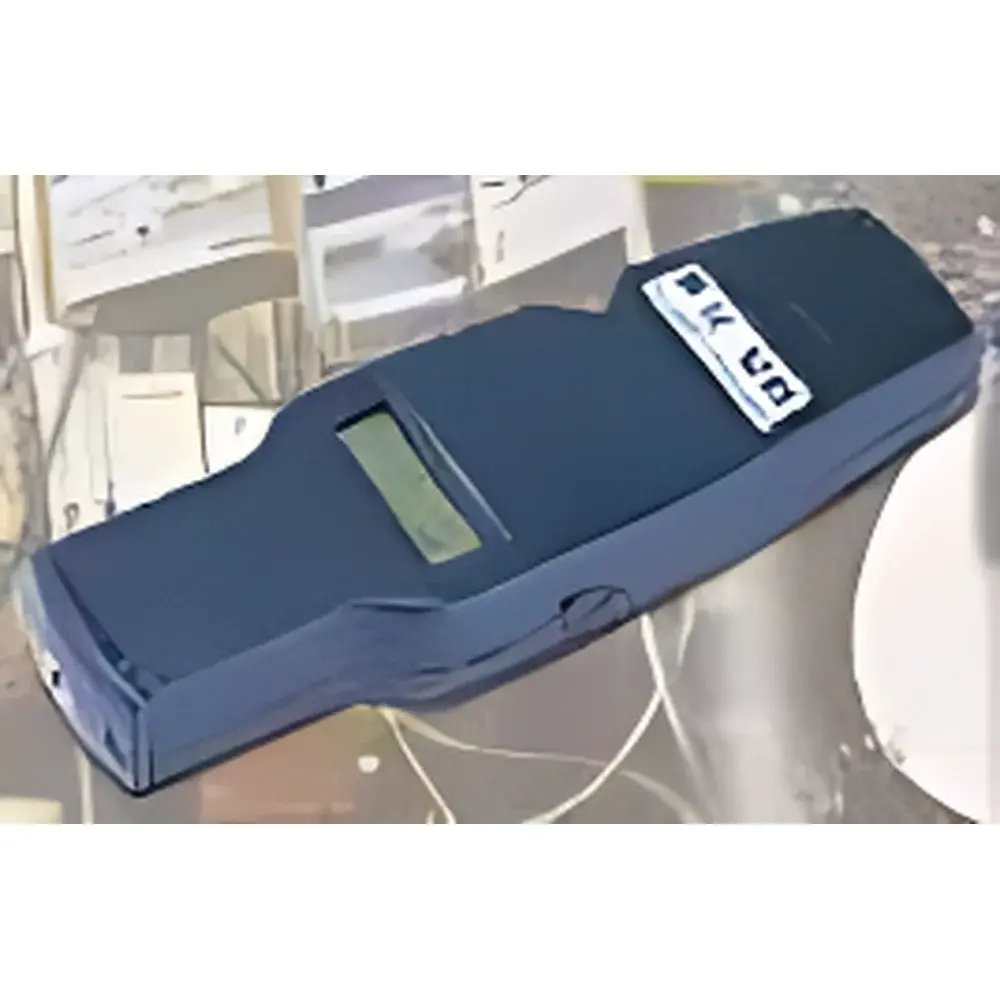
Narda PMM8056 Miniature Electromagnetic Field Analyzer
| Brand | Narda |
|---|---|
| Origin | Germany |
| Model | PMM8056 |
| Electric Field Frequency Range | 3 MHz–40 GHz |
| Electric Field Measurement Range | 0.6 V/m–30 V/m |
| Electric Field Frequency Response | ±3 dB |
| Magnetic Field Frequency Range | 30 MHz–300 MHz |
| Magnetic Field Measurement Range | 7.3 mA/m–3 A/m |
| Magnetic Field Frequency Response | ±3 dB |
| Display | Backlit LCD showing real-time field strength, user-defined thresholds, date/time |
| Audio-visual Alarm | Threshold-triggered audible tone and visual indicator |
| Data Logging | 1 sample/sec (instant), max value every 60 sec, 6-min moving average |
| Interface | Infrared (IR) PC interface |
| Battery Life | 40 h (9 V alkaline, 1200 mAh) |
| Dimensions | 62 × 30 × 190 mm |
| Weight | 200 g |
| Probe Type | Integrated isotropic E-field and H-field sensors |
| Compliance | Designed for compliance with GB 8702–2014 (China EMF exposure limits), ICNIRP 2020 guidelines, and IEEE C95.1–2019 |
Overview
The Narda PMM8056 Miniature Electromagnetic Field Analyzer is a compact, handheld instrument engineered for rapid, reliable assessment of radiofrequency (RF) and microwave electromagnetic fields in occupational and environmental settings. Based on isotropic probe technology and calibrated broadband measurement principles, the PMM8056 simultaneously captures electric (E-field) and magnetic (H-field) vector components without repositioning—enabling true spatially averaged RMS field strength determination per IEC 62232 and EN 50492. Its ultra-compact form factor (62 × 30 × 190 mm, 200 g) allows continuous wearability—e.g., clipped to a lab coat or carried in a shirt pocket—making it ideal for walk-through surveys, mobile site audits, and time-weighted exposure evaluations where portability and operational autonomy are critical. The device operates independently of external power sources and delivers traceable measurements aligned with national and international exposure limit frameworks.
Key Features
- Integrated dual-isotropic probes: Co-located, factory-calibrated 3-axis E-field sensor (3 MHz–40 GHz) and H-field sensor (30 MHz–300 MHz), eliminating alignment dependency and ensuring consistent angular response per ISO/IEC 17025 calibration protocols.
- Real-time threshold monitoring: Configurable alarm thresholds for E-field (V/m) and H-field (A/m) with simultaneous visual (LCD icon + backlight pulse) and audible (variable-tone alert) feedback—supporting immediate operator awareness during high-field excursions.
- Multi-resolution data capture: Continuous logging at 1 Hz resolution; automatic derivation of peak hold (max/min), 6-minute running average (aligned with ICNIRP averaging time windows), and time-stamped event markers.
- Robust embedded architecture: Sealed housing rated IP54 for dust and splash resistance; low-power electronics optimized for >40 hours of continuous operation on a single 9 V alkaline battery (1200 mAh).
- Direct IR interface: No cables or drivers required—enables secure, line-of-sight data transfer to Windows-based analysis software (Narda EMFView) for post-processing, report generation, and audit trail export.
Sample Compatibility & Compliance
The PMM8056 is validated for use across heterogeneous RF environments including cellular base stations (700 MHz–3.8 GHz), Wi-Fi access points (2.4/5/6 GHz), radar systems (X/Ku-band), industrial RF heaters (13.56/27.12 MHz), and consumer appliances (microwave ovens, induction cooktops). It complies with measurement uncertainty requirements defined in EN 50413:2020 (assessment of human exposure to EMFs) and supports evaluation against GB 8702–2014 (China’s electromagnetic environment control limits), ICNIRP 2020 reference levels, and IEEE C95.1–2019 safety thresholds. All probe calibrations are performed in accredited laboratories per ISO/IEC 17025 and include full uncertainty budgets traceable to PTB (Physikalisch-Technische Bundesanstalt, Germany).
Software & Data Management
Data acquired via the integrated infrared interface is imported into Narda EMFView—a Windows-based application compliant with FDA 21 CFR Part 11 (electronic records/signatures) and GLP/GMP documentation standards. EMFView enables spectral decomposition (via FFT post-processing), geotagged survey mapping, customizable report templates (PDF/CSV), and automated compliance flagging against multiple regulatory frameworks. Audit logs record all parameter changes, calibration events, and user actions with timestamped digital signatures—ensuring full data integrity for regulatory submissions or third-party verification.
Applications
- Ongoing occupational health monitoring in telecom infrastructure maintenance, broadcast engineering, and defense electronics testing.
- Pre-commissioning and periodic EMF safety audits for 5G small cells, smart city IoT gateways, and airport navigation systems (ILS/DME/VOR).
- Product conformity testing of household EM-emitting devices per GB 4706.19–2015 (microwave ovens) and GB 4706.29–2008 (induction cookers).
- Electromagnetic compatibility (EMC) pre-scanning prior to formal chamber testing (e.g., EN 61000-4-3 immunity validation).
- Academic and regulatory research requiring portable, repeatable broadband field characterization in urban RF environments.
FAQ
Is the PMM8056 suitable for measuring near-field emissions from PCBs or small antennas?
No—the PMM8056 is optimized for far-field, plane-wave dominated environments (>λ/2π distance from source). Near-field reactive components require specialized near-field probes (e.g., Narda EHP-50F) and are outside its specified operating regime.
Does the instrument support GPS synchronization or georeferenced logging?
No—GPS functionality is not integrated. Geotagging must be performed externally using paired GNSS receivers and synchronized timestamps in EMFView.
Can measurement data be exported in CSV format for statistical analysis?
Yes—EMFView exports fully timestamped, channel-resolved datasets (E-field RMS, H-field RMS, peak values, averages) in UTF-8 CSV with SI unit headers, compatible with MATLAB, Python (pandas), and R.
What is the recalibration interval recommended by Narda?
Annual calibration is recommended under normal use conditions; certificates include full uncertainty statements and traceability to national metrology institutes (PTB, NIST).
Is the PMM8056 compliant with EU CE marking requirements for EMC and safety?
Yes—it bears the CE mark under Directive 2014/30/EU (EMC) and 2014/35/EU (LVD), with test reports available upon request from authorized distributors.







