
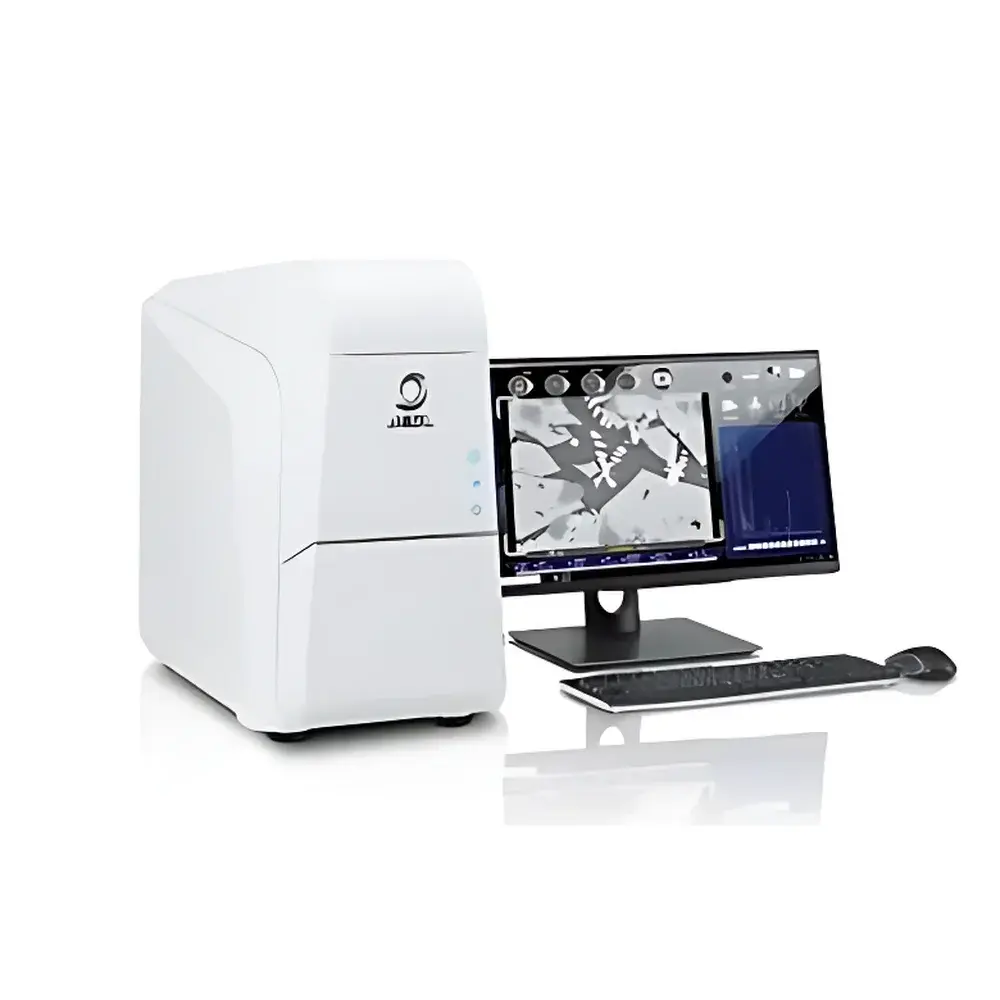
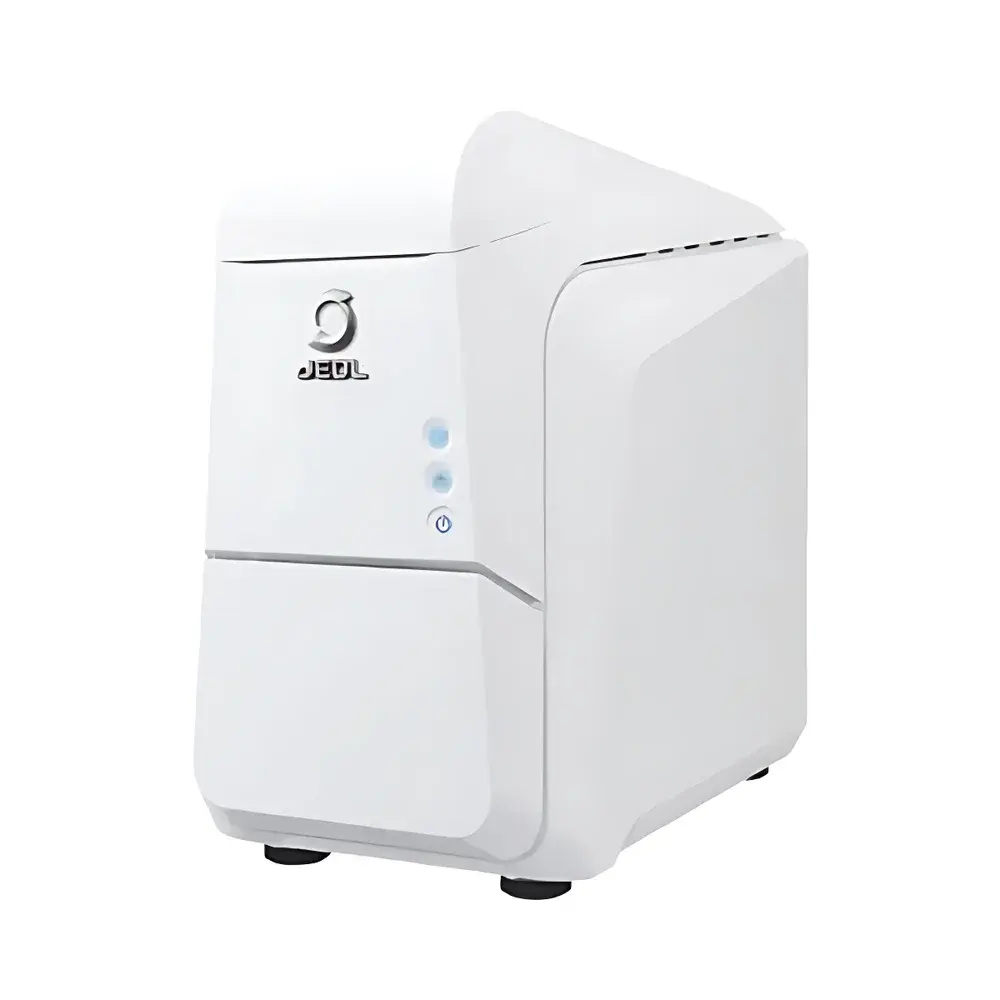
Narishige JCM-7000 Desktop Scanning Electron Microscope
| Brand | Narishige |
|---|---|
| Origin | Japan |
| Model | JCM-7000 |
| Instrument Type | Desktop SEM |
| Magnification Range | 10×–100,000× (print output: 128 mm × 96 mm) |
| 24×–202,168× (on-screen display | 280 mm × 210 mm) |
| Accelerating Voltage | 5 kV, 10 kV, or 15 kV (software-selectable constant-voltage mode) |
| BSE Image Resolution | Not specified (system optimized for compositional and topographic contrast) |
| Specimen Dimensions | Ø80 mm × 50 mm (without stage夹具) |
| Detector Types | Everhart-Thornley secondary electron detector |
| Stage Motion | Motorized X/Y = ±40 mm each |
| Tilt | −15° to +45° |
| Rotation | 360° continuous |
| Vacuum Modes | High Vacuum (HV) and Low Vacuum (LV) |
| Operating System | Windows 10 |
| Data Formats | TIFF, BMP, JPEG, PNG (still) |
| Electron Source | Tungsten filament with integrated Wehnelt cap |
Overview
The Narishige JCM-7000 is a high-performance desktop scanning electron microscope (SEM) engineered for precision, accessibility, and operational flexibility in academic laboratories, quality control environments, and industrial R&D settings. Unlike entry-level compact SEMs that omit critical imaging modalities to reduce cost, the JCM-7000 retains dual-signal detection—secondary electron (SE) and backscattered electron (BSE)—enabling simultaneous morphological and compositional analysis without external add-ons. Its electron optical column employs a thermionic tungsten filament source with an integrated Wehnelt electrode, delivering stable beam current across three selectable accelerating voltages (5 kV, 10 kV, 15 kV), allowing users to optimize signal-to-noise ratio and surface sensitivity for diverse sample types. The system operates in both high vacuum (HV) and low vacuum (LV) modes, supporting direct imaging of non-conductive specimens—including polymers, ceramics, biological tissues, and coated geological samples—without sputter coating or carbon tape pre-treatment. This dual-mode architecture aligns with ISO 16700 and ASTM E1558 standards for SEM-based material characterization, ensuring traceability and method consistency in regulated workflows.
Key Features
- Dual-detector imaging system: Everhart-Thornley SE detector for high-resolution surface topography and a 6-channel segmented BSE detector optimized for atomic number contrast, crystallographic orientation mapping, and depth-sensitive signal separation.
- Motorized precision stage: Fully programmable X/Y translation (±40 mm), tilt (−15° to +45°), and continuous 360° rotation—enabling multi-angle acquisition, cross-sectional alignment, and automated tilt-series collection for Live 3D reconstruction.
- Software-controlled voltage selection: Accelerating voltage switching via GUI interface ensures rapid adaptation between low-kV surface-sensitive imaging and high-kV bulk penetration, minimizing charging artifacts on insulators.
- Integrated vacuum architecture: Equipped with a rotary vane pump (optional oil-free diaphragm pump available), maintaining base pressure ≤5 × 10⁻³ Pa in HV mode and enabling LV operation up to 130 Pa—compliant with IEC 61000-4-8 for electromagnetic compatibility in shared lab environments.
- Real-time digital imaging pipeline: On-board FPGA-accelerated frame acquisition supports AVI streaming at 30 fps, while still-image export conforms to TIFF (16-bit linear), JPEG (lossless compression), PNG (alpha channel support), and BMP (legacy compatibility) formats.
Sample Compatibility & Compliance
The JCM-7000 accommodates specimens up to Ø80 mm in diameter and 50 mm in height without stage fixtures—ideal for bulk materials, fractured components, and unmounted biological sections. Its LV mode eliminates the need for conductive coatings per ISO 21667 guidelines, preserving native surface chemistry during failure analysis or forensic examination. All image metadata—including kV, working distance, dwell time, detector gain, and stage coordinates—is embedded in EXIF-compliant headers, satisfying FDA 21 CFR Part 11 requirements for audit trails in GLP/GMP-regulated labs. The instrument’s mechanical design meets EN 61000-6-2 (immunity) and EN 61000-6-4 (emission) standards for laboratory electromagnetic environments.
Software & Data Management
Controlled via a dedicated Windows 10 workstation (Intel Core i5 or equivalent), the JCM-7000 software suite provides fully automated routines for beam alignment, focus, stigmation correction, brightness/contrast optimization, and stage calibration. Image annotation tools support scale bar embedding, region-of-interest (ROI) measurement (length, area, angle), and histogram-based thresholding for binary segmentation. Raw data files are stored in vendor-neutral formats to ensure long-term archival integrity and third-party interoperability with ImageJ/Fiji, MATLAB, and Python-based analysis pipelines (e.g., scikit-image, OpenCV). Audit logs record user ID, timestamp, parameter changes, and acquisition events—fully compliant with ALCOA+ principles for data integrity in regulated research.
Applications
- Materials science: Fracture surface analysis, grain boundary mapping, inclusion identification in metals and alloys.
- Life sciences: Uncoated plant tissue morphology, insect cuticle ultrastructure, freeze-dried cell monolayers.
- Electronics: Solder joint inspection, PCB delamination assessment, MEMS device metrology.
- Geosciences: Mineral phase discrimination, pore network quantification in shale cores, volcanic ash particle morphology.
- Forensics & conservation: Fiber comparison, paint layer stratigraphy, corrosion product identification on heritage artifacts.
FAQ
Does the JCM-7000 require liquid nitrogen or field emission sources?
No. It uses a robust tungsten thermionic emitter, eliminating cryogenic dependencies and reducing operational overhead.
Can the system perform elemental analysis?
The JCM-7000 does not include an integrated energy-dispersive X-ray spectrometer (EDS); however, its BSE detector geometry and stage stability support seamless integration with third-party EDS modules compliant with JEOL/Northern Digital mounting interfaces.
Is remote operation supported?
Yes—via secure RDP or VNC over local networks, with role-based access control configured through Windows Group Policy.
What maintenance intervals are recommended?
Filament replacement every 150–200 operating hours; vacuum pump oil change every 6 months (rotary vane) or membrane replacement annually (diaphragm option).
How is calibration verified?
Using NIST-traceable grating standards (e.g., SPI #10010) and certified step-height references, with verification logs exportable as PDF reports.




