
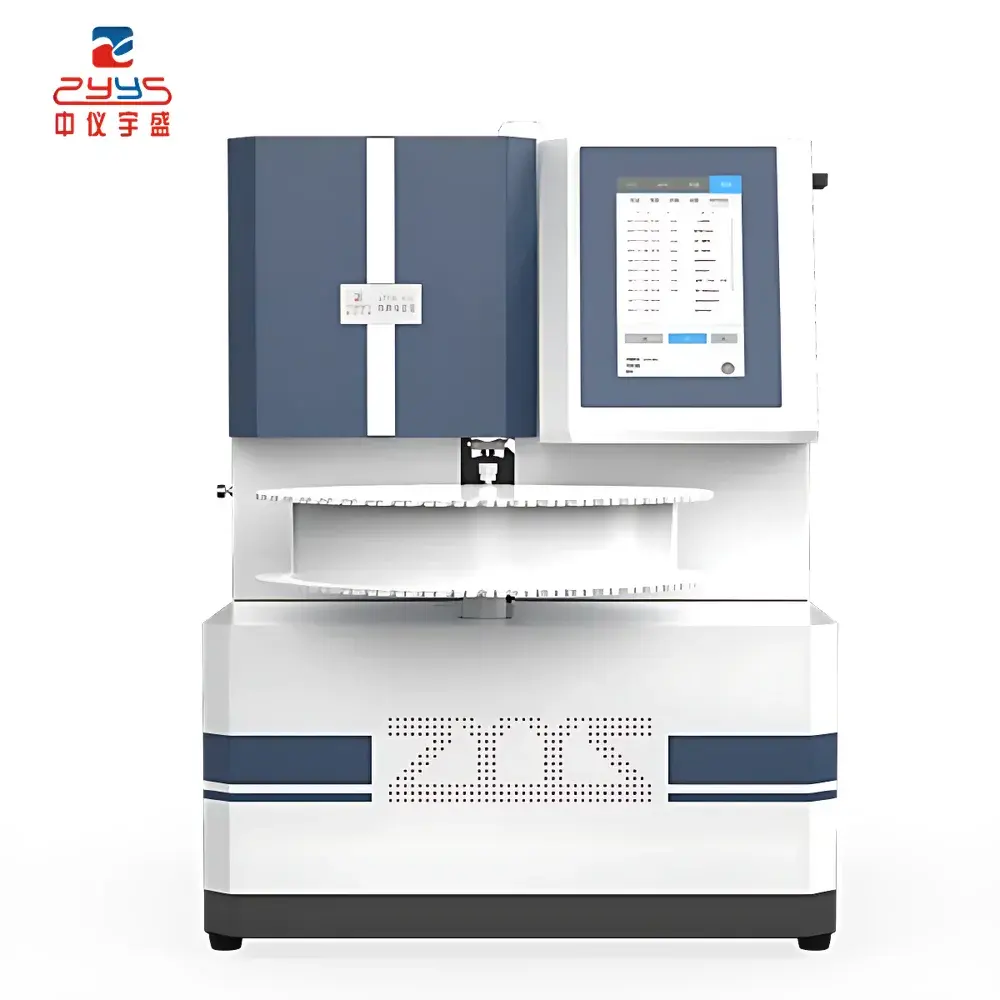
Zhongyi Yusheng ATDS-50A Fully Automated Thermal Desorber
| Brand | Zhongyi Yusheng |
|---|---|
| Origin | Beijing, China |
| Manufacturer Type | Direct Manufacturer |
| Instrument Type | Dual-Stage Thermal Desorber |
| Automation Level | Fully Automated |
| Sample Capacity | 50 Positions |
| Compliance | ASTM D6196, ISO 16017-1, US EPA TO-17, HJ 583–2010, HJ 644–2013, HJ 734–2014, GB/T 18883–2022, GB 50325–2020 |
Overview
The Zhongyi Yusheng ATDS-50A Fully Automated Thermal Desorber is an engineered solution for high-throughput, unattended thermal desorption of volatile and semi-volatile organic compounds (VOCs and SVOCs) from sorbent tubes prior to gas chromatographic analysis. Based on dual-stage thermal desorption principle—comprising primary desorption (tube heating), cryo-focusing (cold trap trapping), and secondary desorption (flash heating into GC inlet)—the ATDS-50A ensures quantitative transfer efficiency, minimal analyte degradation, and robust reproducibility across extended batch runs. Designed for integration with standard split/splitless GC inlets and compatible with both single-quadrupole and triple-quadrupole mass spectrometers, the system supports trace-level analysis in environmental, occupational health, indoor air quality (IAQ), and materials emission testing laboratories.
Key Features
- Fully automated 50-position sample carousel with programmable tube indexing—enabling overnight unattended operation and consistent inter-run positioning accuracy.
- Integrated leak-check protocol executed automatically prior to each desorption cycle, verifying seal integrity between sorbent tube, cold trap, and transfer line (pressure decay detection within ±0.5 psi over 60 s).
- Self-diagnostic startup sequence: real-time verification of heater zones, thermocouple feedback, valve actuation timing, and carousel homing position; error codes logged with actionable fault descriptors.
- Programmable tube-slot addressing—users define discrete tube positions for selective re-analysis or method-specific sequencing without manual reordering.
- Standardized cam-lock tube holder design facilitates rapid, tool-free sorbent tube insertion and cap removal, minimizing mechanical stress on fragile glass or stainless-steel tubes and reducing consumable waste.
- Built-in calibration standard simulation mode: enables periodic system performance verification using certified gaseous or permeation-based standards without external hardware.
Sample Compatibility & Compliance
The ATDS-50A accommodates industry-standard 6 mm OD × 89 mm length sorbent tubes (e.g., Tenax TA, Carbopack B/X, Carboxen 1000, or multi-bed configurations), including U.S. EPA TO-17–compliant tubes. It supports both single-bed and multi-bed sorbent geometries and is validated for use with thermal desorption tubes pre-packed by third-party certified vendors. The system meets technical requirements specified in major regulatory frameworks, including but not limited to: HJ 583–2010 (ambient benzene homologues), HJ 644–2013 (VOCs via TD-GC/MS), HJ 734–2014 (stationary source emissions), GB/T 18883–2022 (indoor air), GB 50325–2020 (civil building IAQ), and ISO 16017-1:2000 (indoor/outdoor air VOCs). Method validation documentation—including recovery studies (≥85% for C2–C12 aliphatics/aromatics), breakthrough volume verification, and carryover assessment (<0.1% for target analytes)—is provided per ICH Q2(R2) and GLP-aligned reporting conventions.
Software & Data Management
Controlled via Windows-based desktop software with role-based user accounts (administrator, analyst, reviewer), the ATDS-50A supports full audit trail functionality compliant with FDA 21 CFR Part 11 requirements—including electronic signatures, immutable event logging (method edits, run initiation, error events), and time-stamped parameter history. Batch methods store complete thermal profiles (pre-desorption bakeout, primary ramp rate, trap cool-down setpoint, secondary flash temperature/duration), valve timing maps, and pressure control parameters. Raw method files are exportable in .xml format; run logs integrate seamlessly with LIMS platforms via ODBC or CSV export. All software updates undergo regression testing against NIST-traceable reference standards and are distributed with version-controlled release notes.
Applications
- Regulatory monitoring of ambient and indoor air VOCs (e.g., benzene, toluene, xylenes, styrene, ethylbenzene, C3–C4 alkylbenzenes) per national and provincial environmental protection bureaus’ directives.
- Workplace exposure assessment in petrochemical, pharmaceutical, coating, and printing industries—aligned with GBZ/T 300 series occupational hygiene standards.
- Emission profiling of building materials (e.g., flooring, adhesives, insulation) under controlled chamber conditions per GB 36246–2018 and ISO 16000-9.
- VOC screening in automotive cabin air per HJ/T 400–2007, including aldehydes and ketones when coupled with derivatization-compatible traps.
- Method development and validation for emerging contaminants such as halogenated benzenes, oxygenated VOCs, and terpenes in complex matrices.
FAQ
Is the ATDS-50A compatible with non-Zhongyi Yusheng GC or GC/MS systems?
Yes—the instrument outputs standard TTL and RS-232 signals for external trigger synchronization and accepts analog voltage inputs for inlet temperature confirmation. Detailed interface schematics and pinout documentation are included in the installation manual.
Does the system support cold trap temperature programming below –30 °C?
The integrated Peltier-cooled trap operates from –30 °C to +400 °C with ±0.5 °C stability; optional liquid nitrogen cooling modules are available for sub-–50 °C focusing upon request.
Can method parameters be locked to prevent unauthorized modification during routine QA/QC runs?
Yes—administrator-defined method templates can be set to “read-only” status; any attempted edit triggers an electronic signature prompt and logs the change attempt with user ID and timestamp.
What maintenance intervals are recommended for long-term operational reliability?
Valve manifold cleaning every 200 runs; cold trap liner replacement every 500 runs; annual calibration verification using certified permeation tubes per ISO/IEC 17025 guidelines.
Is remote monitoring supported for laboratory-wide instrument fleet management?
Via optional Ethernet-enabled controller module, real-time status dashboards, email alerting for fault conditions, and centralized log aggregation are achievable through enterprise-grade SCADA middleware integration.




