
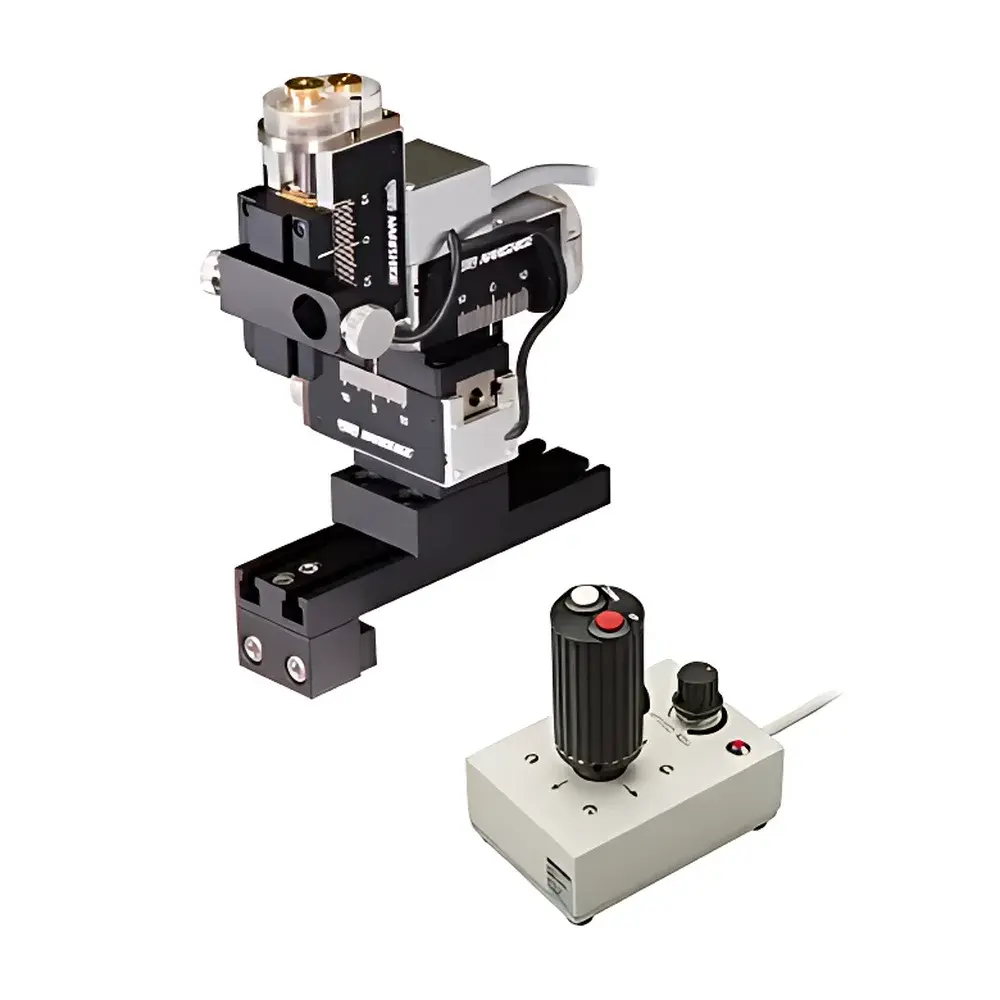
NARISHIGE MM-94B Motor-Driven Micromanipulator (Left-Side Auxiliary Manipulator for MM-94 System)
| Brand | NARISHIGE |
|---|---|
| Origin | Japan |
| Model | MM-94B |
| Travel Range (X/Y/Z) | 22 mm / 22 mm / 22 mm |
| X/Y Axis Speed | 0.1–1.4 mm/s (adjustable via rotary knob), up to 1.4 mm/s with high-speed button |
| Z Axis Speed | 0.2–1.4 mm/s (adjustable), up to 2.8 mm/s with high-speed button |
| Operating Voltage | AC 100–240 V, 50/60 Hz |
| Power Consumption | ~10 W |
| Controller Dimensions | 70 × 100 × 120 mm, 530 g (incl. 1.2 m cable) |
| Control Unit Dimensions | 85 × 112 × 144 mm, 591 g (incl. 1.2 m cable) |
Overview
The NARISHIGE MM-94B is a precision motor-driven micromanipulator designed as a dedicated left-side auxiliary unit for integration with the MM-94 dual-arm micromanipulation system. Engineered for high-resolution electrophysiology, intracellular injection, patch-clamp recording, and microinjection applications, the MM-94B employs stepper-motor actuation coupled with high-ratio harmonic drive gearing to deliver sub-micron positional repeatability and smooth, backlash-free motion across three orthogonal axes (X, Y, Z). Its closed-loop control architecture ensures consistent velocity profiles and precise endpoint positioning without drift—critical when coordinating simultaneous manipulations with a primary right-hand manipulator. Unlike manually operated alternatives, the MM-94B eliminates operator-induced tremor and fatigue, enabling extended-duration experiments requiring sustained nanoliter-scale probe placement accuracy under optical microscopy.
Key Features
- Triaxial motorized motion with independent speed control per axis: X/Y travel range of 22 mm each, Z-axis range of 22 mm—optimized for compatibility with standard microscope stages and inverted optical configurations.
- Variable-speed operation via dual-mode interface: fine-tuning via analog rotary speed knob (0.1–1.4 mm/s on X/Y; 0.2–1.4 mm/s on Z), plus momentary high-speed override (1.4 mm/s on X/Y; 2.8 mm/s on Z) for rapid coarse positioning.
- Low-power, wide-input voltage design (AC 100–240 V, 50/60 Hz) supports global laboratory infrastructure without external transformers; typical power draw remains below 10 W during continuous operation.
- Compact, modular hardware layout: separate controller (70 × 100 × 120 mm, 530 g) and main control unit (85 × 112 × 144 mm, 591 g), both equipped with standardized 1.2 m shielded cables for EMI-resistant signal transmission.
- Robust mechanical construction using machined aluminum housings and ceramic-coated lead screws—designed to maintain dimensional stability over thermal cycles and extended service life in vibration-sensitive environments.
Sample Compatibility & Compliance
The MM-94B is fully compatible with glass micropipettes (0.5–2.0 mm OD), tungsten or platinum-iridium electrodes, and custom-fabricated microprobes used in single-cell manipulation workflows. It interfaces seamlessly with NARISHIGE’s MM-94 mainframe via proprietary DIN-8 multi-pin connectors, preserving synchronized coordinate referencing and shared ground potential. The device complies with IEC 61000-6-2 (immunity) and IEC 61000-6-4 (emission) standards for laboratory-grade electronic equipment. While not classified as a medical device, its performance characteristics align with ISO 13485-aligned quality management practices observed by leading academic core facilities and contract research organizations performing GLP-compliant preclinical studies.
Software & Data Management
The MM-94B operates as a hardware-level peripheral without embedded firmware or onboard data logging. All motion parameters are set exclusively through physical controls—ensuring deterministic real-time response and eliminating latency associated with USB- or Ethernet-based command protocols. This analog-digital hybrid architecture enhances reliability in time-critical applications where jitter-free actuation is non-negotiable (e.g., capacitance compensation during gigaseal formation). For labs requiring traceability, third-party DAQ systems (e.g., National Instruments PXI platforms or Spike2-compatible acquisition hardware) may record analog voltage outputs from the controller’s auxiliary monitoring ports to log position vs. time profiles. No software license, driver installation, or OS dependency is required.
Applications
- Intracellular and extracellular electrophysiological recordings in acute brain slices, dissociated neurons, and cultured cell lines.
- Microinjection of CRISPR/Cas9 ribonucleoprotein complexes, mRNA, dyes, or tracers into zebrafish embryos, Xenopus oocytes, or mammalian blastomeres.
- Paired-patch clamp experiments requiring independent, coordinated movement of two patch pipettes—one mounted on the MM-94 main arm, the other on the MM-94B auxiliary unit.
- Optogenetic probe placement and chronic electrode array alignment in vivo rodent preparations using stereotaxic integration kits.
- Cell sorting and microdissection workflows integrated with laser capture microdissection (LCM) platforms or automated patch-clamp rigs.
FAQ
Is the MM-94B compatible with manipulators other than the MM-94?
No—the MM-94B is mechanically and electrically engineered exclusively for use as a left-side complement to the MM-94 dual-arm system. Its mounting interface, signal protocol, and coordinate frame synchronization are not interoperable with MM-80, MO-200, or non-NARISHIGE platforms.
Does the MM-94B support programmable motion sequences or digital command input?
No—it features analog-only control via front-panel knobs and pushbuttons. No RS-232, USB, or TTL trigger inputs are provided.
Can the MM-94B be used in Faraday cages or RF-shielded environments?
Yes—its low-power design, absence of wireless components, and shielded cabling make it suitable for electromagnetic isolation enclosures when paired with appropriate feedthroughs.
What maintenance is required for long-term performance?
Annual inspection of lead screw lubrication and verification of zero-position encoder offsets using NARISHIGE’s calibration jig (sold separately) is recommended. No user-serviceable electronics are present.
Is CE or UKCA marking applicable?
Yes—the unit carries CE marking per Directive 2014/30/EU (EMC) and 2014/35/EU (LVD); UKCA compliance is maintained through identical technical documentation and testing protocols.



