
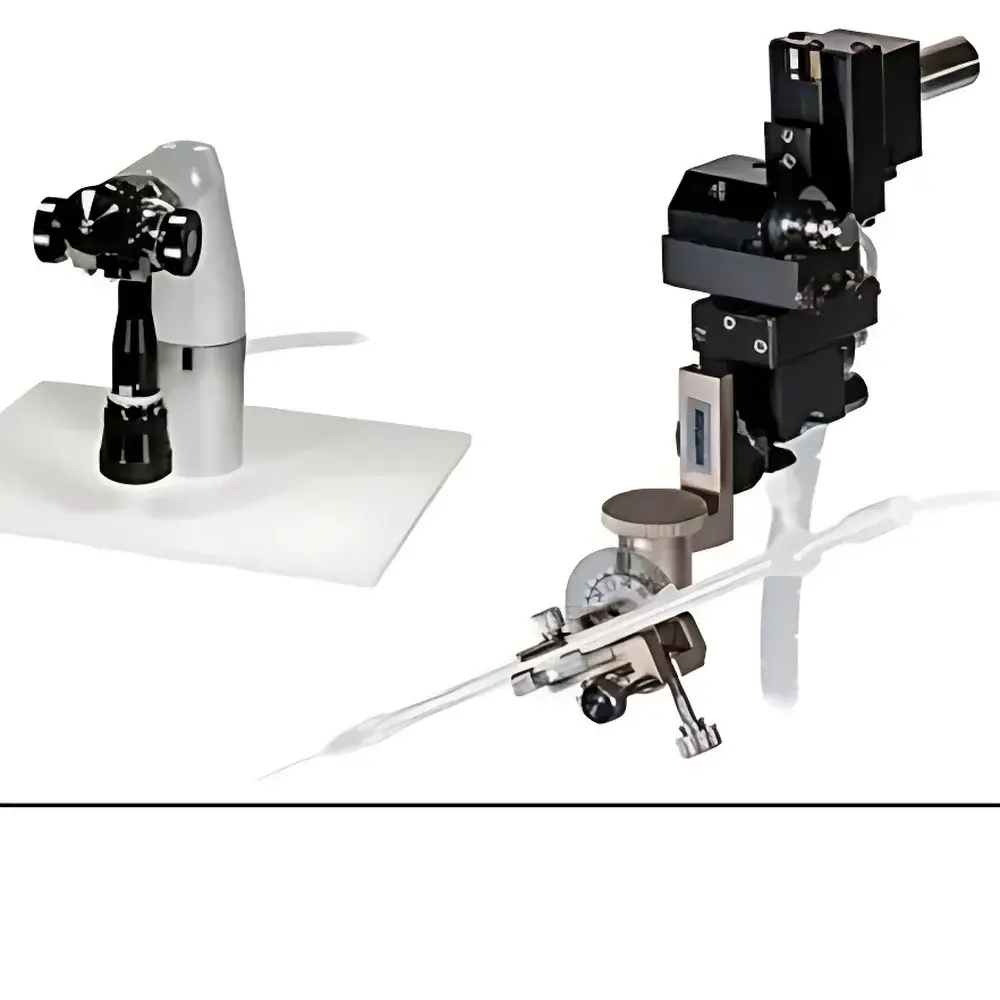
Narishige MMO-4 Hydraulic Three-Axis Micromanipulator
| Brand | Narishige |
|---|---|
| Origin | Japan |
| Model | MMO-4 |
| Actuation Principle | Hydraulic lever + coaxial fine-thread micrometer drives |
| Max Travel per Axis (X/Y/Z) | 10 mm |
| Micrometer Resolution | 2 µm |
| Micrometer Full-Turn Displacement | 250 µm |
| Lever XY Range | 2 mm (adjustable gain) |
| Z-Axis Lever Control | Integrated rotary knob at base |
| Universal Joint | UT-10 with angular adjustment |
| Mounting | Magnetic base with height-adjustable slider |
| Ball Joint Fixation | V-groove + L-clamp mechanical locking |
| Compliance | Designed for ISO/IEC 17025-aligned electrophysiology & microinjection workflows |
| Software Interface | Standalone (no embedded controller) |
Overview
The Narishige MMO-4 Hydraulic Three-Axis Micromanipulator is a precision manual positioning system engineered for high-stability, low-vibration manipulation of microelectrodes, glass pipettes, and injection needles under optical microscopy. It operates on a dual-mode actuation architecture: a pressure-balanced hydraulic lever enables intuitive, fatigue-free XY-plane translation with continuously variable gain control, while three independent coaxial micrometer drives—each with 2 µm graduation and 250 µm per revolution—provide deterministic, backlash-free linear motion along X, Y, and Z axes. Unlike purely mechanical manipulators, the MMO-4 decouples gross positioning from fine adjustment: the hydraulic lever delivers smooth, tremor-damped movement over a 2 mm operational envelope in XY, while the micrometers support repeatable sub-micron repositioning across a full 10 mm range per axis. This hybrid design meets the stringent positional fidelity requirements of patch-clamp electrophysiology, intracytoplasmic sperm injection (ICSI), single-cell biopsy, and microfluidic probe alignment—applications where thermal drift, mechanical hysteresis, or operator-induced vibration must be minimized.
Key Features
- Hydraulic lever control with adjustable gain: Enables proportional XY translation without discrete switching between axes; lever sensitivity tuned via integrated rotary knob at base.
- Dual-input Z-axis actuation: Simultaneous control via lever-mounted rotary knob (for rapid coarse Z adjustment) and dedicated Z micrometer (for sub-2 µm fine positioning).
- UT-10 universal joint with angular calibration scale: Supports precise angular orientation of pipettes (±30° pitch/yaw) and accommodates varying needle lengths via telescoping adjustment.
- Magnetic base with vertical slider: Provides secure attachment to steel microscope stages while allowing height optimization for optical path clearance and ergonomic hand placement.
- V-groove and L-clamp ball-joint fixation: Ensures rigid, non-slip retention of spherical manipulator joints under repeated torque loading during long-duration experiments.
- Independent X/Y/Z micrometers: Each features engraved 2 µm刻度 (scale division), 250 µm/rev lead screw, and knurled brass knobs for tactile feedback and glove-compatible operation.
- Tension-adjustable lever mechanism: Counter-clockwise rotation reduces hydraulic resistance for delicate maneuvers; clockwise increases damping for high-inertia probes.
Sample Compatibility & Compliance
The MMO-4 is routinely deployed in GLP-compliant electrophysiology labs and IVF clinics certified under ISO 13485. Its all-metal construction (stainless steel, anodized aluminum) and absence of elastomeric seals ensure compatibility with ethanol, isopropanol, and 70% v/v disinfectants used in sterile microinjection suites. The UT-10 joint and pipette holder accept standard borosilicate capillaries (OD 1.0–1.5 mm) and tungsten electrodes (up to 100 µm diameter). While the device itself contains no electronic components and thus requires no FDA 510(k) or CE marking, its integration into ICSI workflows aligns with ESHRE guidelines for mechanical stability and positional reproducibility. Calibration traceability follows Narishige’s internal metrology protocol (certified against NIST-traceable gauge blocks), supporting audit readiness for ISO/IEC 17025 accreditation.
Software & Data Management
The MMO-4 is a fully analog, controller-free instrument. It does not incorporate onboard firmware, digital encoders, or USB/RS-232 interfaces. All position data must be recorded manually or synchronized externally via third-party motorized coarse stages (e.g., Narishige MO-202 or MN-4), which provide encoder-based position logging compatible with LabVIEW, MATLAB, or Python-based acquisition platforms. For regulatory environments requiring electronic records, users integrate the MMO-4 within validated workflows where micrometer readings are entered into ELN systems with 21 CFR Part 11-compliant audit trails. No proprietary software is required or provided.
Applications
- Whole-cell patch-clamp recording: Precise electrode approach and seal formation with minimal axial vibration.
- Intracytoplasmic sperm injection (ICSI): Stable needle positioning relative to oocyte membrane under ×400 DIC optics.
- Single-cell RNA extraction: Controlled penetration of cell membranes using pulled quartz pipettes.
- Microelectrode array (MEA) probing: Alignment of recording shanks to predefined electrode sites on cultured neural networks.
- Microfluidic device interfacing: Positioning of inlet/outlet capillaries relative to PDMS channel ports with <5 µm lateral tolerance.
- Optogenetic fiber implantation: Angular registration of 200 µm optical fibers for targeted cortical layer delivery.
FAQ
Is the MMO-4 compatible with inverted microscopes?
Yes—the magnetic base and height-adjustable slider allow secure mounting on standard steel-stage inverted systems (e.g., Nikon Ti2, Zeiss Axio Observer), with sufficient clearance for 40× and 60× objectives.
Can the hydraulic lever be disabled for purely micrometer-based operation?
No—the lever is mechanically coupled to the XY drive train; however, tension adjustment enables near-static positioning when fully tightened.
What is the maximum recommended load for the UT-10 universal joint?
Narishige specifies a static load limit of 150 g at the pipette tip; exceeding this may compromise angular repeatability and joint stiffness.
Does the MMO-4 require periodic hydraulic fluid replacement?
No—the sealed oil reservoir uses inert silicone-based fluid with >10-year service life under normal lab conditions; no maintenance schedule is defined.
Is the ball-joint locking mechanism compatible with cryogenic applications?
Not recommended—thermal contraction of aluminum components below −20°C may reduce clamping force; use only at ambient temperatures (15–30°C).





