
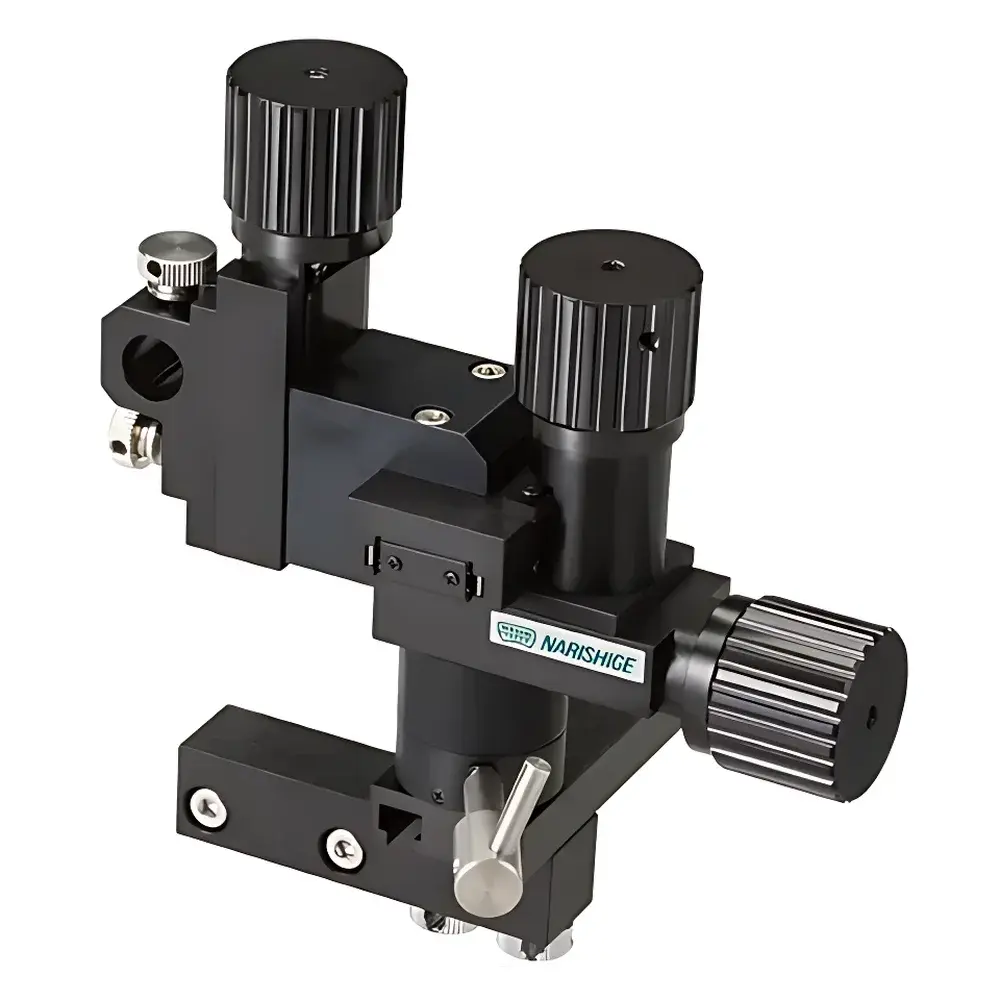
Narishige MN-4 Coarse Manipulator
| Brand | Narishige |
|---|---|
| Origin | Japan |
| Model | MN-4 |
| Construction Material | Anodized Aluminum Alloy |
| Weight | 0.6 kg |
| Dimensions (W × D × H) | 125 × 110 × 135 mm |
| Coarse Travel Range | X: 30 mm, Y: 30 mm, Z: 30 mm |
| Included Accessory | Universal Wrench |
| Compliance | Designed for integration with standard micromanipulator mounting systems (e.g., Narishige MM series, Leica, Olympus, Zeiss microscope stages) |
Overview
The Narishige MN-4 Coarse Manipulator is a precision-engineered mechanical positioning device designed for rapid, repeatable coarse-stage translation in life science and electrophysiology workflows. Unlike motorized or piezo-driven units, the MN-4 employs a robust manual gear-and-rack transmission system optimized for tactile feedback, mechanical stability, and long-term dimensional fidelity. Its operation is grounded in classical mechanical displacement principles—linear motion is achieved via calibrated knurled knobs driving hardened steel lead screws with backlash-compensated nut assemblies. This architecture ensures minimal hysteresis and high positional reproducibility (< ±5 µm over full travel), making it suitable for pre-positioning tasks prior to fine-scale manipulation using complementary micro-manipulators (e.g., Narishige MO-202, MM-33, or hydraulic models). The MN-4 serves as a foundational stage in multi-tiered positioning systems, commonly deployed on inverted microscopes, patch-clamp rigs, and intracellular injection platforms where spatial coordination between coarse repositioning and sub-micron precision is critical.
Key Features
- High-rigidity anodized aluminum alloy frame provides thermal stability and resistance to mechanical creep under sustained load.
- Three-axis independent coarse translation (X/Y/Z) with 30 mm travel per axis, enabling full workspace coverage without stage re-mounting.
- Ergonomic, low-torque control knobs with tactile detents ensure consistent hand-wheel rotation and reduce operator fatigue during extended use.
- Integrated universal wrench included for secure attachment to standard dovetail or threaded mounting plates (M4/M6 compatible).
- Compact footprint (125 × 110 × 135 mm) facilitates integration into space-constrained setups—including dual-manipulator configurations and enclosed environmental chambers.
- No electrical components or firmware required: fully passive, EMI-immune operation ideal for electrophysiological recordings and laser-based experiments.
Sample Compatibility & Compliance
The MN-4 is not a sample-contacting instrument but a mechanical positioning interface. It is routinely validated for use with glass micropipettes (0.5–2.0 mm OD), tungsten or platinum-iridium electrodes, patch-clamp pipettes, and microinjection needles. Its static rigidity supports loads up to 250 g without measurable deflection (>0.1 µm/100 g, measured at Z-axis tip). The device conforms to ISO 9001 manufacturing standards at Narishige’s Tokyo facility and meets RoHS Directive 2011/65/EU for hazardous substance restrictions. While not a medical device, its mechanical design aligns with GLP-aligned laboratory infrastructure requirements for traceable, non-drifting positioning hardware in preclinical neuroscience and developmental biology applications.
Software & Data Management
As a purely mechanical manipulator, the MN-4 does not incorporate embedded electronics, sensors, or digital interfaces. It operates independently of software control and requires no drivers, SDKs, or calibration files. Position data is not digitally recorded; instead, users rely on external documentation (e.g., lab notebooks, video timestamps, or synchronized acquisition software such as pCLAMP, Spike2, or NIS-Elements) to correlate MN-4 coarse positioning events with experimental timelines. For labs requiring audit trails, the MN-4’s fixed mechanical repeatability supports manual logbook entries compliant with FDA 21 CFR Part 11 when paired with electronic lab notebook (ELN) systems that capture operator annotations and timestamped workflow steps.
Applications
- Preliminary electrode or pipette positioning in whole-cell patch-clamp experiments prior to fine adjustment with hydraulic or motorized micromanipulators.
- Rapid repositioning between multiple cell targets during serial intracellular injections in zebrafish, Xenopus oocytes, or cultured neurons.
- Coarse alignment of optical fibers or photostimulation probes in optogenetics rigs integrated with upright or inverted microscopes.
- Stage-level navigation in time-lapse imaging setups where repeated field-of-view shifts must occur without disturbing focus or illumination geometry.
- Support arm for vibration-isolated optical tables in single-molecule fluorescence or TIRF microscopy, where passive stability outweighs active control needs.
FAQ
Is the MN-4 compatible with non-Narishige microscope stages?
Yes—the MN-4 features standardized M4 and M6 threaded mounting holes and accepts common dovetail adapters used by Leica, Olympus, Zeiss, and Nikon inverted and upright stands.
Does the MN-4 require periodic recalibration?
No—its mechanical design eliminates drift or zero-point shift. Repeatability is maintained through precision-machined gears and preloaded linear bearings; no user calibration is specified or supported.
Can the MN-4 be used in humid or CO₂ incubator environments?
Only if mounted externally with feedthrough-compatible shaft extensions; the unit itself is not rated for continuous high-humidity or elevated-CO₂ exposure due to potential anodization degradation over extended periods.
What is the maximum recommended payload for stable operation?
250 g distributed at the manipulator tip; exceeding this may compromise angular stability and increase backlash over time.
Is replacement lubrication available from Narishige?
No—internal mechanisms are factory-sealed and not serviceable; disassembly voids warranty and risks misalignment of gear trains.



