
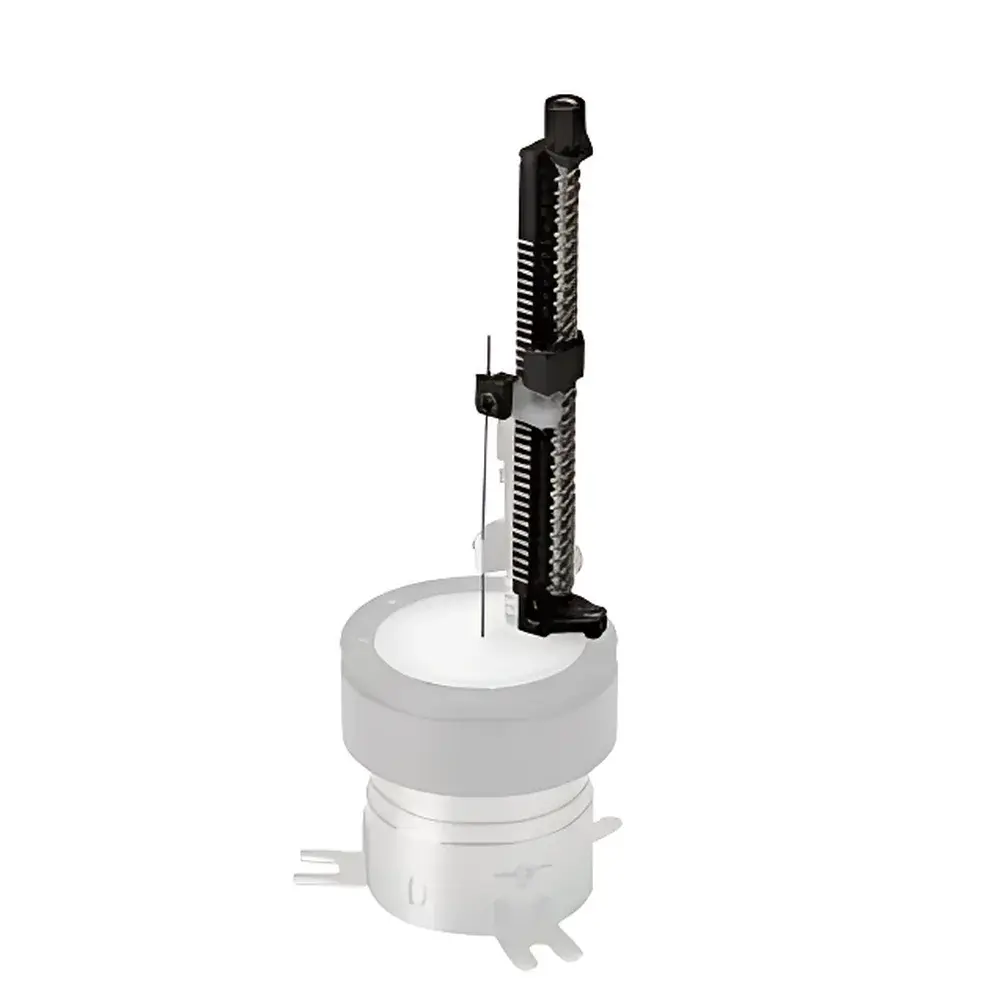
NARISHIGE MO-903A Miniature Coarse-Adjustment Controller
| Brand | NARISHIGE |
|---|---|
| Origin | Japan |
| Model | MO-903A |
| Dimensions (W×D×H) | 12 × 8 × 51 mm |
| Weight | 7 g |
| Coarse Adjustment Range (Z-axis) | 40 mm |
| Compatible With | NARISHIGE MO-903B Micromanipulator |
| Operation Method | Hex Key (Allen Wrench) Actuation |
| Mounting Interface | Standard NARISHIGE modular dovetail coupling |
Overview
The NARISHIGE MO-903A is a precision-engineered miniature coarse-adjustment controller designed exclusively for integration with the NARISHIGE MO-903B motorized micromanipulator system. Unlike fine-positioning stages that rely on piezoelectric or stepper-motor actuation, the MO-903A implements a mechanical, backlash-minimized coarse translation mechanism along the Z-axis—enabling rapid, repeatable macro-positioning prior to high-resolution micro-adjustment. Its operation is based on a calibrated lead-screw drive actuated via a standard hex key (2 mm Allen wrench), delivering deterministic linear displacement without electrical input or software dependency. This hybrid approach—coarse mechanical pre-positioning followed by fine electronic control—significantly reduces total alignment time in electrophysiology, patch-clamp, intracellular injection, and microinjection workflows where initial probe proximity must be established reliably before sub-micron servo control engages.
Key Features
- Ultra-compact form factor (12 × 8 × 51 mm) engineered for space-constrained rig configurations, including multi-manipulator setups on inverted microscopes and vibration-isolated optical tables.
- Z-axis coarse travel of 40 mm with tactile, non-slip scale markings for visual positional reference; travel direction and zero point are unambiguously defined per NARISHIGE’s standardized orientation convention.
- 7 g mass minimizes inertial loading on supporting structures—critical when mounted on cantilevered manipulator arms or lightweight XYZ stages.
- Dovetail-compatible mounting interface ensures mechanical interoperability with the full NARISHIGE MO-series manipulator ecosystem, including MO-903B, MO-101, and MO-202 platforms.
- No power, cables, or firmware required—operation is purely manual and deterministic, eliminating electromagnetic interference (EMI) concerns in low-noise electrophysiology recordings.
- Hex-key actuation provides consistent torque transmission and avoids slippage during repetitive adjustments, supporting long-term reproducibility across daily experimental sessions.
Sample Compatibility & Compliance
The MO-903A is not a standalone instrument but a system-level component intended for use in regulated life science instrumentation environments. It complies with mechanical design requirements specified in ISO 13485:2016 for medical device accessories and conforms to JIS B 7451 (Japanese Industrial Standard for precision positioning mechanisms). While the controller itself does not perform measurements or data acquisition, its structural stability and dimensional repeatability support GLP-compliant experimental protocols when integrated into validated NARISHIGE manipulator systems used in preclinical neurophysiology and developmental biology laboratories. No CE marking or FDA 510(k) clearance applies, as it falls outside the regulatory scope of active medical devices under EU MDR or US FDA definitions.
Software & Data Management
The MO-903A operates independently of software control and generates no digital output. Its function is entirely mechanical and decoupled from host computer systems, making it inherently compatible with any acquisition platform—including Axon pCLAMP, HEKA PatchMaster, or custom LabVIEW-based electrophysiology suites—without driver conflicts or timing dependencies. Positional metadata (e.g., approximate Z-coordinate prior to fine adjustment) must be manually logged in lab notebooks or LIMS systems. For traceability in auditable workflows, users are advised to record hex-key rotation count (each full turn = 0.5 mm displacement, per NARISHIGE calibration documentation) alongside timestamped experimental notes. No audit trail, electronic signature, or 21 CFR Part 11 compliance features are provided—consistent with its classification as a passive mechanical accessory.
Applications
- Rapid Z-axis pre-positioning of glass micropipettes or patch-clamp electrodes prior to engagement of MO-903B’s high-resolution piezoelectric fine stage.
- Coarse depth adjustment of injection needles in embryonic or oocyte microinjection protocols requiring millimeter-scale entry trajectory control.
- Initial alignment of optogenetic fiber optics or silicon probes relative to cortical surface landmarks in in vivo rodent preparations.
- Macro-repositioning of confocal or multiphoton objective collimators where thermal drift necessitates periodic re-zeroing of working distance.
- Modular extension of existing NARISHIGE manipulator arrays in core facilities supporting shared-user electrophysiology rigs.
FAQ
Is the MO-903A compatible with manipulators other than the MO-903B?
Yes—any NARISHIGE manipulator featuring the standard 12-mm dovetail mounting interface (e.g., MO-101, MO-202, MO-903 series) can physically accept the MO-903A, though optimal functional integration is validated only with the MO-903B.
What is the resolution of Z-axis movement?
The MO-903A is not a precision positioning device; its minimum discernible increment is governed by operator dexterity and hex-key torque. Displacement per full 360° turn is 0.5 mm, as specified in NARISHIGE technical documentation.
Does the MO-903A require calibration or maintenance?
No scheduled calibration is required. Users should periodically inspect the lead screw and mating threads for particulate contamination and apply a light coating of NARISHIGE-recommended fluorinated grease (Part No. GREASE-F) every 6 months under continuous use.
Can the MO-903A be sterilized for in vivo applications?
It is not designed for autoclaving or chemical sterilization. Ethanol wipe-down (70 % v/v) is permissible for surface decontamination; avoid immersion or exposure to chlorinated solvents.



