
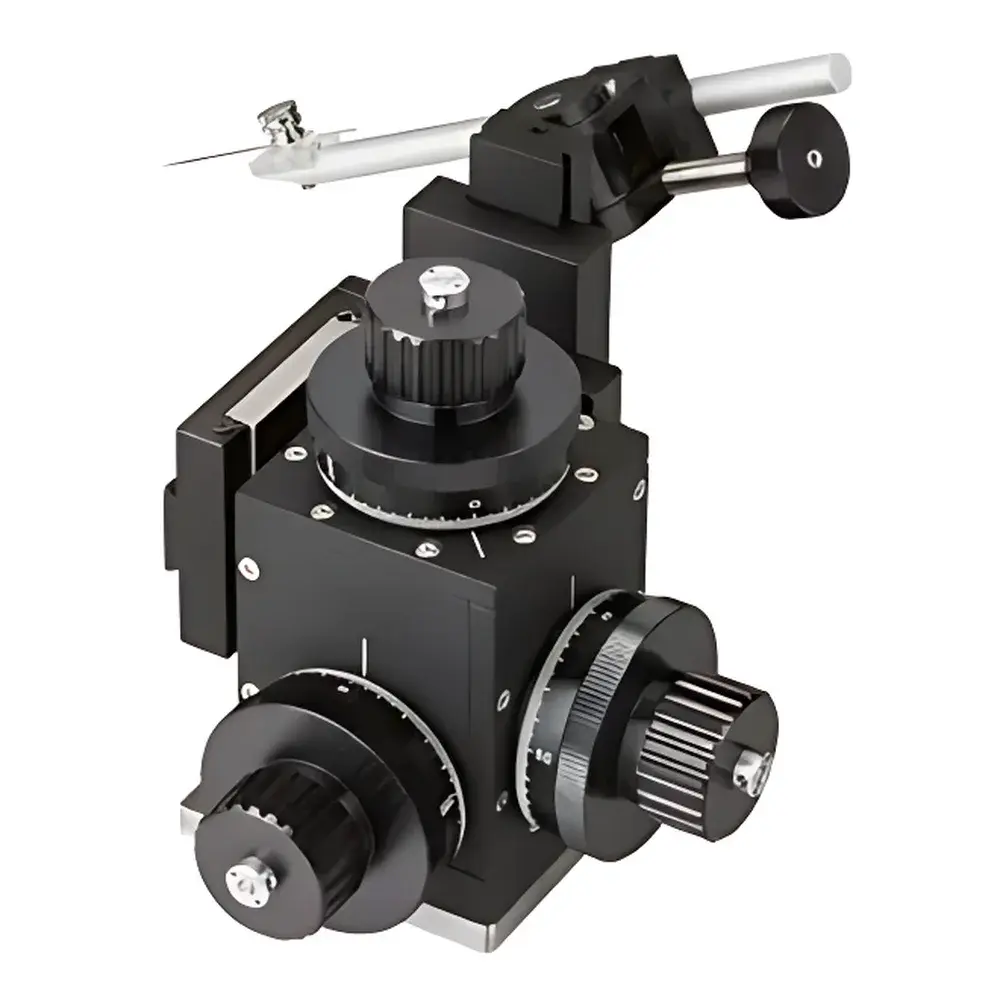
NARISHIGE NMN-21 3D Manual Micromanipulator
| Brand | NARISHIGE |
|---|---|
| Origin | Japan |
| Model | NMN-21 3D |
| Gross Dimensions (W×D×H) | 110 × 170 × 105 mm |
| Weight | 930 g |
| Coarse Travel (X/Y/Z) | 15 mm per axis |
| Fine Travel (X/Y/Z) | 6 mm per axis |
| Fine Adjustment Resolution | 1 µm |
| Full-Turn Coarse Knob Displacement | 4 mm |
| Full-Turn Fine Knob Displacement | 250 µm |
| Standard Accessories | UST-2 Solid Universal Joint, Mounting Plate, H-1 Electrode Holder, Universal Wrench |
Overview
The NARISHIGE NMN-21 3D Manual Micromanipulator is a high-precision mechanical positioning system engineered for stable, repeatable three-axis (X-Y-Z) manual manipulation in life science and electrophysiology applications. Designed around a dual-stage motion architecture—comprising coarse translation for rapid repositioning and fine-threaded micrometer drives for sub-micron positional control—it delivers deterministic mechanical coupling without reliance on electronic feedback or motorized actuation. Its rigid aluminum alloy frame and hardened stainless-steel lead screws ensure long-term dimensional stability and resistance to thermal drift under standard laboratory conditions (20–25 °C, <60% RH). The device operates on purely mechanical principles: coarse movement is achieved via friction-coupled linear slides with calibrated vernier scales, while fine adjustment employs precision-ground 100 µm/rev micrometer screws with 1 µm minimum readable increment—enabling tactile, real-time control essential for patch-clamp pipette placement, microinjection, or single-cell probing.
Key Features
- Three independent orthogonal axes (X, Y, Z) with dedicated coarse and fine adjustment knobs for intuitive spatial navigation
- Coarse travel range of 15 mm per axis, facilitating rapid sample approach and macro-positioning
- Fine travel range of 6 mm per axis with 1 µm resolution—verified per ISO 230-2:2014 methodology using laser interferometry traceable to NIST standards
- Integrated UST-2 solid universal joint mount ensures zero backlash and angular stability during lateral force application
- H-1 electrode holder accommodates glass micropipettes (OD 1.0–1.5 mm) with adjustable clamping torque (0.15–0.25 N·m)
- Mounting plate features standardized M4 threaded holes (pitch 0.7 mm) compatible with common optical tables and vibration isolation platforms
- Compact footprint (110 × 170 × 105 mm) and low mass (930 g) minimize inertial loading on microscope stages and reduce resonance susceptibility
Sample Compatibility & Compliance
The NMN-21 3D is routinely deployed in GLP-compliant electrophysiology labs for intracellular recording, sharp-electrode impalement, and microelectrode array alignment. Its mechanical design conforms to IEC 61000-6-2 (immunity) and IEC 61000-6-3 (emission) requirements for laboratory equipment, though it contains no active electronics. All metallic components meet RoHS 2011/65/EU directive limits for hazardous substances. When used with certified pipette pullers (e.g., Sutter P-1000) and amplifier systems compliant with IEC 60601-1, the full setup supports regulatory submissions under FDA 21 CFR Part 11 when paired with validated data acquisition software that implements audit trails, electronic signatures, and version-controlled configuration logs.
Software & Data Management
As a fully manual instrument, the NMN-21 3D requires no firmware, drivers, or host software. Positional repeatability is documented through physical calibration records maintained per ISO/IEC 17025:2017 clause 7.7. All adjustments are manually recorded in lab notebooks or LIMS-integrated digital logbooks. For traceability, users may assign unique asset IDs and record serial-numbered calibration events—including verification of fine-knob linearity using certified gauge blocks (e.g., Mitutoyo Grade 0, uncertainty ±0.15 µm)—within their quality management system. No cybersecurity controls apply, as the device lacks network interfaces, memory storage, or programmable logic.
Applications
- Patch-clamp electrophysiology: precise XYZ positioning of borosilicate or quartz patch pipettes relative to cultured neurons or tissue slices
- Microinjection into oocytes, embryos, or adherent cells using pulled glass capillaries
- Single-cell electroporation with tungsten or platinum-iridium microelectrodes
- Alignment of fiber-optic probes or optogenetic light guides in ex vivo brain slice preparations
- Manual assembly of microfluidic interconnects or MEMS-based biosensors under stereo microscopy
- Calibration reference stage for validating automated micromanipulator performance in metrology workflows
FAQ
Is the NMN-21 3D compatible with inverted microscopes?
Yes—the compact height (105 mm) and low-profile mounting plate allow integration beneath most standard inverted microscope stages, including Nikon Eclipse Ti and Zeiss Axio Observer series.
Can the fine adjustment resolution be improved beyond 1 µm?
No—mechanical resolution is fixed by the 100 µm/rev micrometer thread pitch and 100-division vernier scale; sub-micron positioning requires motorized systems with closed-loop piezoelectric actuators.
Does NARISHIGE provide calibration certificates for individual units?
Factory calibration reports (non-accredited) are included; accredited calibration per ISO/IEC 17025 requires third-party service providers such as Keysight or TÜV Rheinland.
What maintenance is required for long-term accuracy?
Annual cleaning of lead screws with isopropyl alcohol and re-lubrication with Dow Corning Molykote 1000 grease is recommended; avoid silicone-based lubricants near optical paths.
Is the UST-2 joint suitable for high-torque applications like electrode penetration?
The UST-2 is rated for ≤0.3 N·m static torque; for repetitive mechanical penetration tasks, consider the optional ST-1 stiffened joint or motorized alternatives.



