
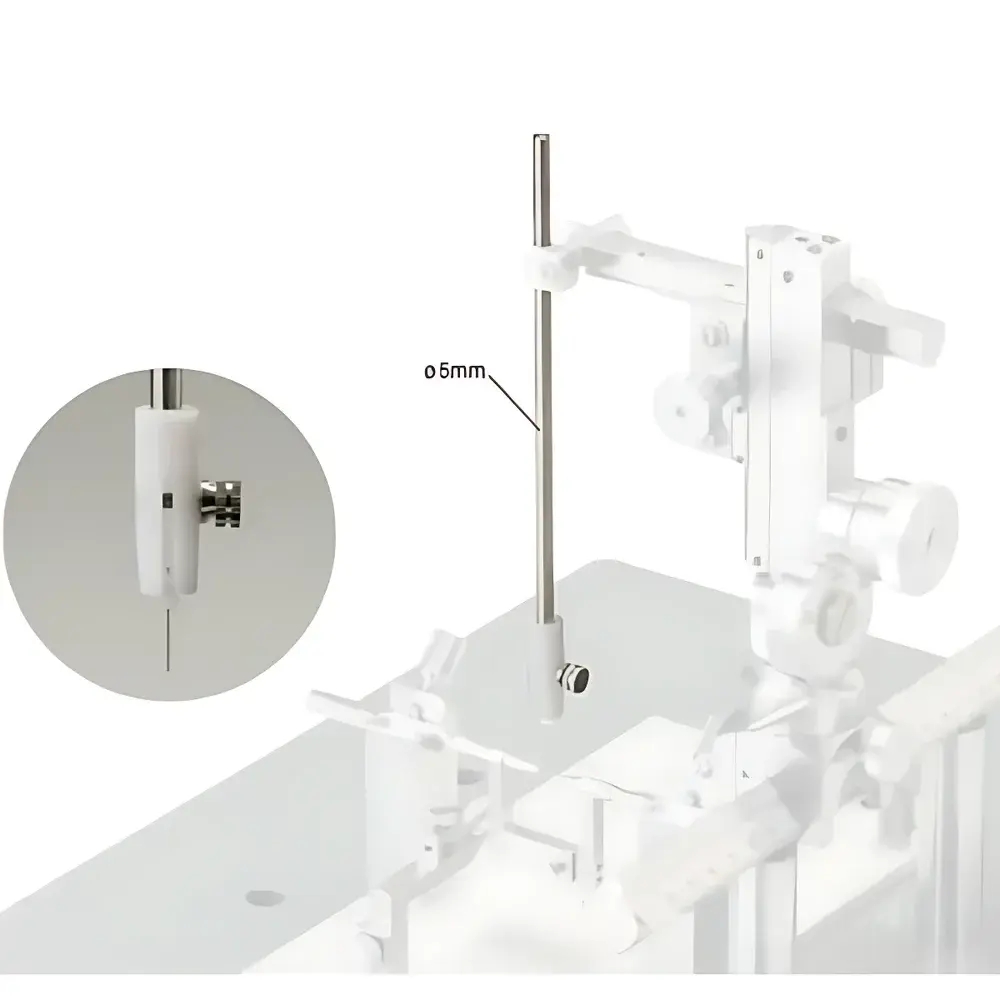
Narishige SHC-1 Micro-Implantation Cannula Holder
| Brand | Narishige |
|---|---|
| Origin | Japan |
| Model | SHC-1 |
| Dimensions | Ø5 × L150 mm |
| Weight | 29 g |
| Material | Anodized Aluminum Body with Chemically Resistant Polymer Tip |
| Mounting Interface | Standard SM-15R/L Micromanipulator Adapter |
| Compliance | Designed for Sterile, GLP-Compliant In Vivo Neuropharmacology & Electrophysiology Setups |
Overview
The Narishige SHC-1 Micro-Implantation Cannula Holder is a precision-engineered mechanical support device designed for stereotactic intracranial or peripheral cannulation procedures in preclinical research. It operates on a simple yet highly effective clamping principle—utilizing a single knurled thumb screw to apply uniform radial pressure around the outer diameter of a cannula (typically Ø3.5 mm), securing it rigidly within the holder’s bore without deformation or slippage. Its function is not measurement-based but mechanical: to eliminate axial and rotational drift during insertion and post-implantation stabilization, thereby ensuring reproducible anatomical targeting when used in conjunction with stereotactic frames (e.g., Narishige SR-6M) and high-resolution micromanipulators (e.g., SM-15R/L). The SHC-1 is purpose-built for acute and chronic implantation workflows where positional fidelity, operator ergonomics, and material compatibility with disinfectants (e.g., 70% ethanol, hydrogen peroxide vapor) are critical.
Key Features
- Precision Clamping Mechanism: A single-axis, brass-threaded locking knob delivers consistent torque transmission—enabling secure fixation of stainless steel, polyimide-coated, or fused silica cannulas (Ø3.0–Ø4.0 mm) without microscratching or plastic deformation.
- Stereo-Compatible Integration: Features a standardized 1/4″-28 UNC threaded base compatible with Narishige SM-15R/L micromanipulator arms and third-party stereotactic adapters (e.g., Kopf 963, David Kopf Instruments).
- Corrosion-Resistant Architecture: Main body constructed from aerospace-grade anodized aluminum (Type II, black hardcoat); tip cap fabricated from medical-grade PEEK polymer—resistant to repeated autoclaving (up to 121°C, 15 psi), ethanol immersion, and common laboratory solvents.
- Minimalist Ergonomic Design: Total mass of 29 g reduces cantilever load on micromanipulator arms; compact Ø5 × 150 mm cylindrical profile allows unobstructed optical access during concurrent microscopy or laser ablation procedures.
- Repeatable Position Retention: Zero-backlash clamping ensures that once calibrated via micromanipulator scale readouts, the cannula’s axial position remains invariant across multiple insertion cycles—critical for longitudinal studies requiring identical coordinates across sessions.
Sample Compatibility & Compliance
The SHC-1 accommodates standard neuropharmacological cannulas—including 26–33 gauge stainless steel guide cannulas (Plastics One C313G, Bioanalytical Systems CMA/Microdialysis probes), polyimide-insulated tungsten electrodes, and custom-fabricated glass micropipettes. Its design conforms to widely adopted preclinical instrumentation standards: ISO 13485-compliant manufacturing traceability (Narishige Japan facility), compatibility with USP cleanroom handling protocols, and full integration into FDA 21 CFR Part 11–aligned experimental workflows when paired with audit-trail-enabled digital micromanipulator controllers (e.g., Narishige MN-400). No electrical components or software dependencies render it inherently compliant with IEC 61000-4 electromagnetic immunity requirements.
Software & Data Management
As a passive mechanical interface, the SHC-1 requires no firmware, drivers, or software integration. All positional data (depth, angle, lateral offset) are recorded manually or via synchronized digital micromanipulator readouts (e.g., Narishige MN-400 encoder outputs exported as CSV/TXT). When deployed in GLP-regulated environments, its use is documented in instrument logs alongside stereotactic coordinate tables and surgical SOPs—ensuring full traceability from implantation to histological verification. Calibration certificates for associated micromanipulators and stereotactic frames constitute the primary metrological chain; the SHC-1 itself undergoes annual visual inspection per institutional biosafety protocols.
Applications
- Intracerebral Drug Delivery: Stabilizes bilateral guide cannulas during chronic infusion of neuroactive compounds (e.g., dopamine agonists, siRNA vectors) in rodent models of Parkinson’s disease or depression.
- In Vivo Electrophysiology: Secures tetrode or silicon probe arrays during acute recordings, minimizing mechanical noise induced by manual handling or respiratory motion coupling.
- Microdialysis Probe Implantation: Maintains precise depth control for CMA probes in striatal or hippocampal sampling—reducing tissue damage and improving analyte recovery consistency.
- Peripheral Catheterization: Adaptable for jugular vein or carotid artery cannulation in pharmacokinetic studies, particularly where simultaneous blood pressure monitoring and IV dosing are required.
- Developmental Neuroscience: Used in neonatal mouse/rat pups for intraventricular injections—leveraging low mass and fine-torque actuation to avoid skull fracture during delicate positioning.
FAQ
Can the SHC-1 be autoclaved?
Yes—the aluminum body and PEEK tip are rated for full-cycle autoclaving (121°C, 15 psi, 20 min). However, repeated cycles may accelerate wear on the internal Teflon-lined bushing; replacement bushings (Narishige P/N: SHC-BUSH) are available.
Is the SHC-1 compatible with non-Narishige micromanipulators?
It accepts any manipulator with a 1/4″-28 UNC female thread mount. Adapters for Leica, Scientifica, and Sutter MP-285 systems are commercially available through authorized distributors.
What is the maximum recommended insertion force when using the SHC-1?
No active force amplification is provided. Users must rely on micromanipulator motorized or manual feed mechanisms; the SHC-1 transmits only the force applied through the manipulator arm—typically ≤500 mN for cortical penetration in murine models.
Does the SHC-1 include depth calibration markings?
No. Depth referencing is performed externally via micromanipulator digital displays or calibrated vernier scales integrated into the stereotactic frame.
How often should the internal clamping bushing be replaced?
Under daily use in a core facility setting, replacement every 6–12 months is recommended to maintain optimal grip retention and prevent micro-slip during slow-speed insertions.
Related Products



