
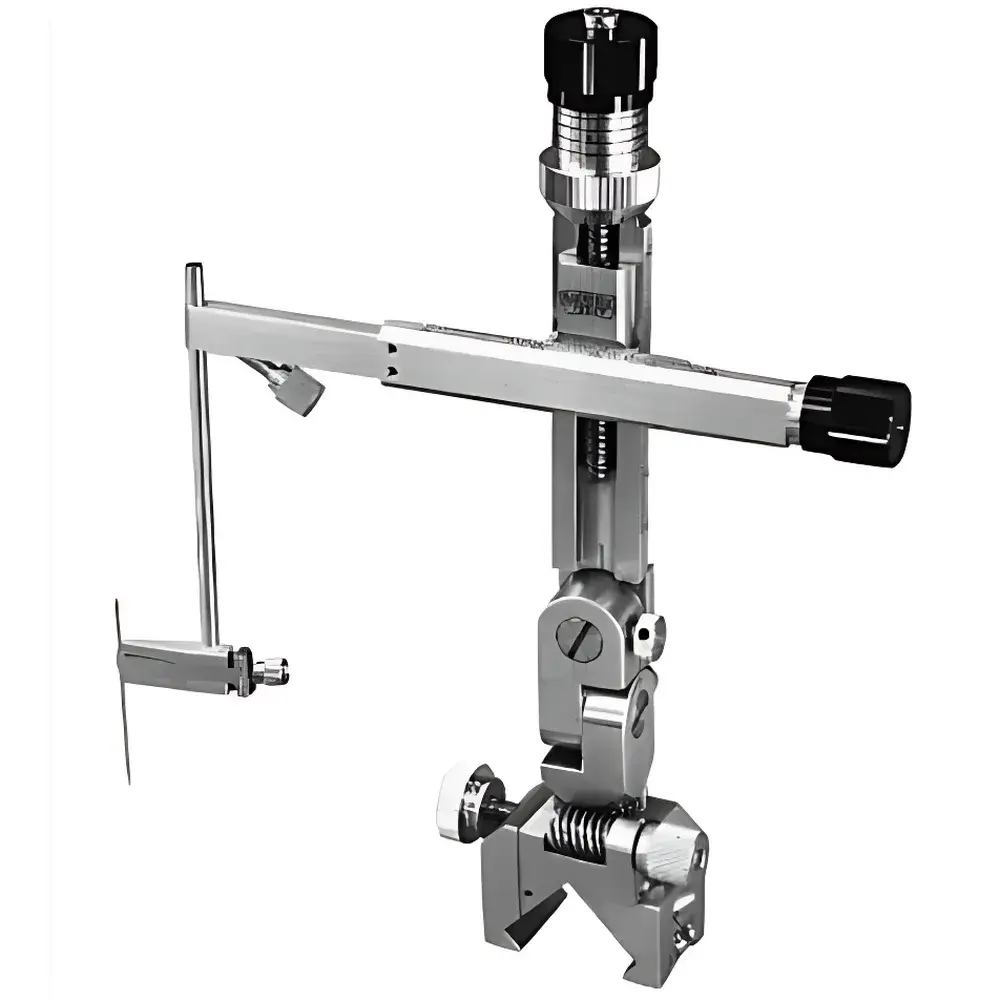
Narishige SM-25A Stereotactic Micromanipulator
| Brand | Narishige |
|---|---|
| Origin | Japan |
| Model | SM-25A |
| Gross Weight | 350 g |
| Dimensions (W×D×H) | 125 × 28 × 172 mm |
| Coarse Motion Range | X ±2 mm, Z ±15 mm |
| Fine Motion Range | Z ±5 mm |
| Minimum Step Size | 10 µm |
| Maximum Pivot Angle Adjustment | ±250 µm (arc displacement at tip) |
| Mounting Interface | Standard stereotactic rail or adapter plate |
| Actuation | Manual micrometer-driven coarse/fine Z-axis, manual pivot and rotation controls |
| Compatibility | Designed for integration with Narishige and third-party stereotactic frames (e.g., David Kopf, Stoelting) |
Overview
The Narishige SM-25A Stereotactic Micromanipulator is a precision mechanical positioning instrument engineered for high-resolution electrophysiological recording, microinjection, and targeted neural intervention in vivo. It operates on the principle of orthogonal three-axis mechanical translation combined with calibrated angular pivoting—enabling sub-micron repeatability in electrode placement relative to a stereotactic coordinate system. Unlike motorized or hydraulic alternatives, the SM-25A relies on manually actuated, gear-reduced micrometer drives and hardened stainless-steel kinematic joints to deliver deterministic, backlash-free motion without electronic noise interference—a critical requirement for low-noise extracellular and intracellular recordings. Its ultra-slim profile (28 mm depth) minimizes obstruction in confined surgical fields while maintaining torsional rigidity through optimized beam geometry and precision-ground linear guides. The device is not standalone; it functions as an integrated module within a full stereotactic setup, interfacing directly with standard L-shaped or U-shaped stereotactic frames via standardized mounting rails.
Key Features
- Ultra-low-profile design (28 mm depth) optimized for unobstructed optical access and compatibility with multi-electrode arrays and two-photon imaging setups.
- Dual-stage Z-axis control: coarse travel (±15 mm) for rapid approach and fine adjustment (±5 mm) with 10 µm minimum incremental resolution, enabling precise depth calibration during acute brain slice or in vivo penetration.
- Pivot-based angular alignment system allowing continuous, repeatable electrode angulation—critical for targeting deep nuclei (e.g., substantia nigra, ventral tegmental area) while avoiding vasculature.
- Manual horizontal plane rotation (via ergonomic handle) facilitating real-time reorientation of electrode trajectory without frame repositioning.
- Modular construction using corrosion-resistant anodized aluminum and hardened steel components, supporting autoclave-compatible disassembly and ethanol/IPA wipe-down per GLP-compliant lab protocols.
- Interchangeable electrode holders compatible with 1.0–1.5 mm OD glass pipettes, metal microelectrodes, and optrodes—secured via spring-loaded collet or setscrew mechanisms.
Sample Compatibility & Compliance
The SM-25A is validated for use across rodent (mouse, rat), avian, and non-human primate stereotactic procedures. Its mechanical stability meets ISO 13485-aligned handling requirements for Class I laboratory equipment used in preclinical research environments. While not a medical device per FDA 21 CFR Part 820, its dimensional repeatability and material traceability support compliance with GLP (OECD Principles) and AAALAC-accredited animal protocol documentation. All surface finishes conform to ISO 8502-3 for particulate cleanliness, minimizing contamination risk during sterile preparations. No electrical or pneumatic interfaces are present—eliminating electromagnetic interference concerns in EEG/LFP or patch-clamp recordings.
Software & Data Management
As a purely mechanical manipulator, the SM-25A does not incorporate embedded firmware, wireless connectivity, or digital feedback loops. Positional data must be recorded manually or synchronized externally via third-party systems (e.g., Spike2, OpenEphys, or custom MATLAB/Python scripts) using calibrated stage encoders or video-based tracking (e.g., DeepLabCut). Its analog operation ensures immunity to software crashes, firmware updates, or cybersecurity vulnerabilities—making it suitable for long-duration chronic experiments (>72 h) where system uptime is mission-critical. Documentation of positional settings (micrometer dial readings, pivot angle marks, rotation handle index) is performed using standardized lab notebooks or ELN platforms compliant with 21 CFR Part 11 when paired with electronic signature workflows.
Applications
- In vivo single-unit and multi-unit extracellular recording in awake, head-fixed or anesthetized subjects.
- Ionophoretic or pressure-mediated drug microinjection into discrete brain regions with volumetric control down to nanoliter increments.
- Targeted viral vector delivery (AAV, lentivirus) for optogenetic or chemogenetic construct expression.
- Chronic implantation of tetrodes, silicon probes, or flexible neural interfaces with precise trajectory planning.
- Combined electrophysiology and two-photon calcium imaging requiring minimal physical occlusion above the craniotomy site.
- Developmental neurobiology studies involving embryonic or neonatal rodent brain targeting under stereomicroscopic guidance.
FAQ
Is the SM-25A compatible with non-Narishige stereotactic frames?
Yes—it mounts to any frame equipped with standard 12.7 mm or 19 mm pitch T-slot rails using optional adapter plates (e.g., Narishige SA-1 or custom-machined brackets).
Does it support motorized or automated control?
No. The SM-25A is strictly manual. For motorized alternatives, consider the Narishige MO-10 or MN-151 series.
What is the maximum recommended electrode weight?
Up to 5 g for stable operation; heavier loads may compromise fine-adjustment resolution and increase drift over time.
Can it be sterilized between uses?
Yes—fully disassemblable design allows autoclaving of metal components (121°C, 20 min); polymer parts (e.g., knobs, grips) require cold sterilization (70% ethanol or hydrogen peroxide vapor).
How does SM-25A differ from SM-25C?
The SM-25C integrates oil-damped remote-control actuators for vibration-free motion in sensitive applications; the SM-25A prioritizes compactness, tactile feedback, and electromagnetic silence for electrophysiology.



