
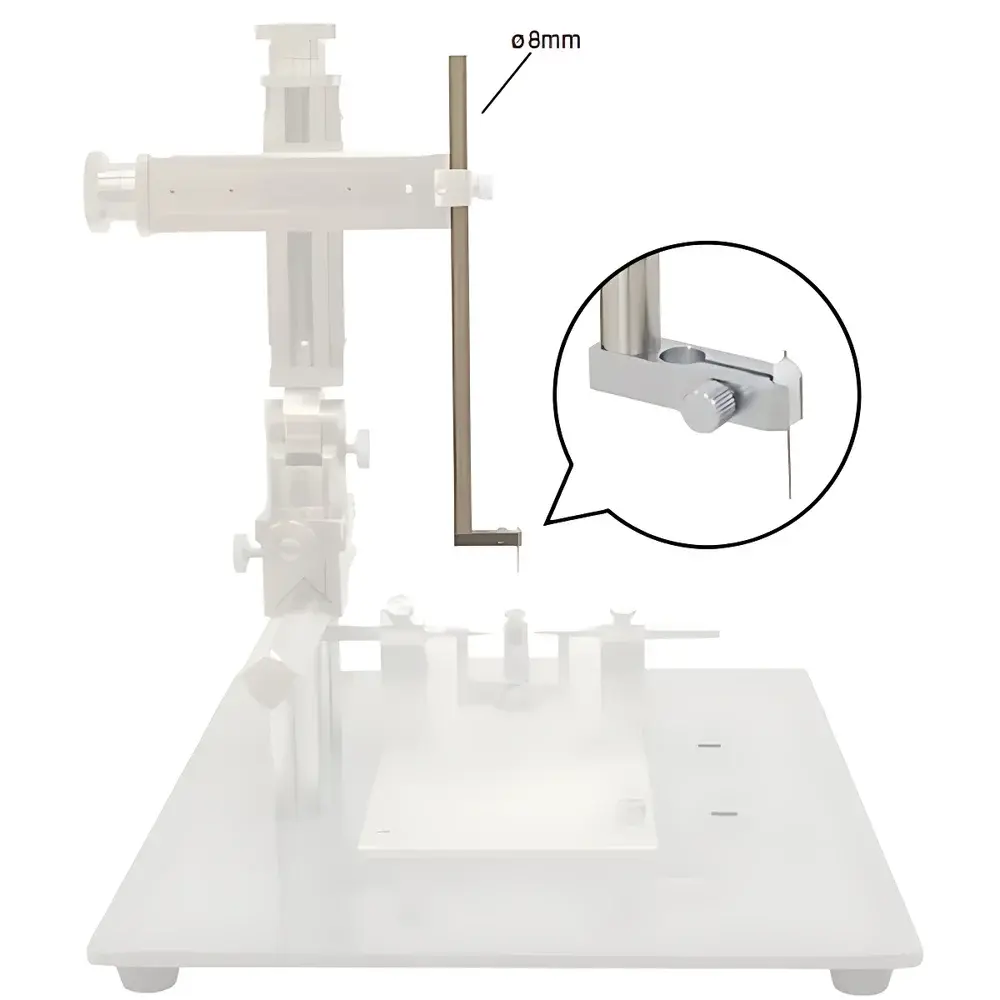
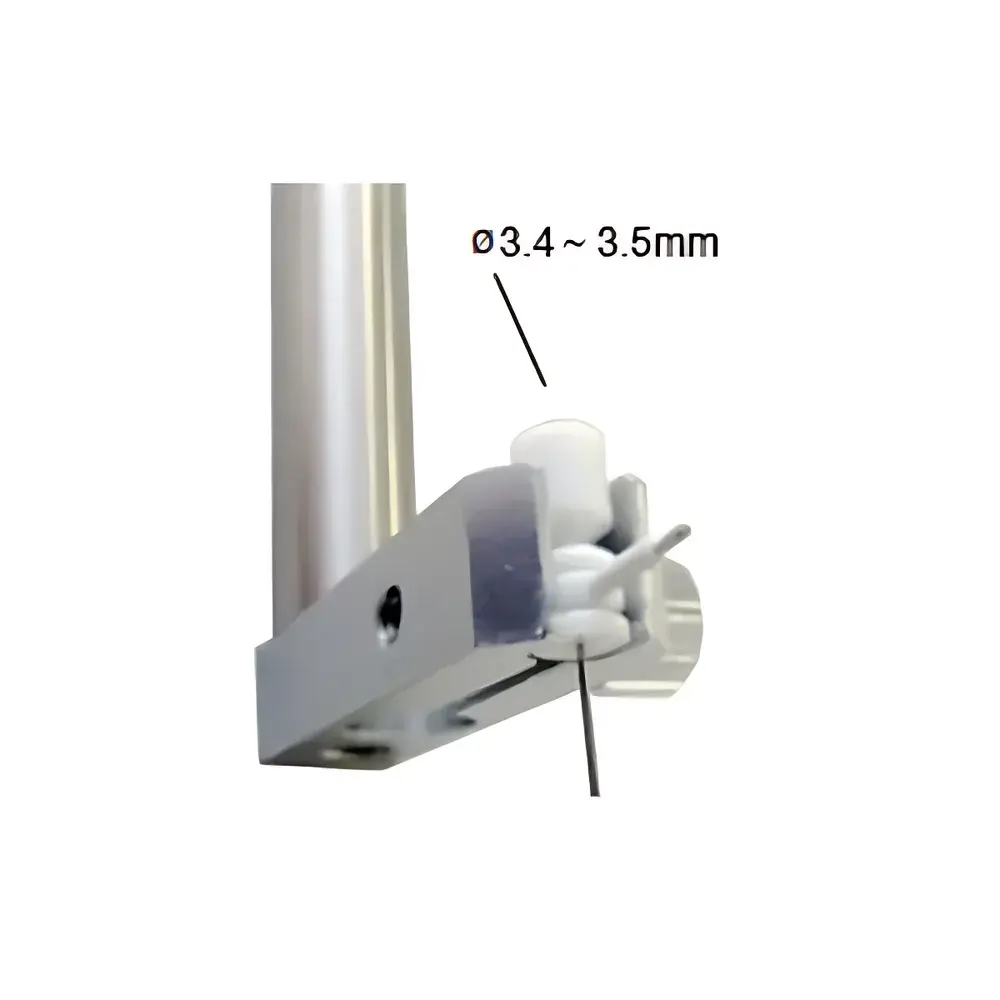
Narishige SMM-HC Cannula Holder
| Brand | Narishige (NARISHIGE) |
|---|---|
| Origin | Japan |
| Model | SMM-HC |
| Dimensions | 29 × 8 × 206 mm |
| Weight | 90 g |
| Compatibility | 3.4–3.5 mm OD cannulae |
| Shaft Outer Diameter | 8 mm |
| Design Feature | Separable holding segment with left-right directional adjustability |
| Mounting | Top-entry fixation requiring upper sleeve coverage — enables secure clamping of T-shaped cannulae |
Overview
The Narishige SMM-HC Cannula Holder is a precision-engineered mechanical fixture designed for stable, repeatable positioning of micro-cannulae in stereotactic and intracranial experimental workflows. It operates on a rigid lever-and-sleeve clamping principle, where axial compression applied via a threaded sleeve generates uniform radial force around the cannula’s outer diameter—ensuring zero slippage during insertion, recording, or infusion procedures. Unlike the SHC-1 holder, the SMM-HC features an 8 mm outer-diameter shaft and a top-access clamping geometry that requires partial coverage of the cannula’s proximal end; this configuration uniquely accommodates T-shaped cannulae and other non-cylindrical profiles commonly used in multi-channel infusion or hybrid electrode-cannula assemblies. Its compact footprint (29 × 8 × 206 mm) and lightweight construction (90 g) enable seamless integration into multi-axis micromanipulator systems—including Narishige’s MO-10, MM-10, and SM-10 series—without introducing mechanical resonance or load imbalance.
Key Features
- High-stability clamping mechanism engineered for 3.4–3.5 mm outer-diameter cannulae, delivering consistent grip force across repeated thermal and mechanical cycles.
- Modular holding segment detachable from the main shaft, enabling 180° left/right reorientation to accommodate bilateral or angled stereotactic trajectories.
- Top-entry fixation design eliminates need for side-loading—reducing risk of cannula tip deformation or misalignment during installation.
- Machined from corrosion-resistant, anodized aluminum alloy with tight-tolerance surface finish (Ra < 0.8 µm), ensuring long-term dimensional stability under exposure to ethanol, chlorhexidine, and standard saline-based perfusates.
- No-tool operation: single-turn sleeve engagement provides tactile feedback at optimal torque threshold—minimizing operator-induced variability in clamping pressure.
Sample Compatibility & Compliance
The SMM-HC is validated for use with stainless steel, fused silica, and polyimide-coated cannulae meeting ISO 8536-4 (infusion devices) and ASTM F2102 (biomaterials compatibility) dimensional tolerances. Its clamping geometry conforms to common neuroscientific standards for chronic implantation hardware, including those referenced in NIH Guide for the Care and Use of Laboratory Animals (Section IV.C.4). While not a medical device per FDA 21 CFR Part 820, the holder supports GLP-compliant experimental protocols when used in conjunction with traceable calibration logs and documented maintenance records. It is routinely employed in studies adhering to ARRIVE 2.0 guidelines for reproducibility in preclinical neuroscience.
Software & Data Management
As a purely mechanical positioning component, the SMM-HC does not incorporate embedded electronics, firmware, or digital interfaces. It functions independently of software control but is fully interoperable with third-party stereotactic planning platforms—including Stereotaxic Atlas Tools (SAT), Paxinos & Watson coordinate mapping modules, and open-source Python-based trajectory calculators (e.g., BrainReg, QuickNII). When integrated into automated rigs (e.g., motorized MO-10 stages), positional metadata—such as cannula angle, depth, and lateral offset—is logged externally via host controller software (e.g., MATLAB Instrument Control Toolbox, LabVIEW DAQmx), satisfying audit-trail requirements under ISO/IEC 17025:2017 Clause 7.7.
Applications
- Chronic intracerebral cannulation for targeted drug delivery, viral vector infusion, or optogenetic fiber placement in rodent models.
- Simultaneous electrophysiology and microdialysis: securing combined electrode-cannula probes in dual-pipette holders without cross-axis interference.
- In vitro slice work: stabilizing angled cannulae during acute brain slice perfusion or local field potential recordings.
- Developmental neurobiology: precise placement of guide cannulae for timed postnatal injections in neonatal mouse pups using customized adaptor mounts.
- Teaching laboratories: standardized mounting solution for undergraduate neuropharmacology labs requiring reproducible intracranial access points across cohorts.
FAQ
What cannula outer diameters are supported?
The SMM-HC is dimensionally optimized for cannulae with 3.4 mm and 3.5 mm outer diameters. It is not compatible with 2.5 mm or 4.0 mm profiles without custom bushings.
Can it hold T-shaped cannulae?
Yes—the top-entry clamping architecture and 8 mm shaft diameter allow full engagement of T-shaped cannulae where the transverse arm rests against the upper sleeve flange.
Is the holder autoclavable?
No. Anodized aluminum components must not be subjected to steam sterilization. Clean with 70% ethanol or isopropyl alcohol and air-dry; avoid ultrasonic cleaning due to potential thread wear.
How does it differ from the SHC-1 holder?
The SHC-1 uses side-entry clamping and accommodates smaller shaft diameters (6 mm); the SMM-HC’s 8 mm shaft and top-load design provide higher torsional rigidity and support for asymmetric cannula geometries.
Does Narishige provide mounting adapters for specific manipulators?
Yes—standard M4 and M6 threaded base plates are available as optional accessories (part numbers SMM-ADP-M4, SMM-ADP-M6) for direct integration with Narishige and equivalent third-party micromanipulators.



