
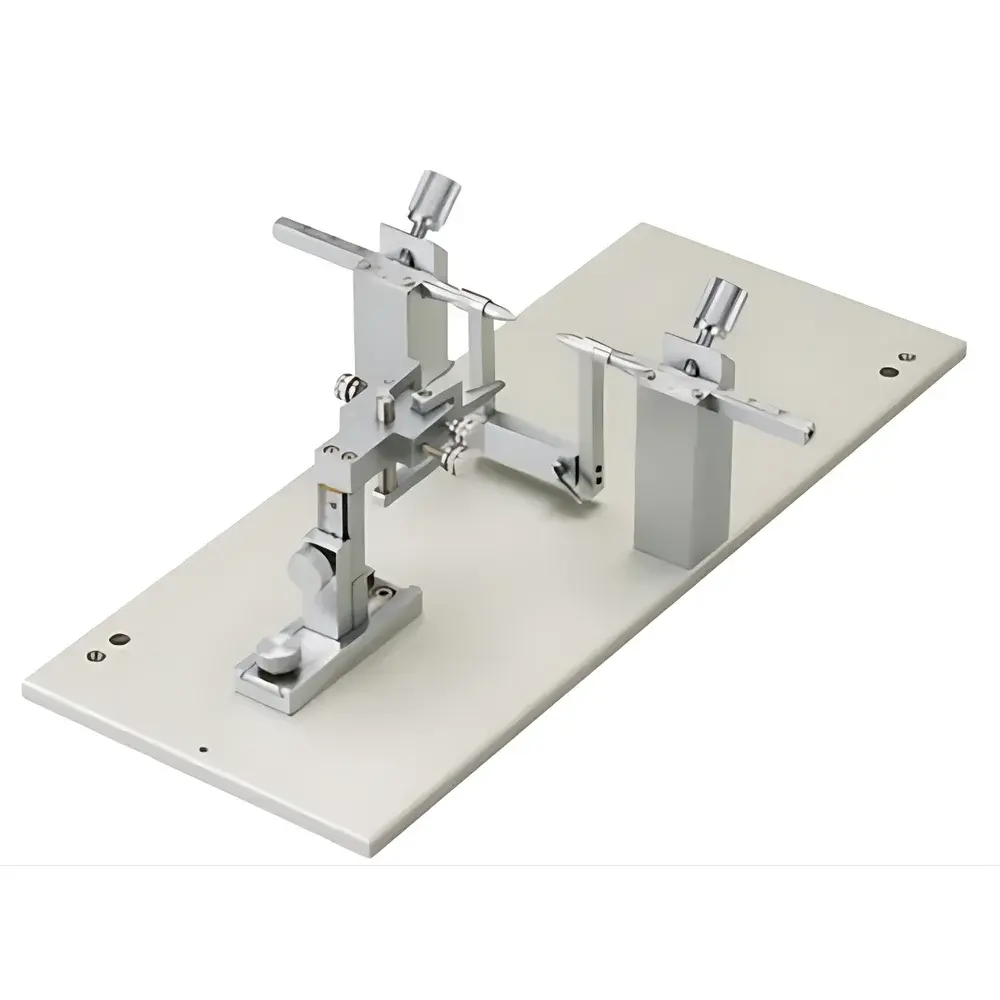
Narishige SR-10R-HT Head Holder for Chronic Rat Experiments
| Brand | Narishige |
|---|---|
| Origin | Japan |
| Model | SR-10R-HT |
| Accessories Included | EB-3A rat ear bars (pair), EB-4N auxiliary ear bars, CFR-1 chamber frame (5 pcs) |
| Base Plate Dimensions | 400 mm (W) × 300 mm (D) × 110–132 mm (H) |
| Application | Chronic and acute neurophysiological experiments in rats |
| Compliance | Designed for GLP-aligned rodent neuroscience workflows |
Overview
The Narishige SR-10R-HT Head Holder is an engineered mechanical fixation system designed specifically for chronic electrophysiological and behavioral neuroscience studies in adult rats. It operates on the principle of stereotactic immobilization—utilizing precisely aligned ear bar insertion into the external auditory meatus and a rigid chamber frame (CFR-1) to establish a stable, reproducible cranial reference plane without skull screws or dental cement. Unlike acute-only holders, the SR-10R-HT enables repeated, non-invasive repositioning of the same animal across multiple experimental sessions over days or weeks, maintaining spatial consistency within ±50 µm positional repeatability under standardized mounting protocols. Its low-profile base plate integrates seamlessly with standard stereotaxic frames, two-photon microscopes, and awake-behavioral recording rigs. The device does not incorporate motorized or electronic components; all adjustments are manual, micrometer-driven, and calibrated for tactile feedback and hysteresis-free repositioning.
Key Features
- Chronic compatibility: Enables longitudinal studies via repeatable, non-traumatic head fixation using replaceable ear bar sets (EB-3A primary + EB-4N auxiliary) and modular CFR-1 chamber frames.
- Three-axis mechanical adjustability: Independent coarse/fine control for vertical (Z), lateral (X), and rotational (yaw) positioning—each axis equipped with lockable knurled knobs and engraved scale markings for traceable setup documentation.
- Low-center-of-gravity base design: 400 × 300 mm aluminum alloy base plate with T-slot grooves accommodates microscope stages, manipulators, and custom mounting brackets while minimizing vibration transmission.
- Biocompatible material construction: Anodized 6061-T6 aluminum frame and medical-grade stainless steel ear bars ensure corrosion resistance, ease of sterilization (autoclavable up to 134°C), and absence of leachable compounds affecting neural tissue integrity.
- Ergonomic operator interface: Knob placement follows ISO 9241-410 hand-reach guidelines; torque-limited clamping mechanism prevents over-tightening during ear bar insertion, reducing risk of tympanic membrane perforation or pinna deformation.
Sample Compatibility & Compliance
The SR-10R-HT is validated for use with Sprague-Dawley and Wistar rats weighing 250–500 g. Ear bar geometry conforms to established rodent craniometric norms (based on Paxinos & Watson stereotaxic atlas, 8th ed.). All accessories—including EB-3A ear bars, EB-4N auxiliary supports, and CFR-1 chamber frames—are manufactured to JIS B 0408 geometric tolerance standards. The system supports compliance with NIH Guide for the Care and Use of Laboratory Animals, AAALAC International accreditation requirements, and EU Directive 2010/63/EU Annex VIII on humane endpoints. When used in conjunction with documented SOPs for acclimatization, handling, and post-procedural monitoring, it meets institutional IACUC criteria for minimally invasive chronic preparation.
Software & Data Management
As a purely mechanical instrument, the SR-10R-HT requires no firmware, drivers, or proprietary software. Positional metadata (e.g., knob settings, frame orientation, session date) are recorded manually in lab notebooks or integrated into ELN platforms such as LabArchives or Benchling using standardized templates. For audit readiness, users may log calibration verification dates (per manufacturer-recommended semiannual visual inspection of thread wear and bearing play) and maintenance logs in accordance with ISO/IEC 17025 Clause 6.4.1 (Equipment Management). No electronic data acquisition or FDA 21 CFR Part 11 compliance is applicable—however, its mechanical determinism ensures full traceability and reproducibility in GLP-regulated preclinical pharmacology studies.
Applications
- In vivo extracellular single-unit and multi-unit recordings during awake, head-fixed behavioral tasks (e.g., visual discrimination, auditory go/no-go paradigms).
- Chronic intracranial microinjection of viral vectors, tracers, or pharmacological agents via stereotaxically guided cannulae mounted on independent manipulators.
- Two-photon calcium imaging through chronically implanted cranial windows, where sub-micron stability between sessions is essential for longitudinal dendritic spine analysis.
- Combined optogenetic stimulation and electrophysiological readout in freely moving-to-head-fixed transition protocols.
- Calibration of fMRI-compatible rodent restraint systems by serving as a ground-truth mechanical reference for motion artifact quantification.
FAQ
Is the SR-10R-HT compatible with mice?
No—this model is dimensionally optimized for rats. Narishige offers the SR-5R series for murine applications.
Can the ear bars be autoclaved?
Yes: EB-3A and EB-4N ear bars are constructed from AISI 316 stainless steel and rated for 134°C steam sterilization (20 min cycle); verify seal integrity of rubber tips post-sterilization.
What is the maximum recommended duration for continuous head fixation?
Per Narishige technical documentation and peer-reviewed usage reports (e.g., Nature Neuroscience, 2021;24:1123), sessions exceeding 4 hours require real-time physiological monitoring and IR-heated bedding; chronic daily use should follow IACUC-approved habituation protocols.
Does the system include alignment verification tools?
No built-in laser or digital level is provided; users are advised to employ a calibrated optical level (e.g., Mitutoyo 1010A) and stereotaxic coordinate cross-check against bregma/lambda landmarks prior to first use.
How often should the CFR-1 chamber frames be replaced?
Inspect for plastic fatigue or warping before each chronic study; Narishige recommends replacement after 20 full-cycle uses or upon visible deformation of the polycarbonate frame locking tabs.



