
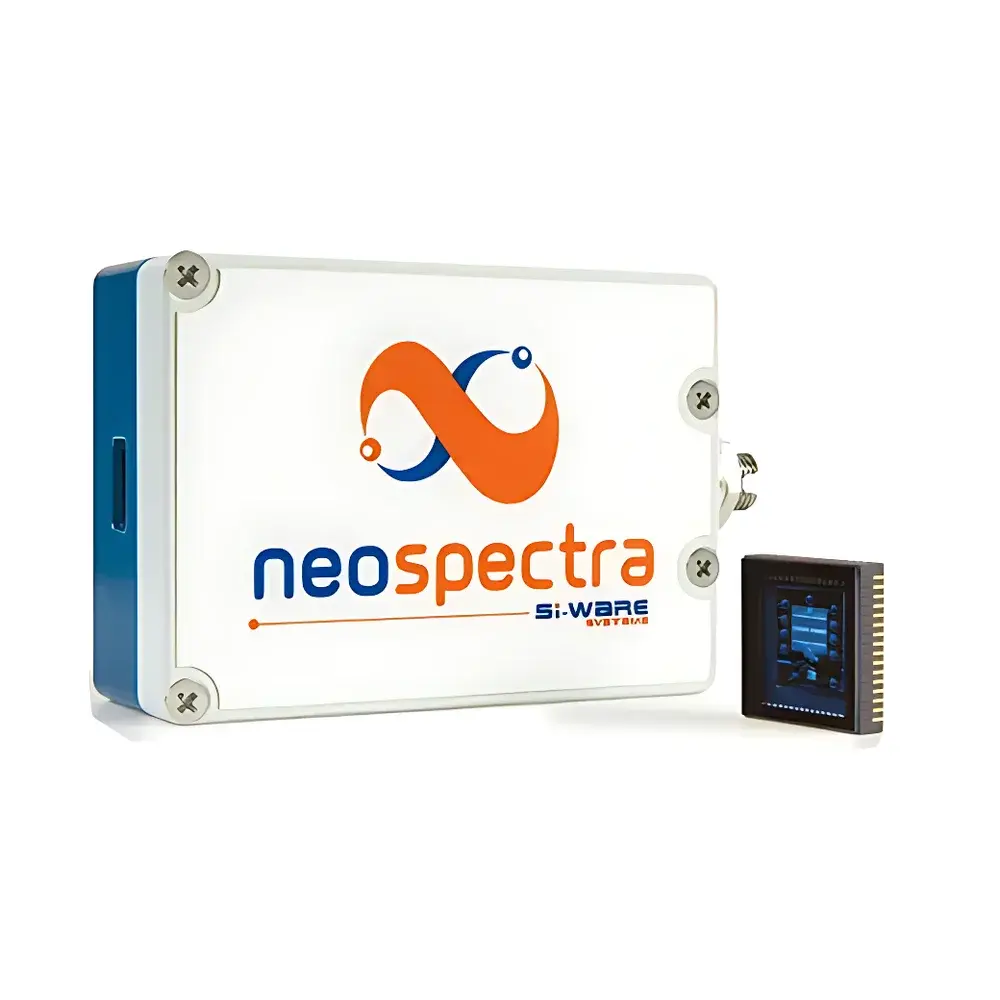
NeoSpectra SWS6211 Fourier Transform Near-Infrared (FT-NIR) Spectrometer
| Origin | Imported |
|---|---|
| Manufacturer Type | Authorized Distributor |
| Model | SWS6211 |
| Spectral Range | 1250–2500 nm |
| Interface | USB 2.0 |
| Detector | Single-element InGaAs photodiode |
| Optical Coupling | Fiber-optic (SMA 905 connector) |
| Power Consumption | <1.5 W |
| Dimensions | 72 × 52 × 32 mm |
| Weight | <120 g |
| Compliance | CE, RoHS, FCC Class B |
Overview
The NeoSpectra SWS6211 is a compact, OEM-grade Fourier Transform Near-Infrared (FT-NIR) spectrometer engineered for integration into industrial process analyzers, portable diagnostic tools, and embedded quality control systems. Unlike dispersive or filter-based NIR sensors, the SWS6211 employs a monolithic micro-electromechanical systems (MEMS) interferometer—fabricated using semiconductor photolithography—to perform rapid, high-stability spectral acquisition via the Michelson interferometry principle. This core architecture enables true FT-NIR performance in a footprint smaller than a standard smartphone, delivering interference patterns (interferograms) that are digitally transformed via fast Fourier transform (FFT) algorithms to yield calibrated absorbance or reflectance spectra across the 1250–2500 nm wavelength band. The instrument operates without moving macroscopic mirrors or gratings, ensuring long-term mechanical robustness and immunity to vibration-induced misalignment—critical for field-deployed or inline manufacturing environments.
Key Features
- MEMS-based FT-NIR interferometer with solid-state optical path stability and sub-millisecond scan repetition
- Single-element InGaAs photodetector optimized for high signal-to-noise ratio (SNR) in the 1250–2500 nm range
- Fiber-optic input (SMA 905) enabling flexible remote sampling, probe coupling, or integration with flow cells and attenuated total reflectance (ATR) accessories
- USB 2.0 interface with vendor-provided SDK (C/C++, Python, LabVIEW) supporting real-time spectral streaming at up to 10 Hz full-spectrum acquisition
- Ultra-low power consumption (<1.5 W) suitable for battery-powered handheld devices and edge-computing platforms
- Compact form factor (72 × 52 × 32 mm) and lightweight design (<120 g) facilitating seamless embedding into space-constrained instrumentation
- Factory spectral calibration traceable to NIST-traceable standards; optional user recalibration protocol supported via reference white tile or certified polystyrene film
Sample Compatibility & Compliance
The SWS6211 is compatible with transmission, diffuse reflectance, and fiber-coupled contact/non-contact measurement geometries. It supports solid, liquid, and semi-solid samples—including powders, granules, pastes, and thin films—without requiring sample preparation beyond standard NIR protocols (e.g., particle size homogenization for agricultural grains or tablet compression for pharmaceuticals). The device complies with CE marking requirements under the EU Electromagnetic Compatibility Directive 2014/30/EU and RoHS 2011/65/EU for hazardous substance restrictions. It meets FCC Part 15 Class B limits for unintentional radiators. While not a standalone GLP/GMP-certified instrument, its digital output architecture supports audit-ready data logging when integrated into validated systems compliant with 21 CFR Part 11 (electronic records/signatures), ISO/IEC 17025 (testing laboratories), and ASTM E1655 (standard practices for NIR quantitative analysis).
Software & Data Management
The SWS6211 ships with NeoSpectra Studio—a cross-platform application for spectral acquisition, preprocessing (baseline correction, Savitzky-Golay smoothing, multiplicative scatter correction), and chemometric modeling (PLS regression, PCA, SIMCA classification). Raw interferogram and spectrum files are saved in open-format HDF5 or CSV, enabling interoperability with MATLAB, R, Python (scikit-learn, PyMca), and commercial chemometrics suites (Unscrambler X, GRAMS/AI). The SDK provides low-level access to hardware registers, enabling custom firmware updates, dynamic range adjustment, and synchronized triggering with external actuators or PLCs. All spectral metadata—including timestamp, integration time, temperature sensor readings (onboard thermistor), and calibration ID—are embedded in file headers to support traceability and data integrity per ALCOA+ principles.
Applications
The SWS6211 serves as a foundational spectral engine in applications demanding miniaturized, cost-effective, and reproducible NIR quantification. In food and agriculture, it enables on-site moisture, protein, and fat analysis in grains, dairy powders, and meat products. Within pharmaceutical manufacturing, it supports raw material identification (RMI), blend uniformity monitoring, and tablet coating thickness verification. In petrochemical settings, it facilitates real-time hydrocarbon composition tracking in refinery streams. Polymer producers use it for additive concentration control and degradation assessment. Emerging deployments include point-of-care biomarker screening (e.g., blood glucose estimation in interstitial fluid), metal surface oxide layer characterization, and in-line polymer extrusion monitoring. Its modularity allows pairing with machine learning inference engines deployed on edge hardware (e.g., NVIDIA Jetson, Raspberry Pi 4) for autonomous decision-making.
FAQ
Is the SWS6211 suitable for regulatory submissions in pharmaceutical or clinical environments?
The SWS6211 is an analytical sensor module—not a finished medical device or GMP-compliant instrument. Its use in regulated workflows requires integration into a validated system architecture, including documented risk assessment, change control, and electronic record controls aligned with FDA 21 CFR Part 11 or EU Annex 11.
Can the spectral resolution be adjusted post-purchase?
Yes. Resolution is determined by the maximum optical path difference (OPD) of the MEMS interferometer and can be configured via software-controlled scan length—offering selectable resolutions from 8 cm⁻¹ to 32 cm⁻¹ without hardware modification.
Does the device support temperature stabilization or compensation?
It includes an onboard thermistor for ambient temperature monitoring. Spectral drift compensation algorithms are implemented in NeoSpectra Studio and accessible via SDK for custom thermal correction models.
What optical accessories are compatible with the SMA 905 interface?
Standard 400 µm core silica optical fibers, bifurcated probes, integrating spheres (30 mm and 50 mm), and fixed-pathlength transmission cells (0.1–5 mm) with quartz or sapphire windows are mechanically and optically compatible.
Is factory recalibration required annually?
No scheduled recalibration is mandated. However, users operating in critical applications should perform periodic performance verification using NIST-traceable reference materials (e.g., SRM 2036 for reflectance, SRM 2068 for transmittance) and document results per internal SOPs.





