
NeuronBC TA-2.0 Total Organic Carbon (TOC) Analyzer — Online & Offline Dual-Mode
| Brand | NeuronBC |
|---|---|
| Origin | Beijing, China |
| Model | TA-2.0 |
| Instrument Type | Online/Offline Dual-Mode TOC Analyzer |
| Measurement Principle | Direct Conductivity Detection |
| Oxidation Method | UV Photolysis (185/254 nm) |
| Measurement Range | 0.001–1.0 mg/L (1–1000 ppb) |
| Accuracy | ±3% of reading |
| Resolution | 0.001 mg/L |
| Detection Limit | 0.001 mg/L |
| Repeatability | ±3% RSD |
| Conductivity Detection Range | 0.055–8.000 µS/cm |
| Sample Temperature Range | 1–95 °C |
| Ambient Operating Temperature | 5–65 °C |
| Power Supply | 100–240 VAC, 50 Hz, 120 W |
| Data Storage Capacity | >5000 measurement records |
| Audit Trail | 16-event log with timestamped entries |
| User Access Control | 4-tier role-based authentication (compliant with FDA 21 CFR Part 11) |
| Interface Ports | Ethernet, RS-232, analog power output |
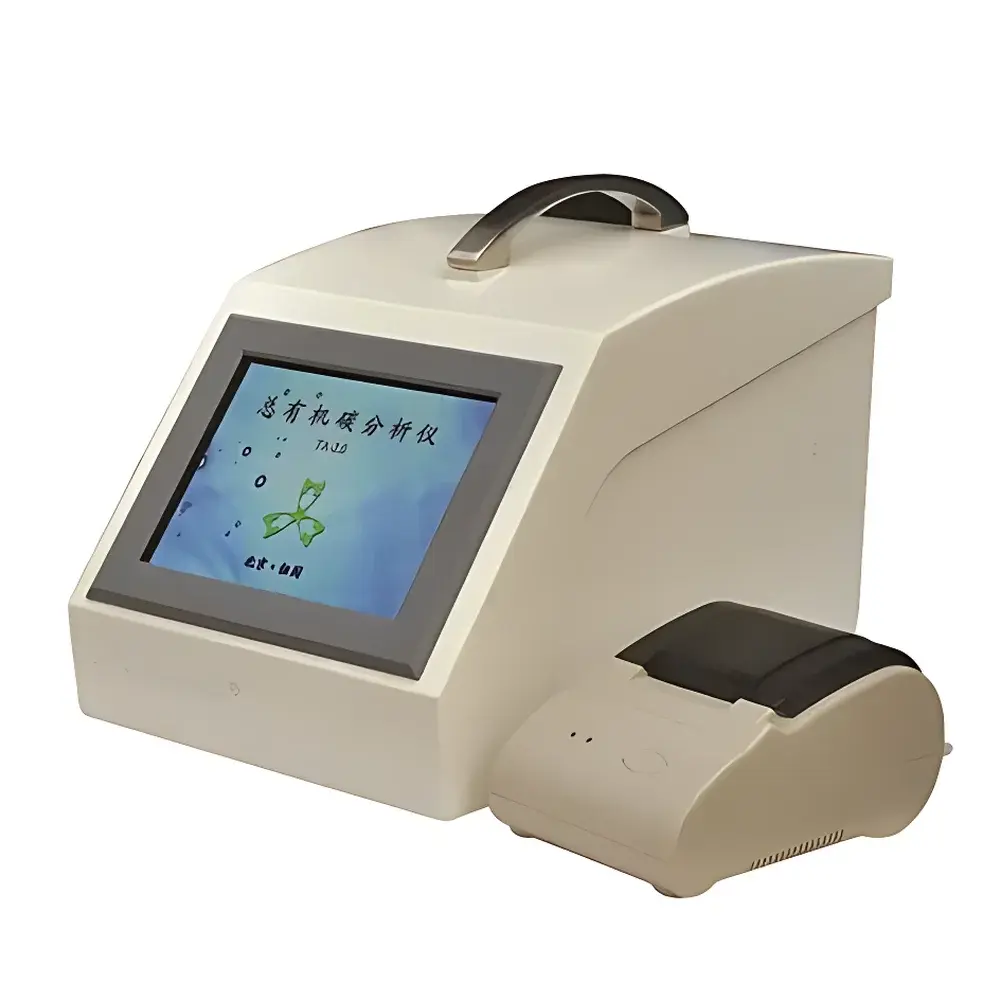
| Display | Color TFT touchscreen |
| Dimensions (L×W×H) | 400 × 240 × 270 mm |
| Weight | 8.5 kg |
Overview
The NeuronBC TA-2.0 Total Organic Carbon (TOC) Analyzer is an engineered dual-mode analytical platform designed for rigorous water quality assessment in regulated and industrial environments. It operates on the principle of direct conductivity detection following ultraviolet (UV) photolytic oxidation—utilizing dual-wavelength UV lamps (185 nm and 254 nm) to mineralize non-purgeable organic carbon (NPOC) into CO₂, which is then quantified via high-sensitivity conductivity measurement of the resultant carbonate species. Unlike combustion-based systems, this method eliminates catalyst degradation, carrier gas dependency, and thermal interference, delivering stable baseline performance across extended unattended operation. The TA-2.0 supports both online continuous monitoring (up to three independent sampling points via optional manifold integration) and offline laboratory analysis, enabling seamless transition between process validation, routine QC, and regulatory compliance testing—particularly in pharmaceutical water systems (PW, WFI, Purified Water), semiconductor ultrapure water loops, and municipal/industrial effluent monitoring.
Key Features
- Dual-mode architecture: Configurable for real-time online deployment or benchtop offline analysis without hardware modification
- Pump-free fluidic design: Eliminates peristaltic tubing, check valves, and pressure-reducing assemblies—reducing maintenance intervals, consumable costs, and flow variability
- High-precision UV oxidation module: Optimized optical path and dwell time ensure >95% oxidation efficiency for recalcitrant organics (e.g., humic acids, low-MW alcohols) within the 0.001–1.0 mg/L range
- Low-drift conductivity cell: Temperature-compensated electrode array with auto-zero calibration capability, supporting stable detection down to 0.001 mg/L TOC (1 ppb)
- Industrial-grade embedded system: ARM-based CPU with real-time OS ensures deterministic response (<5 min analysis cycle), synchronized data logging, and deterministic I/O handling
- FDA 21 CFR Part 11 compliance: Role-based 4-level user authentication (Administrator, Supervisor, Analyst, Viewer), electronic signatures, immutable audit trail (16+ event types with UTC timestamps), and secure data export via USB mass storage
Sample Compatibility & Compliance
The TA-2.0 accommodates aqueous samples across a broad physicochemical spectrum: purified water (USP , EP 2.2.44), water-for-injection (WFI), clean-in-place (CIP) rinse waters, cooling tower make-up, and secondary treated wastewater. Its 1–95 °C sample temperature tolerance permits direct integration into hot water distribution loops (e.g., pharmaceutical thermally sanitized systems). The instrument conforms to ISO 8469:1995 (water quality—determination of TOC) and supports validation protocols aligned with ASTM D5905, USP , and EU GMP Annex 1 requirements. All firmware and software modules undergo version-controlled release cycles with documented change history—essential for GLP/GMP audit readiness.
Software & Data Management
The integrated touchscreen HMI provides intuitive navigation for method selection, calibration execution (zero/span verification), and real-time trend visualization. Raw conductivity and calculated TOC values are stored with full metadata (operator ID, timestamp, method ID, system status flags). Data export supports CSV format via USB interface; historical records (>5000 entries) retain full traceability including instrument configuration snapshots at time of acquisition. Optional Ethernet connectivity enables integration into SCADA or LIMS platforms using Modbus TCP or OPC UA protocols. Audit trail entries include login/logout events, calibration actions, method modifications, and report generation—each cryptographically signed and tamper-evident per 21 CFR Part 11 Subpart B requirements.
Applications
- Pharmaceutical manufacturing: Continuous TOC surveillance of PW/WFI distribution systems per FDA guidance and EU GMP Annex 1
- Biotechnology facilities: Monitoring of buffer preparation tanks and chromatography eluent streams
- Semiconductor fabs: Ultrapure water loop certification (ASTM F631) and particle-free TOC trending
- Power generation: Feedwater purity assurance in boiler feed systems
- Environmental laboratories: Regulatory reporting for EPA Method 415.3 and ISO 8469-compliant wastewater discharge monitoring
- Cleanroom facility qualification: Post-sanitization rinse water verification during ISO 14644-1 environmental monitoring campaigns
FAQ
Does the TA-2.0 require carrier gas or chemical reagents for oxidation?
No. It uses only UV photolysis (185/254 nm) for oxidation—no persulfate, ozone, or high-temperature combustion is involved.
Can the instrument be validated per IQ/OQ/PQ protocols?
Yes. Factory-supplied validation documentation includes DQ templates, IQ/OQ test scripts, and PQ acceptance criteria aligned with ASTM D5905 and USP .
Is remote diagnostics supported?
Via optional Ethernet connection and secure VPN, qualified service engineers can perform firmware updates, diagnostic logs review, and parameter optimization under customer authorization.
What sample volume is required per analysis?
Approximately 25 mL per cycle in offline mode; online mode operates continuously with programmable sampling frequency (1–60 min intervals).
How is calibration verified during routine operation?
Zero verification uses deionized water; span verification employs certified potassium hydrogen phthalate (KHP) standard solutions traceable to NIST SRM 84a.







