
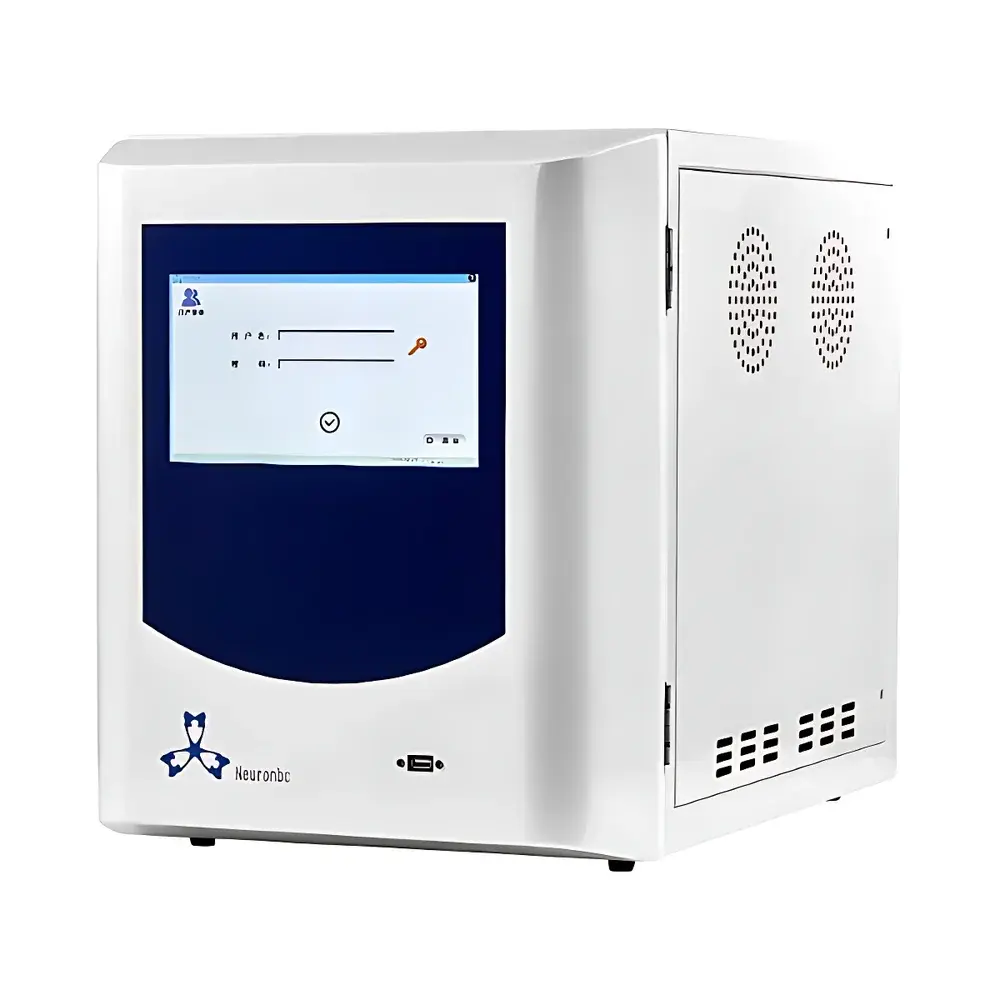
NeuronBC TA-200 Total Organic Carbon Analyzer
| Brand | NeuronBC |
|---|---|
| Origin | Beijing, China |
| Model | TA-200 |
| Instrument Type | Online TOC Analyzer |
| Detection Principle | Non-Dispersive Infrared (NDIR) Absorption |
| Oxidation Method | High-Temperature Catalytic Combustion |
| Measurement Range | 0–30,000 mg/L |
| Accuracy | ±3% |
| Resolution | 0.001 mg/L |
| Detection Limit | 0.001 mg/L |
| Repeatability | ±3% |
Overview
The NeuronBC TA-200 Total Organic Carbon Analyzer is an online, high-stability TOC measurement system engineered for continuous, unattended operation in regulated water quality monitoring environments. It employs non-dispersive infrared (NDIR) detection following high-temperature catalytic combustion oxidation — a method widely recognized in ASTM D7573, ISO 8245, and USP for its robustness in quantifying total organic carbon across diverse aqueous matrices. The instrument is designed to meet the analytical demands of drinking water treatment plants, pharmaceutical manufacturing facilities (aligned with FDA 21 CFR Part 11 data integrity requirements), municipal wastewater utilities, and industrial process water loops where real-time TOC trending and compliance reporting are critical.
Key Features
- Integrated high-temperature catalytic oxidation furnace (up to 900 °C) with Pt-based catalyst, ensuring complete conversion of refractory organics and particulate-bound carbon into CO₂.
- Dual-path NDIR detector with 24-bit digital signal resolution, enabling linear dynamic range extension from sub-ppb to 30,000 mg/L without manual range switching.
- Intelligent TIC (Total Inorganic Carbon) reaction module combining heating, active cooling, condensate management, and liquid-level sensing in a single compact flow cell — minimizing residence time and cross-contamination risk.
- Real-time flow-rate stabilization via closed-loop pressure-controlled peristaltic pumping and PID-regulated gas stream modulation, eliminating baseline drift caused by hydraulic or pneumatic fluctuations.
- Inherent safety architecture: low-voltage internal circuitry (<24 V DC), automatic leak detection via differential pressure monitoring, and fail-safe shutdown protocols triggered by out-of-spec gas flow, temperature deviation, or moisture breakthrough.
- Modular mechanical design with tool-free access to consumables (catalyst cartridge, NDIR cell window, desiccant trap), supporting field replacement in under 15 minutes with no calibration recalibration required.
Sample Compatibility & Compliance
The TA-200 accepts liquid samples with conductivity ≤5 mS/cm and suspended solids <50 mg/L (pre-filtration recommended). It is validated for use with potable water, ultrapure water (UPW), biopharmaceutical process streams, secondary effluent, and surface water with minimal pretreatment. The system supports audit-ready operation per GLP and GMP frameworks: all method parameters (oxidation temperature, acidification delay, purge duration, integration window) are electronically logged with user ID, timestamp, and change history. Raw detector output, calibration verification results, and system diagnostic events are stored in encrypted binary format compliant with FDA 21 CFR Part 11 Annex 11 requirements for electronic records and signatures.
Software & Data Management
- Embedded web-based interface (HTTPS-enabled) allows remote configuration, real-time trend visualization, alarm acknowledgment, and report export (CSV/PDF) without client software installation.
- Onboard data logger retains ≥30 days of second-by-second sensor outputs, including NDIR voltage, furnace thermocouple readings, carrier gas pressure, and condensate level status.
- Automated QC checks: daily system suitability tests (SST) verify oxidation efficiency and detector linearity using certified KHP and NaHCO₃ standards; deviations >±3% trigger configurable email/SNMP alerts.
- OPC UA and Modbus TCP support enables seamless integration into SCADA, MES, and LIMS platforms for centralized data aggregation and automated compliance reporting (e.g., EPA 40 CFR Part 141.74).
Applications
The TA-200 delivers trace-level TOC quantification in applications requiring regulatory adherence and operational continuity: validation of WFI (Water for Injection) and Purified Water systems per USP ; monitoring of RO permeate and EDI feed in semiconductor UPW loops; compliance tracking of treated wastewater discharge per EU Urban Wastewater Treatment Directive (91/271/EEC); and source water assessment in watershed protection programs. Its ability to operate continuously for >6 months between maintenance intervals makes it suitable for unmanned remote stations and distributed sensor networks.
FAQ
What sample preparation is required prior to analysis?
No filtration or acidification is mandatory for low-turbidity samples (<5 NTU). For wastewater or high-solids influents, a 0.45 µm inline filter is recommended upstream of the autosampler to prevent catalyst fouling.
Does the TA-200 comply with pharmacopeial methods for pharmaceutical water testing?
Yes — it satisfies USP , EP 2.2.44, and JP 17 requirements for TOC determination in Purified Water and Water for Injection when operated using the validated high-temperature combustion/NDIR protocol.
Can the instrument be integrated into an existing plant DCS or historian system?
Yes — native Modbus TCP and OPC UA server functionality enable bidirectional communication with DeltaV, Siemens Desigo, ABB Ability, and OSIsoft PI System without third-party gateways.
How often must the catalyst be replaced?
Under typical municipal water conditions, the Pt-coated ceramic catalyst maintains >95% oxidation efficiency for ≥12 months; replacement interval extends to 24 months in UPW applications with pre-treated feed.
Is on-site calibration verification supported?
The system includes automated calibration verification routines using onboard standard solutions (KHP, sodium bicarbonate), with full traceability to NIST-traceable CRM certificates included in shipment.







