
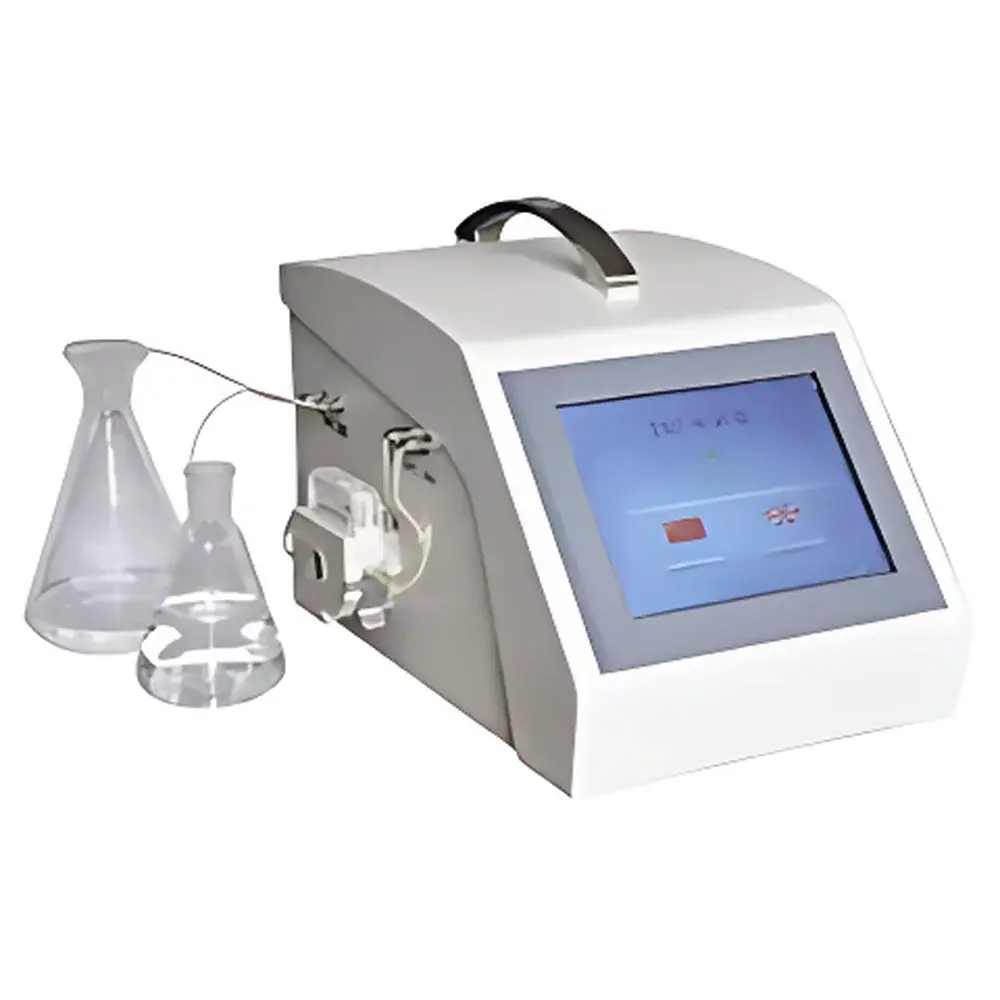
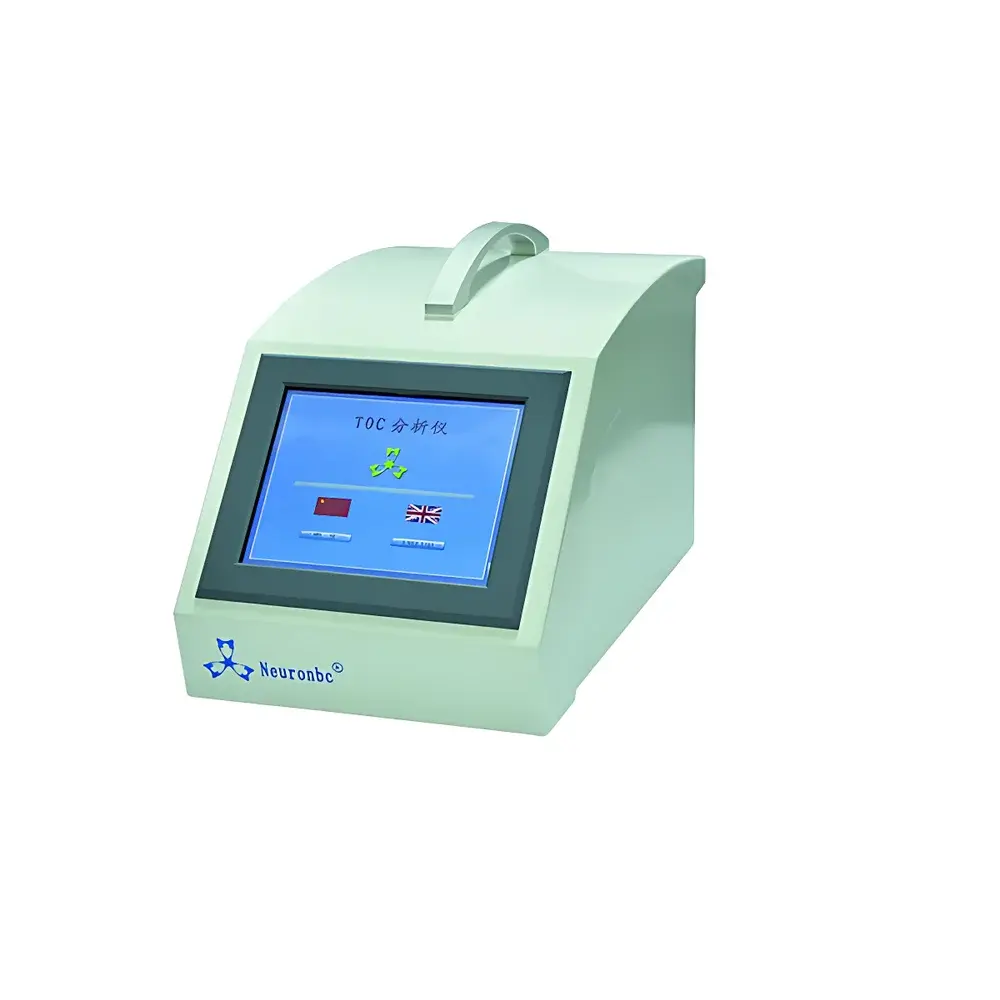
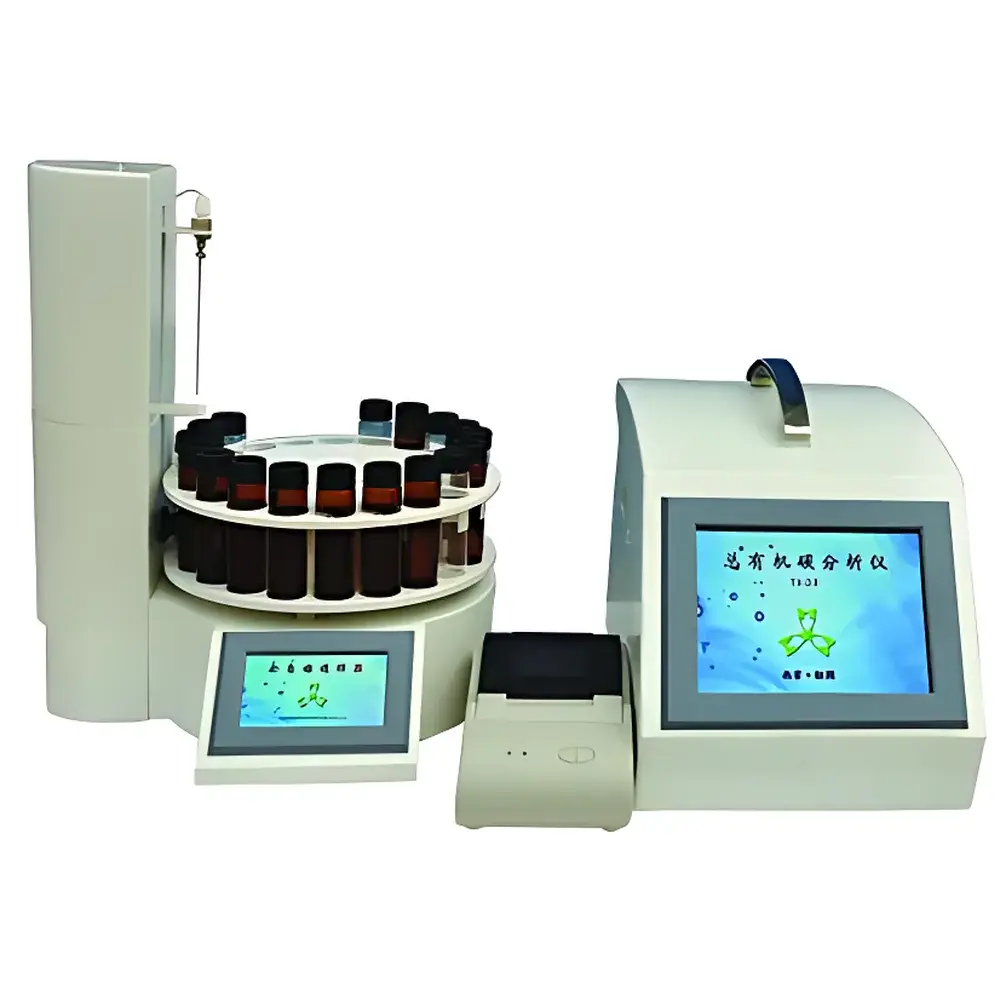
NeuronBC TOC Analyzer Model T – Laboratory & Pharmaceutical Online/Offline Total Organic Carbon Analyzer
| Brand | NeuronBC |
|---|---|
| Origin | Beijing, China |
| Model | T 2.0 |
| Instrument Type | Laboratory TOC Analyzer |
| Detection Principle | Direct Conductivity Method |
| Oxidation Method | UV Photolysis (185/254 nm) |
| Measurement Range | 0.1–1000 µg/L (ppb) |
| Accuracy | ±3% of reading |
| Detection Limit | 0.1 µg/L |
| Resolution | 0.001 µg/L |
| Repeatability | ≤3% RSD |
| Response Time | <5 minutes |
| Sample Temperature Range | 1–95 °C |
| Power Supply | 220 V AC |
| Display | Color TFT Touchscreen |
| Data Storage | Internal high-capacity flash memory with timestamped audit trail |
| Compliance | Meets Chinese Pharmacopoeia (ChP) 2020 Edition Chapter 0682 requirements for TOC testing |
Overview
The NeuronBC TOC Analyzer Model T is a dedicated total organic carbon (TOC) measurement system engineered for pharmaceutical-grade water quality assurance—specifically designed to meet the stringent analytical demands of purified water (PW), water for injection (WFI), and clean-in-place (CIP) rinse validation. It operates on the direct conductivity detection principle following UV photolytic oxidation (at dual wavelengths: 185 nm for radical generation and 254 nm for enhanced organic bond cleavage). In this method, dissolved organic carbon (DOC) in the aqueous sample is quantitatively converted to CO₂ under low-pressure UV irradiation in the presence of a catalyst-free quartz reaction chamber. The resulting CO₂ dissolves to form carbonic acid, inducing a measurable increase in solution conductivity. By sequentially measuring total carbon (TC) and inorganic carbon (TIC)—the latter determined via acidification and sparging—the instrument calculates TOC as the difference: TOC = TC − TIC. This approach eliminates reliance on carrier gases, chemical oxidants, or consumable reagents, ensuring operational simplicity and long-term stability in regulated environments.
Key Features
- UV-only oxidation architecture: No persulfate, no ozone, no gas cylinders—enabling maintenance-free operation and eliminating cross-contamination risks.
- True dual-mode capability: Configurable for either online continuous monitoring (via 4–20 mA analog output and Modbus RTU interface) or discrete offline laboratory analysis using syringe or peristaltic sampling.
- Integrated color touchscreen HMI: Intuitive graphical interface supporting multilingual prompts (English default), real-time trend visualization, and on-device method editing.
- Electronic signature and role-based access control: Compliant with ALCOA+ data integrity principles; supports three-tier user permissions (Operator, Supervisor, Administrator) with password protection and activity logging.
- Automated alarm and control logic: Programmable high-limit alerts trigger visual/audible warnings and optional dry-contact outputs for integration into facility SCADA or PLC systems.
- Portable benchtop form factor: Compact footprint (W320 × D280 × H220 mm) and lightweight design (<8 kg) facilitate mobility between sampling points or QC labs without recalibration.
Sample Compatibility & Compliance
The Model T analyzer is validated for use with ultrapure water matrices commonly encountered in pharmaceutical manufacturing—including PW, WFI, and distilled water—across temperatures from 1 °C to 95 °C. Its low detection limit (0.1 µg/L) and sub-ppb resolution ensure reliable quantification at pharmacopeial action limits (e.g., ChP ≤500 µg/L for PW, ≤100 µg/L for WFI). The system conforms to key regulatory expectations: it supports full audit trail generation (time-stamped events, parameter changes, result edits), meets 21 CFR Part 11 readiness through electronic signature enforcement, and provides traceable calibration records required for IQ/OQ/PQ execution. All firmware and software updates are version-controlled and documented per GAMP 5 guidelines.
Software & Data Management
Data is stored internally on encrypted flash memory with automatic time/date stamping and immutable record retention. Each test entry includes raw conductivity values, calculated TOC/TIC/TC concentrations, oxidation efficiency metrics, and operator ID. Export options include USB mass storage (CSV format) and RS232 serial output for LIMS integration. Optional PC-based NeuronLink™ software enables advanced reporting—including batch summary dashboards, SPC charts, and deviation investigation workflows—and supports automated PDF report generation with embedded digital signatures.
Applications
- Pharmaceutical water systems: Real-time TOC verification during PW/WFI production, distribution loop monitoring, and post-sanitization rinse water assessment.
- Cleanroom utility validation: TOC profiling of final rinse waters in component cleaning processes per ISO 14644 and EU GMP Annex 1.
- Biotechnology process support: Monitoring feedwater quality for buffer preparation and cell culture media formulation.
- Regulated industrial sectors: Semiconductor ultrapure water qualification (SEMI F63), food & beverage process water compliance (FDA Food Code Annex 1), and environmental wastewater screening (EPA Method 415.3 alignment).
FAQ
Does the Model T require periodic catalyst replacement or UV lamp recalibration?
No—its UV oxidation module uses high-stability low-pressure mercury lamps with integrated intensity monitoring; lamp life exceeds 12,000 hours, and no catalyst or reagent cartridges are employed.
Can the instrument be integrated into a DeltaV or Siemens PCS7 DCS environment?
Yes—via optional Modbus TCP/IP or 4–20 mA analog output with configurable scaling and fail-safe signal mapping.
Is the internal data log compliant with FDA 21 CFR Part 11 for electronic records?
The system supports Part 11 readiness when deployed with enabled electronic signatures, audit trail logging, and secure user authentication—but formal validation remains the responsibility of the end-user’s QA department.
What is the recommended calibration frequency for routine pharmaceutical use?
Per USP and ChP guidance, daily system suitability testing (SST) with sucrose and 1,4-benzoquinone standards is advised; full multi-point calibration is recommended weekly or after maintenance.
Does the analyzer support automatic temperature compensation for conductivity measurements?
Yes—real-time PT100 sensor feedback enables dynamic compensation across the full 1–95 °C operating range, minimizing matrix-induced drift.
Related Products







