
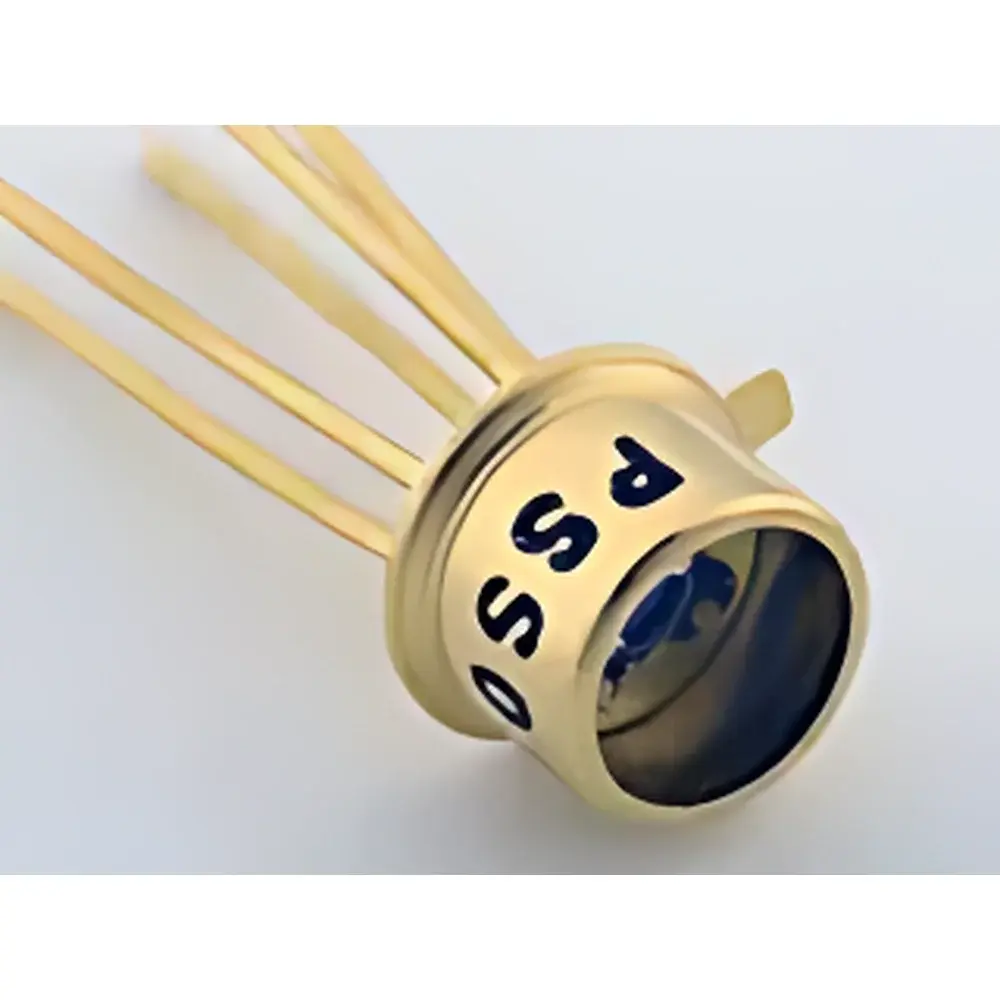
NewOpto QP45-Q Quadrant Photodetector
| Brand | NewOpto |
|---|---|
| Model | QP45-Q |
| Active Area | 6.7 × 6.7 mm² |
| Quadrant Configuration | Four electrically isolated, radially symmetric photodiode segments separated by a narrow gap (≤20 µm) |
| Spectral Range | Optimized for 1064 nm (high-responsivity InGaAs or Si-based epitaxial structure) |
| Reverse Bias | Up to 150 V |
| Dark Current | ≤3 nA per quadrant (at 150 V, 25°C) |
| Rise Time | ≤5 ns (50 Ω load) |
| Package | Hermetically sealed TO-8S metal can with quartz window |
| Operating Temperature | –10°C to +60°C |
| Compliance | RoHS-compliant, ISO 9001-manufactured components |
Overview
The NewOpto QP45-Q Quadrant Photodetector is a precision optoelectronic sensor engineered for real-time, high-bandwidth measurement of laser beam position and angular deviation in demanding optical alignment, active stabilization, and closed-loop feedback systems. Based on the principle of differential photocurrent comparison across four geometrically symmetric, electrically isolated photodiode quadrants, the device enables sub-microradian beam displacement resolution through normalized error signal generation (e.g., (A+C)−(B+D) and (A+B)−(C+D)). Its monolithic chip architecture—fabricated using ion-implanted or epitaxially grown semiconductor processes—ensures excellent inter-quadrant uniformity (<±1.5% responsivity variation), low crosstalk (<−45 dB at 1 kHz), and stable spectral response across the near-infrared, particularly at 1064 nm, making it ideal for Nd:YAG, fiber laser, and ultrafast amplifier applications where thermal drift and polarization sensitivity must be minimized.
Key Features
- High-speed response: ≤5 ns rise time per quadrant under 50 Ω termination, supporting dynamic beam tracking up to 70 MHz modulation bandwidth.
- Low dark current: ≤3 nA per quadrant at full 150 V reverse bias, enabling high signal-to-noise ratio (SNR > 65 dB) in low-flux alignment scenarios.
- Precision geometry: 6.7 × 6.7 mm² active area with ≤20 µm inter-quadrant gap; quadrant centers aligned to within ±0.5 µm via photolithographic registration.
- Robust packaging: TO-8S hermetic metal can with AR-coated fused silica window (R < 0.25% @ 1064 nm), rated for operation in ambient humidity up to 85% RH non-condensing.
- Thermal stability: Gain drift <±0.02%/°C over −10°C to +60°C; calibrated quadrant matching maintained across industrial temperature cycling (IEC 60068-2-14).
- Electrical isolation: >10¹² Ω inter-quadrant resistance at 150 V, ensuring minimal signal leakage during differential readout.
Sample Compatibility & Compliance
The QP45-Q is compatible with continuous-wave (CW) and pulsed laser sources operating from 400 nm to 1100 nm, with peak responsivity optimized for 1064 nm (typical 0.95 A/W). It supports integration into vacuum-compatible optical benches (via optional ceramic feedthrough variants) and meets mechanical shock tolerance per MIL-STD-883H Method 2002.2 (500 g, 1 ms half-sine). All units undergo 100% functional screening—including quadrant linearity verification (±0.2% deviation up to 10 mW total incident power), dark current mapping, and thermal hysteresis testing. Manufacturing adheres to ISO 9001:2015 quality management standards; RoHS 2011/65/EU and REACH SVHC declarations are available upon request. Device-level documentation supports traceability to NIST-traceable optical power calibrations.
Software & Data Management
The QP45-Q operates as an analog transducer and requires external low-noise transimpedance amplification (TIA) and signal conditioning. NewOpto provides reference schematics for quad-channel TIAs with 10⁶ V/A gain and <2 pA/√Hz input-referred noise. For system integration, the detector is fully compatible with industry-standard data acquisition platforms including National Instruments PXIe-6363 (2 MS/s, 16-bit), Keysight M9203A AXIe digitizers, and Thorlabs Kinesis-compatible motion controllers. LabVIEW™ drivers and Python API examples (PyVISA + NumPy) are supplied for real-time centroid calculation, beam jitter analysis (Allan deviation), and closed-loop PID control loops. Audit trails, calibration history, and raw quadrant current logs may be archived in accordance with FDA 21 CFR Part 11 requirements when paired with validated DAQ software.
Applications
- Laser cavity alignment and mode-matching optimization in Ti:sapphire and Yb-doped fiber oscillators.
- Active vibration cancellation in interferometric metrology systems (e.g., gravitational wave detector path length stabilization).
- Beam pointing stabilization in free-space optical communication terminals (FSO) and satellite laser ranging ground stations.
- Real-time focus shift monitoring in high-NA microscopy and adaptive optics wavefront sensing subsystems.
- Position-sensitive feedback for piezo-driven mirror mounts in ultrafast pulse compressor tuning and dispersion compensation.
- Non-contact displacement sensing in MEMS characterization and micro-opto-electro-mechanical systems (MOEMS) testing.
FAQ
What is the maximum average optical power the QP45-Q can handle without damage?
The device is rated for ≤15 mW total average incident power (uniformly distributed) at 1064 nm. Localized hotspots exceeding 1 kW/cm² irradiance may cause irreversible surface heating—beam homogenization or neutral density attenuation is recommended for high-power applications.
Is the QP45-Q suitable for use in ultra-high vacuum (UHV) environments?
Standard TO-8S packaging is not UHV-rated due to outgassing from internal epoxy adhesives. NewOpto offers a UHV variant (QP45-Q-UHV) with ceramic-to-metal seals and zero-epoxy die attachment, certified to <1×10⁻⁹ mbar·L/s total pressure rise.
How is quadrant imbalance corrected during system calibration?
A two-step procedure is employed: first, DC offset nulling via adjustable potentiometers in the TIA stage; second, gain-matching using a spatially filtered, centered Gaussian beam and iterative least-squares fitting of quadrant current ratios against known lateral displacements.
Can the QP45-Q be used with femtosecond laser pulses?
Yes—the ≤5 ns rise time supports pulse widths down to ~10 ps (FWHM) when coupled with appropriate impedance-matched cabling and terminations. Pulse energy should remain below 10 nJ per pulse to avoid transient saturation effects.
Does NewOpto provide NIST-traceable calibration certificates?
Yes—optional factory calibration includes quadrant responsivity (A/W), linearity deviation (±0.15% FS), and inter-quadrant gain ratio (±0.003), traceable to NIST SRM 2210a via PTB-accredited transfer standards. Certificates comply with ISO/IEC 17025:2017.



