
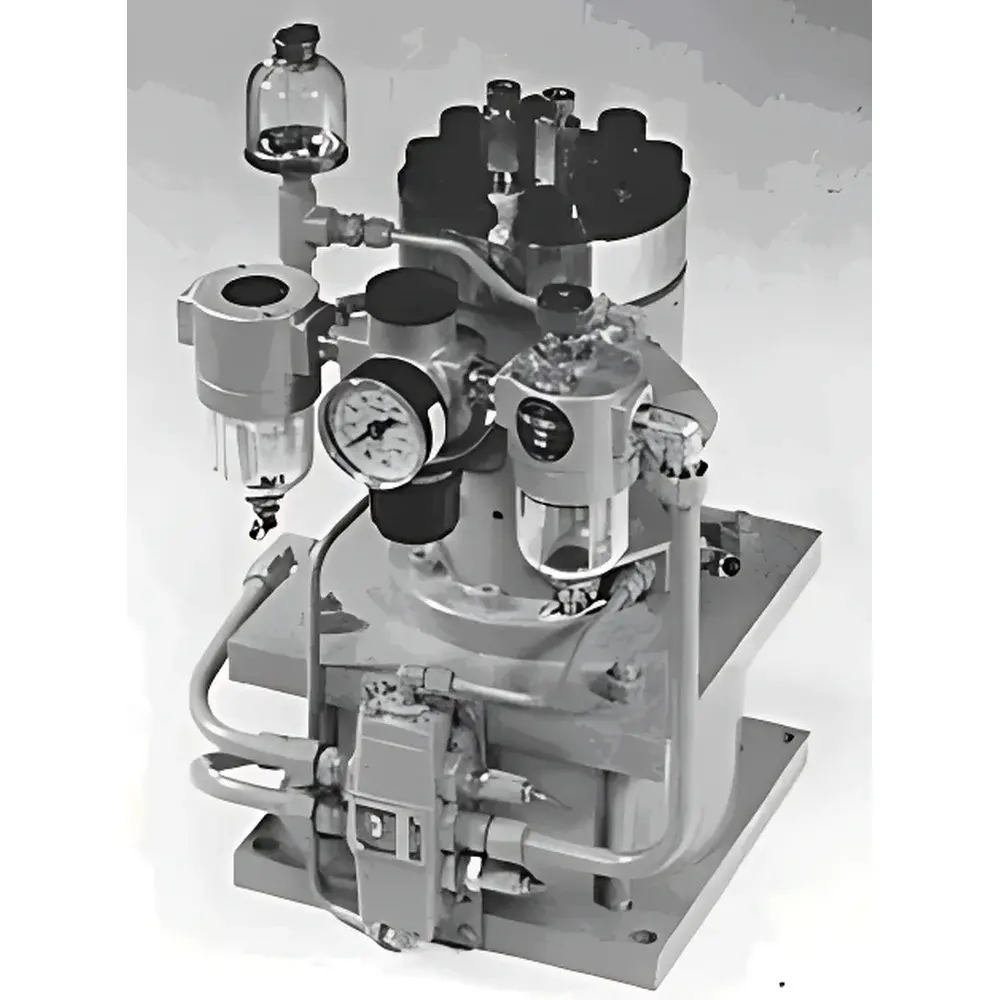
Newport 46-140xx Series Diaphragm Gas Compressor
| Brand | Newport |
|---|---|
| Origin | USA |
| Type | Imported Laboratory Diaphragm Compressor |
| Model Series | 46-14021-2, 46-14025-2, 46-14035-2, 46-14060-2, 46-14067, 46-14068 |
| Compression Principle | Pneumatically Actuated Metal Diaphragm |
| Flow Rate | 0–0.5 Nm³/h |
| Maximum Output Pressure | 0–200 MPa (0–30,000 psi) |
| Dew Point | +3 °C at Atmospheric Pressure |
| Particulate Filtration | <0.01 µm |
| Air Drive Inlet/Outlet Port | 0.053 cm / 1.27 cm |
| Fluid Side Port | 0.635 cm OD Tubing |
| Power Requirement | 50 Hz AC Supply |
| Compliance | Designed for ISO 8573-1 Class 2 compressed gas purity and GLP-compliant lab environments |
Overview
The Newport 46-140xx Series Diaphragm Gas Compressor is an ultra-high-pressure, oil-free gas compression system engineered for precision laboratory applications requiring contamination-free, chemically inert pressurization of inert, reactive, or toxic gases. Unlike piston or screw compressors, this series employs a pneumatically driven, multi-layer metal diaphragm (typically stainless steel or Hastelloy C-276) to isolate the drive air from the process gas—eliminating lubricant carryover, particulate generation, and chemical interaction. The compressor operates on the principle of positive displacement via reciprocating diaphragm deflection, synchronized with check-valve-controlled inlet and outlet cycles. It is specifically designed for integration into analytical gas supply systems, supercritical fluid chromatography (SFC), high-pressure reactor feed control, hydrogenation studies, and calibration gas blending where pressure stability, gas purity, and long-term seal integrity are non-negotiable.
Key Features
- Ultra-high pressure capability up to 200 MPa (30,000 psi), available in single-stage (up to 70 MPa), double-ended (dual independent compression chambers), and two-stage configurations (6–10 MPa or 10–30 MPa interstage staging)
- Hermetically sealed metal diaphragm architecture ensures zero hydrocarbon contamination and full compatibility with O₂, H₂, CO₂, NH₃, Cl₂, and corrosive process gases
- Integrated particulate filtration rated to <0.01 µm and dew point control to +3 °C at ambient pressure—meeting ISO 8573-1 Class 2 requirements for solid and moisture content
- Modular porting design with standardized 0.635 cm OD tubing connections and dual pneumatic interface (0.053 cm air inlet / 1.27 cm exhaust) for flexible system integration
- Robust mechanical construction with net weights ranging from 39 kg to 75 kg and footprint-optimized dimensions (e.g., 30.5 × 33 × 43.2 cm for compact single-stage units)
- Stable volumetric output across pressure range: certified flow repeatability ±1.5% at 0.5 Nm³/h under constant drive air supply (6.2 bar, dry, filtered)
Sample Compatibility & Compliance
This compressor series supports a broad spectrum of process gases without degradation of diaphragm integrity or performance drift. Its all-metal wetted path—comprising 316L stainless steel head, nickel-alloy diaphragms, and fluoropolymer-coated valves—ensures compatibility with aggressive media including anhydrous ammonia, chlorine, hydrogen sulfide, and high-purity helium or argon. Units are assembled and tested per ASME B31.3 Process Piping standards for high-pressure gas service. All models are supplied with CE marking for electromagnetic compatibility (EMC Directive 2014/30/EU) and conformity to Machinery Directive 2006/42/EC. For regulated laboratories, the system supports audit-ready operation when paired with external pressure transducers and data loggers compliant with FDA 21 CFR Part 11 requirements for electronic records and signatures.
Software & Data Management
While the 46-140xx series operates as a standalone analog device, it is fully compatible with third-party SCADA and PLC-based control systems via 4–20 mA pressure feedback loops and digital I/O triggers (e.g., cycle completion, overpressure alarm). Optional OEM-integrated pressure monitoring modules provide real-time output of discharge pressure, drive air consumption (76.41 m³/h nominal), and stroke count (120 cpm fixed frequency). All operational parameters—including diaphragm life estimation based on cumulative stroke count—are recordable in CSV or XML format using standard LabVIEW or Python-based acquisition scripts. The absence of embedded firmware or proprietary software eliminates validation overhead in GxP environments.
Applications
- Gas supply for supercritical fluid chromatography (SFC) using CO₂ at 10–30 MPa
- Pressurized feed delivery to autoclaves and high-pressure reaction vessels in catalytic hydrogenation research
- Calibration gas generation for trace-level environmental analyzers (e.g., GC-MS, FTIR) requiring stable 0.1–20 MPa backing pressures
- Inert gas purging and blanketing in glovebox and anaerobic chamber systems
- High-pressure gas storage pre-fill for portable gas cylinders used in field-deployable spectroscopic instruments
- Material testing under extreme hydrostatic stress conditions (e.g., phase behavior studies of clathrate hydrates)
FAQ
What drive air quality is required for reliable diaphragm life?
ISO 8573-1 Class 2 compressed air (≤0.1 µm particles, ≤−40 °C pressure dew point, ≤0.1 mg/m³ oil aerosol) is mandatory. Failure to meet this specification accelerates diaphragm fatigue and compromises seal longevity.
Can this compressor be used with hydrogen or oxygen?
Yes—provided all wetted components are specified in compatible alloys (e.g., Monel for H₂, copper-free stainless for O₂) and installed per CGA G-4.1 and G-4.4 safety guidelines. Oxygen service requires dedicated cleaning and certification.
Is tubing between dual-ended or two-stage units included?
No. Interconnection tubing must be rated for the maximum operating pressure (e.g., Swagelok® SS-4HP or equivalent ultra-high-pressure seamless tubing) and installed with calibrated torque on all fittings.
Does the unit include pressure relief or burst disc protection?
Standard models do not integrate internal relief devices; users must install ASME-certified external pressure relief valves and rupture discs upstream of the process line per local jurisdictional requirements.
What maintenance intervals are recommended?
Diaphragm replacement is scheduled every 10,000–15,000 hours of operation or after 1.8 million strokes—whichever occurs first. Drive air filter elements require replacement every 500 operating hours under typical lab conditions.



