
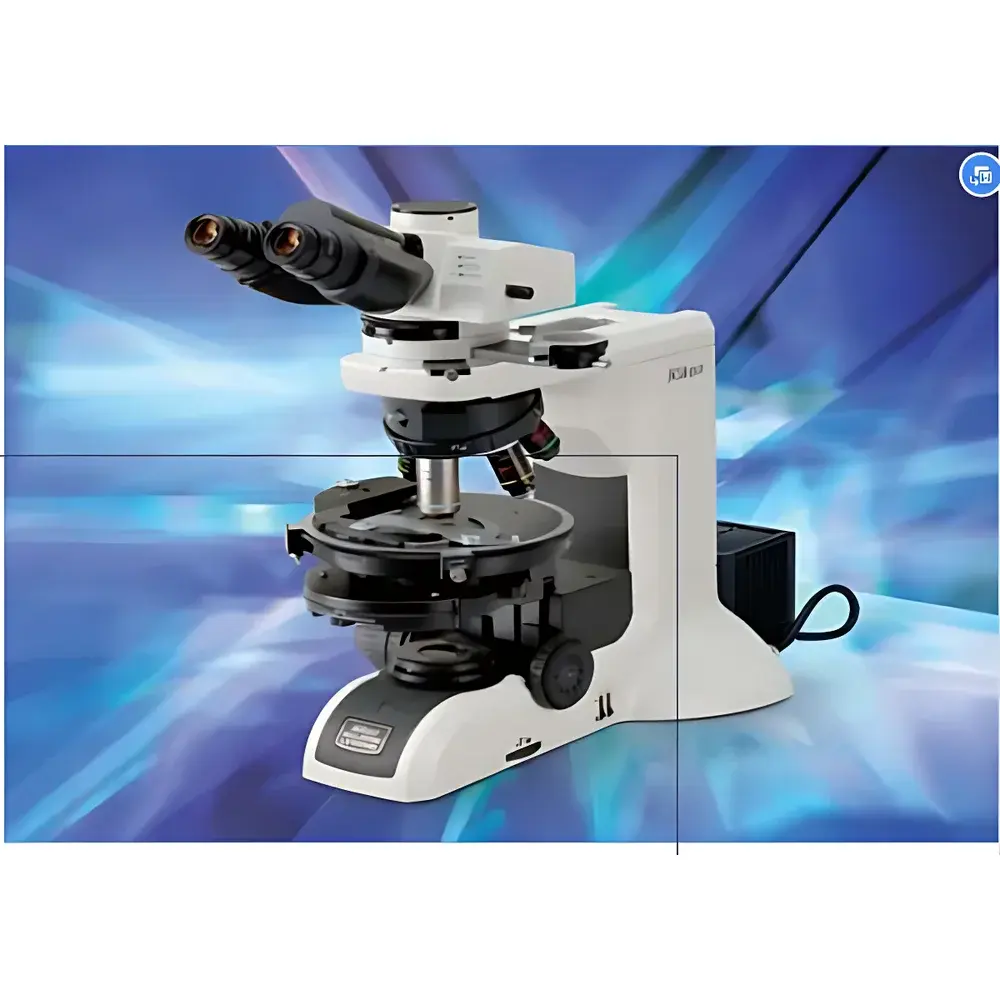
Nikon LV100POL Infrared Microscope System with MEGATOO+ IR Imaging Module
| Brand | Nikon |
|---|---|
| Origin | USA |
| Manufacturer Type | Authorized Distributor |
| Origin Category | Imported |
| Model | Nikon LV100POL |
| Pricing | Upon Request |
Overview
The Nikon LV100POL Infrared Microscope System—enhanced with the MEGATOO+ IR imaging module—is a high-precision polarized light microscope engineered for advanced microspectroscopic analysis in the visible-to-near-infrared (VIS–NIR) spectral range. Built upon Nikon’s CFI60 optical architecture, the system integrates polarization contrast, transmitted/reflected illumination flexibility, and optimized IR transmission pathways to support quantitative micro-FTIR, hyperspectral mapping, and birefringence characterization. Its core optical design enables simultaneous high-resolution visible imaging and spectrally resolved infrared detection from 360 nm to 2000 nm—leveraging a custom Thorlabs broadband IR source (360–2600 nm) and an InGaAs-sensitive CCD detector calibrated for 360–2000 nm response. Unlike conventional visible-light microscopes, this configuration prioritizes IR throughput efficiency, minimal chromatic aberration across dual bands, and thermal stability during extended acquisition—critical for reproducible microspectral data under GLP-compliant workflows.
Key Features
- CFI60 infinity-corrected optical system delivering long working distance (up to 10.5 mm at 20×) and high numerical aperture (NA up to 0.75), ensuring diffraction-limited resolution and minimal axial chromatic shift across VIS–NIR wavelengths
- Dual-mode illumination: 50 W halogen lamp with optimized filament geometry and enlarged effective source area—providing >20–40% higher irradiance at 50× and above compared to standard 100 W units, while reducing power consumption by 50% and thermal load on the optical train
- Polarization optics suite: Precision-centered Bertrand lens in intermediate tube; rotatable analyzer with ±0.1° angular resolution; dedicated Nikon compensator slot supporting quartz wedge, gypsum, and mica retardation plates for quantitative retardation measurement
- Rotating circular mechanical stage: 180 mm diameter, orthogonal steel roller bearing guide system, 45° incremental detents, 5 kg load capacity, and backlash-free rotation for repeatable crystallographic orientation mapping
- IR-optimized optical path: Anti-reflection coated objectives (transmitted/reflected dual-use type) fabricated from lead- and arsenic-free eco-glass; all internal mirrors and beam splitters specified for >92% reflectivity from 400–2000 nm
Sample Compatibility & Compliance
The system accommodates standard 25 mm and 32 mm thin-sections, polished wafers (Si, Ge, sapphire), polymer films, pharmaceutical tablets, mineral grains, and biological tissue sections mounted on CaF2, BaF2, or KBr IR-transparent substrates. All optical components meet ISO 10110 surface quality standards (scratch-dig 20–10), and the mechanical stage conforms to ASTM E1558 for rotational repeatability in crystallographic indexing. The integrated illumination and detector calibration protocols support traceable alignment per NIST SRM 2036 (optical flatness) and are compatible with FDA 21 CFR Part 11 audit trail requirements when paired with validated third-party acquisition software.
Software & Data Management
Control and spectral acquisition are managed via vendor-neutral APIs compatible with MATLAB, Python (PyVISA, OpenCV), and LabVIEW. Raw image stacks and interferograms are saved in TIFF-6.0 format with embedded EXIF metadata (wavelength, exposure time, polarization angle, stage coordinates). Spectral processing supports baseline correction, atmospheric compensation (H2O/CO2 removal), and peak deconvolution using OPUS or KnowItAll libraries. Audit logs record operator ID, timestamp, instrument configuration, and detector gain settings—enabling full traceability for ISO/IEC 17025 and GMP-regulated environments.
Applications
- Materials science: Phase identification in composites, stress-induced birefringence mapping in polymers, grain boundary analysis in polycrystalline ceramics
- Geology & mineralogy: Identification of optically anisotropic minerals (e.g., quartz, calcite, mica) via interference figure analysis and extinction angle measurement
- Pharmaceutical QA/QC: Polymorph screening of active pharmaceutical ingredients (APIs), crystallinity assessment in lyophilized formulations
- Forensics: Fiber and pigment analysis with spectral correlation against FBI/NIST IR databases
- Life sciences: Birefringent collagen fiber orientation in connective tissue, starch granule morphology in plant histology
FAQ
What spectral range does the MEGATOO+ IR module cover?
The system acquires images and spectra from 360 nm to 2000 nm, with optimal quantum efficiency between 900–1700 nm using the InGaAs CCD detector.
Is the LV100POL compatible with FTIR spectrometers?
Yes—via fiber-coupled input port and motorized filter wheel, it interfaces directly with commercial benchtop FTIR systems (e.g., Thermo Nicolet iS50, Bruker Vertex 80v) for micro-transmission/reflection measurements.
Can I perform quantitative retardation measurements?
Yes—the calibrated Bertrand lens, precision rotatable analyzer, and Nikon compensator slots enable retardation quantification down to ±0.5 nm using standard Michel-Lévy charts or digital fringe analysis algorithms.
Does the system support automated stage scanning for hyperspectral mapping?
When equipped with Nikon’s PRIOR ProScan III motorized XY stage and optional Z-focus encoder, the platform supports programmable grid-based spectral acquisition with sub-micron positional repeatability.
Are service and calibration documentation provided per ISO/IEC 17025?
Full calibration certificates—including photometric linearity, polarization extinction ratio (>1000:1), and stage angular accuracy—are issued with each installation and updated annually per accredited metrology lab protocols.




